ANGELO CANEVARI: STRUTTURE
Sculpture Exhibition
PRESENTATION
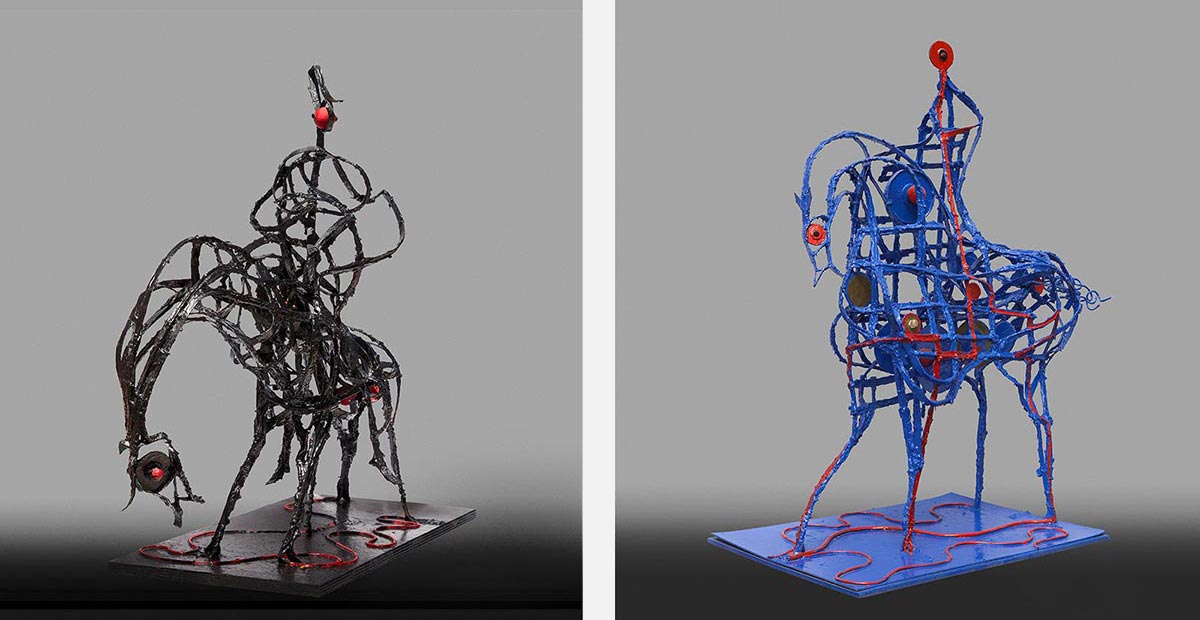
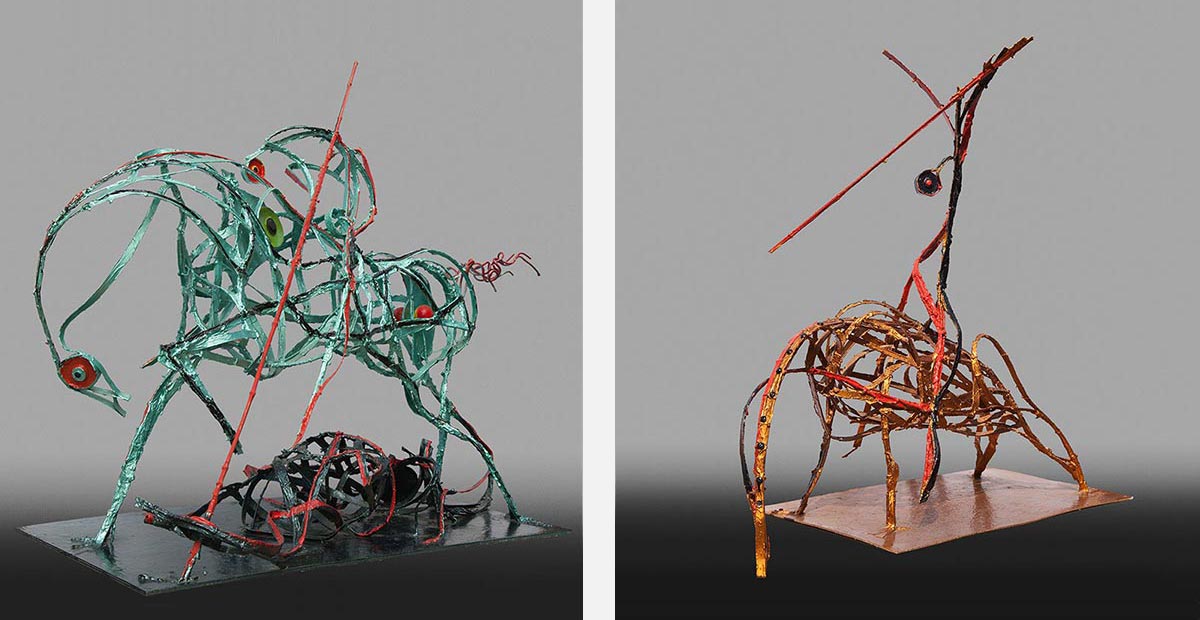
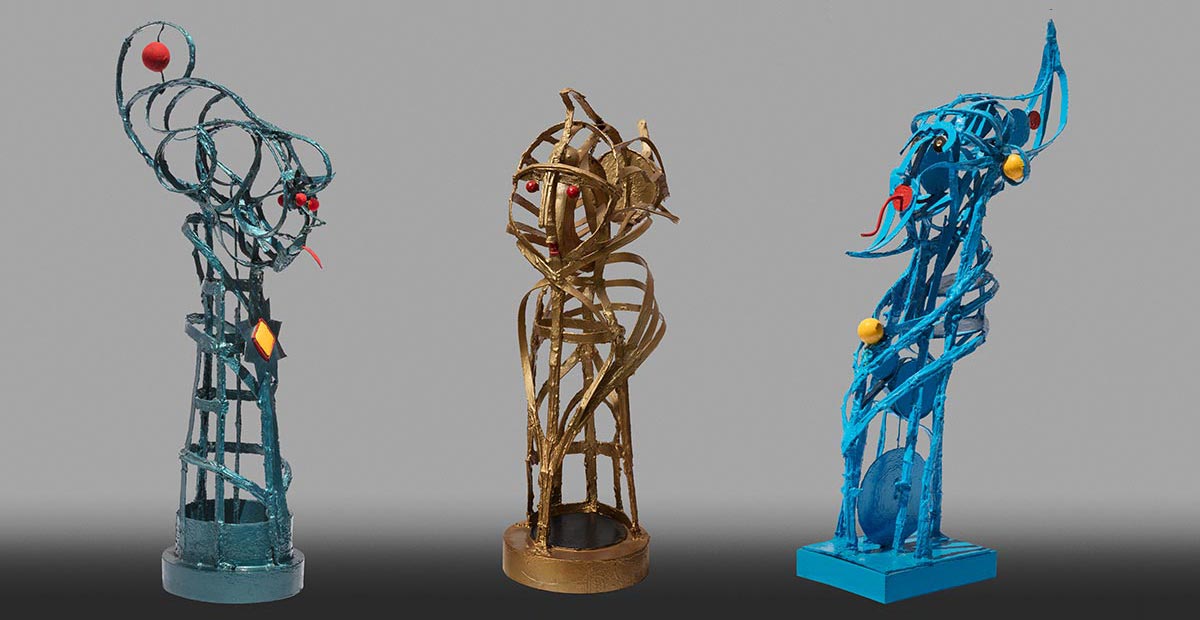
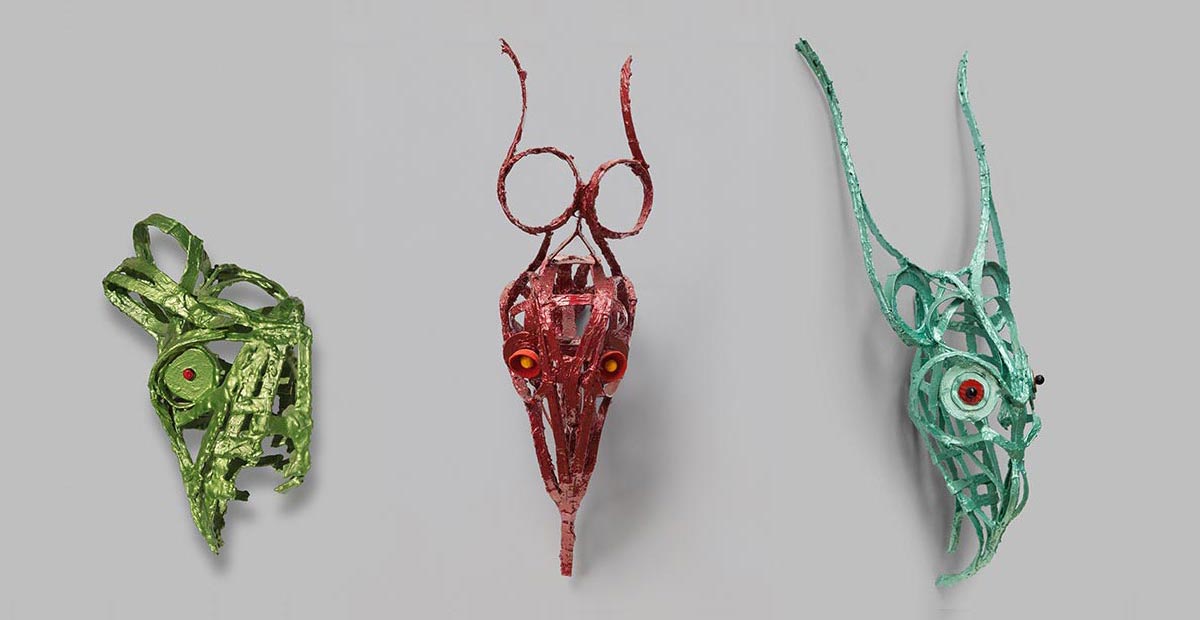
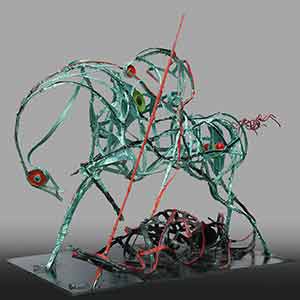
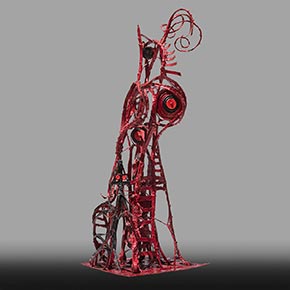
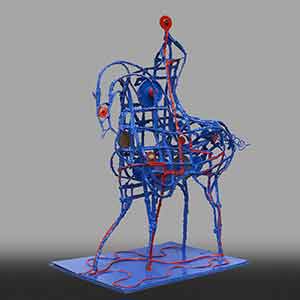
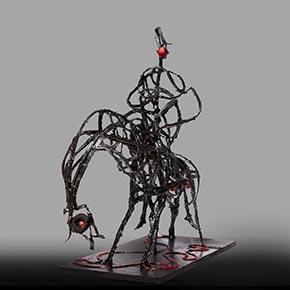
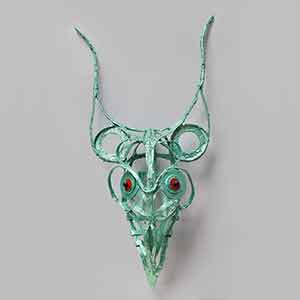
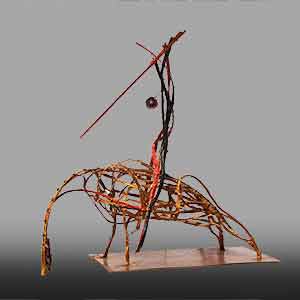
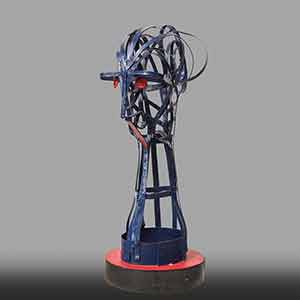
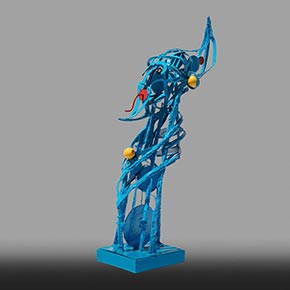
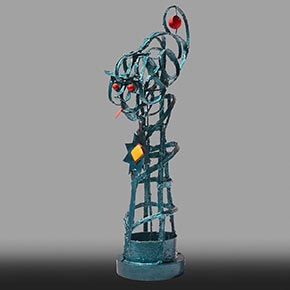
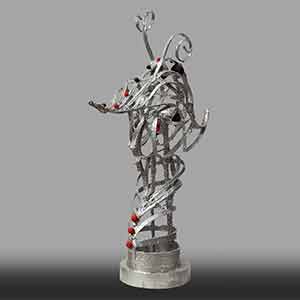
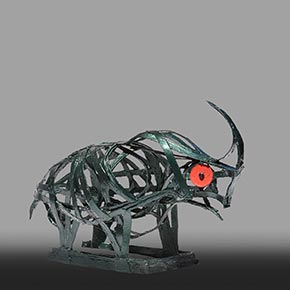
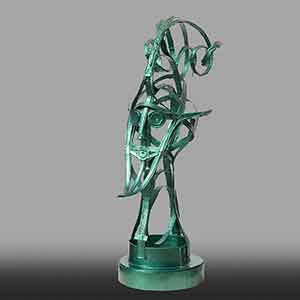
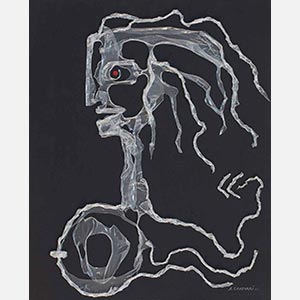
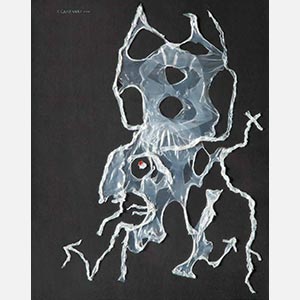
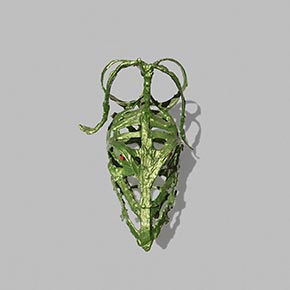
The first time I saw the works Arco Gallery is presenting here it was a revelation. Works unlike anything Canevari had made before, and yet unmistakably his. Intriguing and powerful, glowing with metallic paint, the red eyes looking straight at me. I knew immediately I wanted to bring them to the world, but they had no critical context, so I set out to study the lineage that led to their creation. Angelo Canevari: Strutture is the result of that commitment.
Valentina Puccioni
Full story of the Strutture
FOREWORD
The works in this exhibition were created in Canevari's studio in Amelia, an ancient hill town in Umbria where he spent most of the last thirty years of his life. They were made between the early 2000s and his final years, and his passing in 2014 prevented him from presenting this crucial body of work to the public.
In the Strutture a lifetime Canevari spent in ink drawing and lost-wax bronze casting converges in an opus that represents the culmination of his creative journey.
The works in this exhibition were created in Canevari's studio in Amelia, an ancient hill town in Umbria where he spent most of the last thirty years of his life. They were made between the early 2000s and his final years, and his passing in 2014 prevented him from presenting this crucial body of work to the public.
In the Strutture a lifetime Canevari spent in ink drawing and lost-wax bronze casting converges in an opus that represents the culmination of his creative journey. The line that had always moved across paper now moves through space. The interior armature that the great bronze founders buried inside their finished surfaces is here offered without concealment, structure and subject simultaneously. What results are figures that hold the energy of a drawing and the authority of a monument without being fully either: a warrior, a sacred presence, a legendary queen, an ancient emblem, each carrying the full weight of its iconographic tradition in a form that seems always on the verge of becoming something else.
What the Strutture propose, and what makes them unavoidable in any serious consideration of where figurative sculpture stands, is a resolution to one of the central tensions of the postwar period: how the figure survives without nostalgia, and how structural logic carries meaning without becoming illustration. The open armature is the answer. A Struttura is simultaneously a figure and a drawing and a structure, never fully resolving into the representational image it nonetheless unmistakably is. The depth of the research behind this, the technical mastery, the historical knowledge, the formal precision, is what makes the resolution convincing rather than programmatic.
Novelist and theater director Andrea Camilleri, whose decades-long creative exchange with Canevari was one of the defining relationships of his artistic life, described these sculptures as using not only space but above all time as an essential compositional element. The Strutture are where that formulation finds its fullest proof. Made in the last years of a working life that began in the early 1950s, never shown until now: they enter the room carrying everything.
ARTIST BIO
Angelo Canevari
(Rome, 1929 – Amelia, 2014) was an Italian sculptor whose practice spanned lost-wax bronze casting, ink drawing, and theatrical design. From a lineage of Roman artists active since the seventeenth century, his father having designed the monumental mosaics at the Foro Italico and his uncle having created five statues for the same monumental project, he trained alongside the painter Corrado Cagli and in the studios of the Roman postwar avant-garde before establishing an independent practice that extended across six decades.
Angelo Canevari
(Rome, 1929 – Amelia, 2014) was an Italian sculptor whose practice spanned lost-wax bronze casting, ink drawing, and theatrical design. From a lineage of Roman artists active since the seventeenth century, his father having designed the monumental mosaics at the Foro Italico and his uncle having created five statues for the same monumental project, he trained alongside the painter Corrado Cagli and in the studios of the Roman postwar avant-garde before establishing an independent practice that extended across six decades.
His work received critical attention from Enrico Crispolti, Giuseppe Marchiori, and Paolo Portoghesi, among others, and was exhibited in Rome, Milan, and internationally across his career. His monumental commissions include the bronze doors for the Cathedral of Belluno and a series of coins for the Vatican Mint. His decades-long creative exchange with the novelist and theater director Andrea Camilleri produced both published work and theatrical collaborations.
Solo Exhibitions
1954 Galleria Portonovo, Rome, Italy
1960 Galleria La Babuinetta, Rome, Italy
Galleria L’Obelisco, Rome, Italy
Setay Gallery, Beverly Hills, CA
1961 Galleria L’Obelisco, Rome, Italy
1963 Galleria l’Agostina, Rome, Italy
1966 Galleria La Rosta, Bari, Italy
Rome-Chicago Gallery, Chicago, IL
1967 Städtische Galerie Falkenhaus, Würzburg, Germany
1968 Galleria La Navicella, Catania, Italy
Galleria Ghelfi, Verona, Italy
Galleria Pater, Milan, Italy
Galleria Ghelfi, Vicenza, Italy
Galleria Mariani, Ravenna, Italy
1969 Galleria Antenore, Padova, Italy
Galleria Zanini, Rome, Italy
Galleria Cassano, Italy
1970 Galleria Il Sedile, Lecce, Italy
Galleria Metastasio, Prato, Italy
Minigalleria Valsesiana, Vercelli, Italy
1971 Galleria Il Cavalletto, Molfetta, Italy
Studio 188, Trani, Italy
34° Fiera del Levante, Bari, Italy
Galleria Ghelfi, Verona, Italy
Galleria del Ponte, Vicenza, Italy
Galleria Il Grifo, Rome, Italy
1972 Galleria Due Torri, Bologna, Italy
Galleria S. Michele, Brescia, Italy
1973 Galleria Arte Cortina, Cortina d’Ampezzo, Italy
Galleria Jacopo della Quercia, Siena, Italy
Centro Studi L’Esagono, Lecce, Italy
Galleria Arte Oggi, Messina, Italy
1974 Galleria Michelucci, Florence, Italy
Galleria L’Incontro, Molfetta, Italy
Studio 188, Trani, Italy
1975 Galleria La Spirale, Bari, Italy
Galleria Senato, Milan, Italy
Galleria Condotti 85, Rome, Italy
1976 Galleria Maitani, Orvieto, Italy
Galleria In Primo Piano, Taranto, Italy
Kulturni Centar, Galerija Citaonice, Belgrade, Yugoslavia
Galleria Giorgi, Florence, Italy
1977 Galleria In Primo Piano, Taranto, Italy
Galleria Jacopo della Quercia, Siena, Italy
Galleria Il Nuovo Carpine, Rome, Italy
1978 Galleria La Spirale, Bari, Italy
Galleria Del Corso, Latina, Italy
1979 Centro Iniziative Culturali – CIC, Avezzano, Italy
Galleria Centrale, Falanto, Brindisi, Italy
Reale Collegio di Spagna, Bologna, Italy
1981 Galleria Il Gianicolo Centro d’Arte, Perugia, Italy
Galleria La Gradiva, Rome, Italy
1982 Galleria La Gradiva, Rome, Italy
Palazzo Crepadonna, Belluno, Italy
1984 Spanish Academy of Fine Arts in Rome, Rome, Italy
1985 Galleria Il Ponte, Florence, Italy
Galleria La Meridiana, Messina, Italy
1988 Galleria Grafica Campioli, Monterotondo, Italy
Sala S. Rita in Campitelli, Rome, Italy
2026 Arco Gallery, New York, NY (Angelo Canevari: Strutture)
Group Exhibitions
1958 Italian Pavilion, Exposition Universelle de 1958, Brussels, Belgium
1962–65 IX Rassegna di Pittori di Roma e del Lazio, Rome, Italy
1963 VII Quadriennale d’Arte di Roma, Rome, Italy
Galerie des Deux Mondes, New York, NY
1964 Artisti Italiani d’Oggi, Istituto di Cultura Italiana, Tripoli, Libya
Mostra Internazionale di Palazzo Strozzi, Florence, Italy
1965 IV Biennale Internationale de Paris, Paris, France
Rembrandt Art Center, Johannesburg, South Africa
1966 Mostra Internazionale Premio del Fiorino, Florence, Italy
Italian Section, Biennale Internationale de Paris, Paris, France
IX Quadriennale d’Arte di Roma, Rome, Italy
Italian Artists Today, Rome-Chicago Gallery, Chicago, IL
1967 VII Biennale d’Arte Sacra Contemporanea, Premio Federico Motta,
Bologna, Milan, Rome, Italy
1968 VI Biennale Romana Arti Figurative, Rome, Italy
VIII Biennale d’Arte Sacra Contemporanea, Premio Federico Motta,
Bologna, Milan, Rome, Italy
1969 Rhein-Tiber Prize, Köln, Germany
1971 Biennale Internazionale d’Arte, Premio del Fiorino, Florence, Italy
IX Biennale d’Arte Sacra Contemporanea Antoniano, Bologna, Italy
Biennale d’Arte Triveneta, Concorso Internazionale del Bronzetto,
Padova, Italy
1972 III Biennale dell’Adriatico, Mostra Nazionale del Disegno,
Civitanova Marche, Italy
1973 IX Concorso Internazionale del Bronzetto, Padova, Italy
International Market for Current Art, Düsseldorf, Germany
1974 XII Quadriennale Nazionale d’Arte, Turin, Italy
Omaggio al Petrarca, Palazzo Pretorio, Arezzo, Italy
1975 BITEF 9, Belgrade, Yugoslavia
1976 X Concorso Internazionale del Bronzetto, Padova, Italy
Mostra Internazionale del Bronzetto Italiano,
Helsinki; Copenhagen; Oslo
1977 Scultori Italiani Contemporanei, Rijeka, Murska Sobota,
Belgrade, Yugoslavia
Scultori Italiani Contemporanei, Valletta, Malta
1978 15 Sculpteurs Italiens, Triennale Européenne de Sculpture,
Jardins du Palais Royal, Paris, France
1979 Mostra della Grafica Italiana Contemporanea nell’America del Sud,
Museo Nacional de Bellas Artes, Rio de Janeiro, Brazil
XII Biennale Internazionale della Piccola Scultura, Padova, Italy
1980 VI Biennale di Scultura di Arese, Villa Reale, Monza, Italy
Omaggio a S. Benedetto, Abbazia di Montecassino, Italy
1981 Grafica Italiana Contemporanea, Musée de Grenoble, France
1997 Biennale Internazionale d’Arte, Alessandria d’Egitto, Egypt