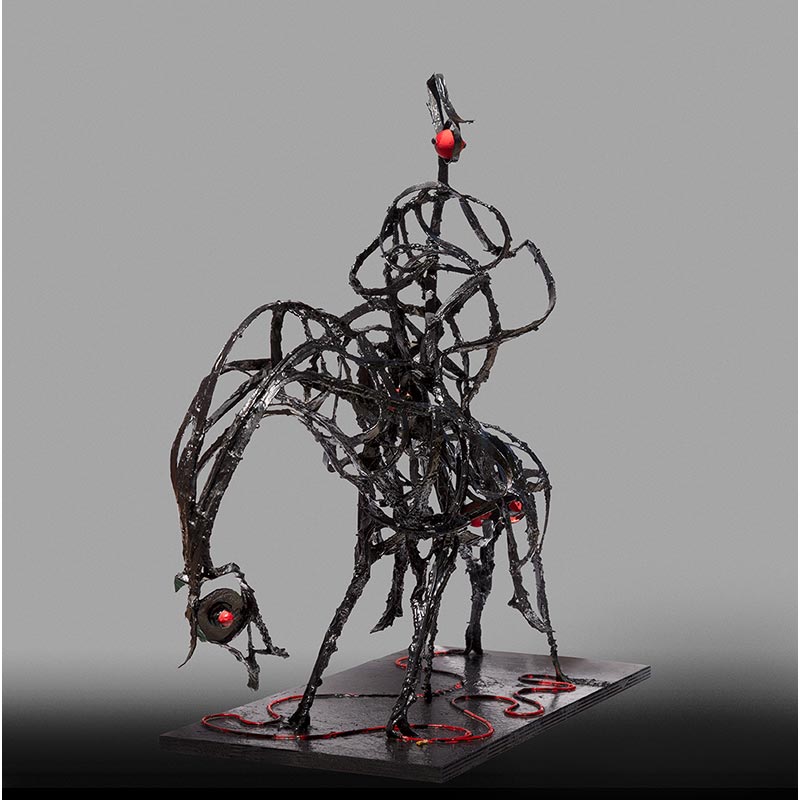
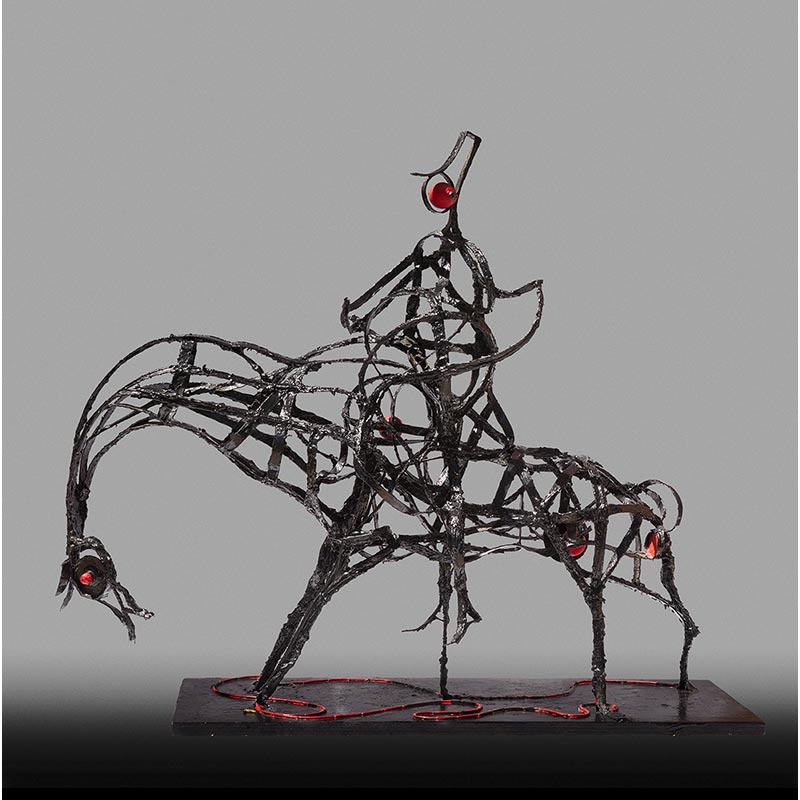
Horse and rider are rendered entirely in black, the construction loose and gestural to the point of turbulence: the horse leans hard left, legs splayed wide, while the rider sits upright above the chaos of the animal's motion. Strips of metal and cardboard wound into forms that barely cohere before flying apart again. Red wire coils freely across the base, escaping the structure entirely, the one element in the series that refuses to stay anchored.
Horse and rider are rendered entirely in black, the construction loose and gestural to the point of turbulence: the horse leans hard left, legs splayed wide, while the rider sits upright above the chaos of the animal's motion. Strips of metal and cardboard wound into forms that barely cohere before flying apart again. Red wire coils freely across the base, escaping the structure entirely, the one element in the series that refuses to stay anchored.
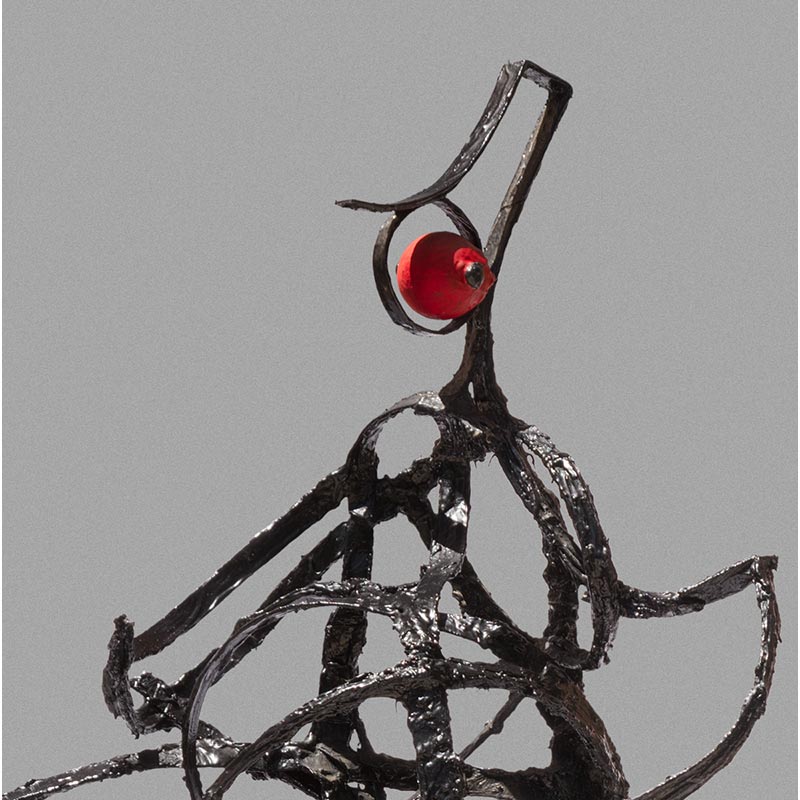
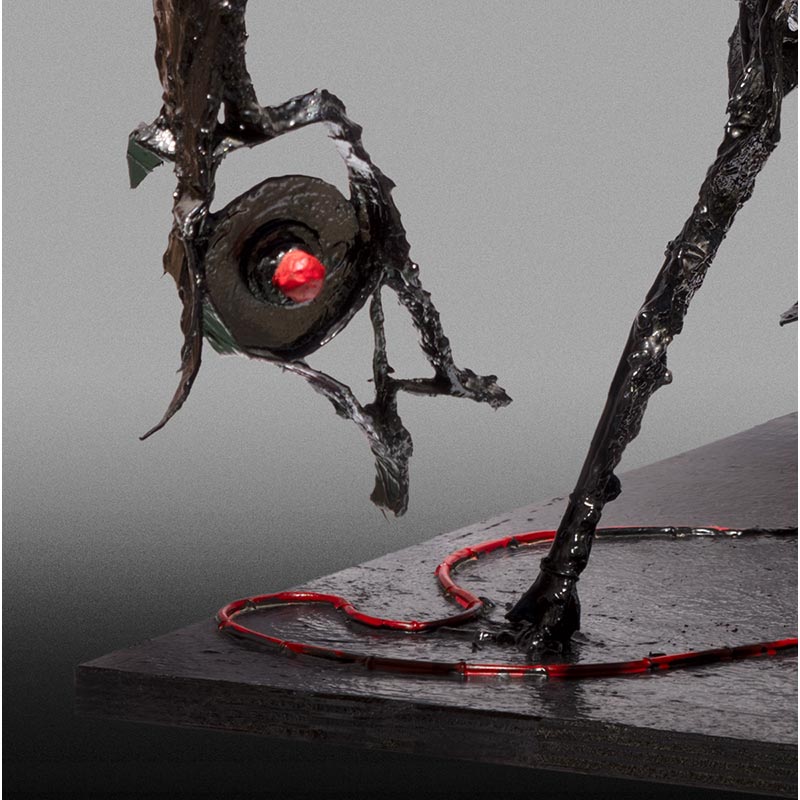
The Hussar, the light cavalryman of Central and Eastern European military tradition, was the figure of mobile warfare: fast, lightly armored, dependent on speed and aggression rather than the weight and ceremony of heavy cavalry. Canevari's formal choices enact this precisely. The black palette absorbs light rather than reflecting it, giving the work a quality of shadow and dissolution: no heraldic surface, no chromatic claim to permanence, only the dark energy of a form in motion. Red spheres anchor within the composition at the rider's head and across the horse's body, as in every other work in the series. But here the red does something it does nowhere else: it also escapes, coiling loose across the base in wire that has broken free of the figure entirely. The red both anchors and abandons the composition simultaneously.
In the Strutture [Structures], the red accent functions as a consistent compositional anchor: the point of consciousness, intensity, or conflict within the dominant chromatic field. The Hussar is the series' single exception, not because the red refuses to anchor but because it refuses to stay anchored, because it does both at once. A figure defined by centrifugal force cannot submit to a single focal logic. The red marks the rider and escapes to the base, the work enacting formally what the Hussar subject demands: presence and dissolution, the charge that has already begun to scatter.
Canevari spent the formative years of his practice in Corrado Cagli's studio, absorbing what he described as un senso religioso del mestiere, a sacred regard for the craft: the conviction that nothing should be improvised, that the work's vitality depended on the precision of its making rather than the energy of its gesture. Crispolti, writing of Cagli's cardboard-strip sculptures of 1961-62, describes exactly the method that runs through the Strutture: sottili strisce articolate per aggiunzione, thin strips articulated by addition, a single primary element repeated until it becomes a figure. Cagli's wire constructions of the 1970s, among them the work known as La Gabbia [The Cage], pushed that additive logic further into the open armature: geometric interior planes suspended within a framework that is simultaneously cage and figure, structure and subject. The Strutture carry that formal inheritance forward, and the Hussar is its most extreme expression: the wire construction at the moment when the centrifugal energy of the subject tests the structural principle to its limit. The cage barely holds. The strips fly. This is where the master's research, extended by the student who became a master himself, reaches its formal boundary. The art historian Giorgio Di Genova, writing of Cagli's wire constructions of the same period, described what Cagli and Mirko were pursuing together as "disegnato scultura colorata nello spazio" — drawing sculpture and color in space simultaneously: the linear mark extended into three dimensions, the drawing that had always been the foundation of Canevari's practice offered finally as the complete sculptural object.