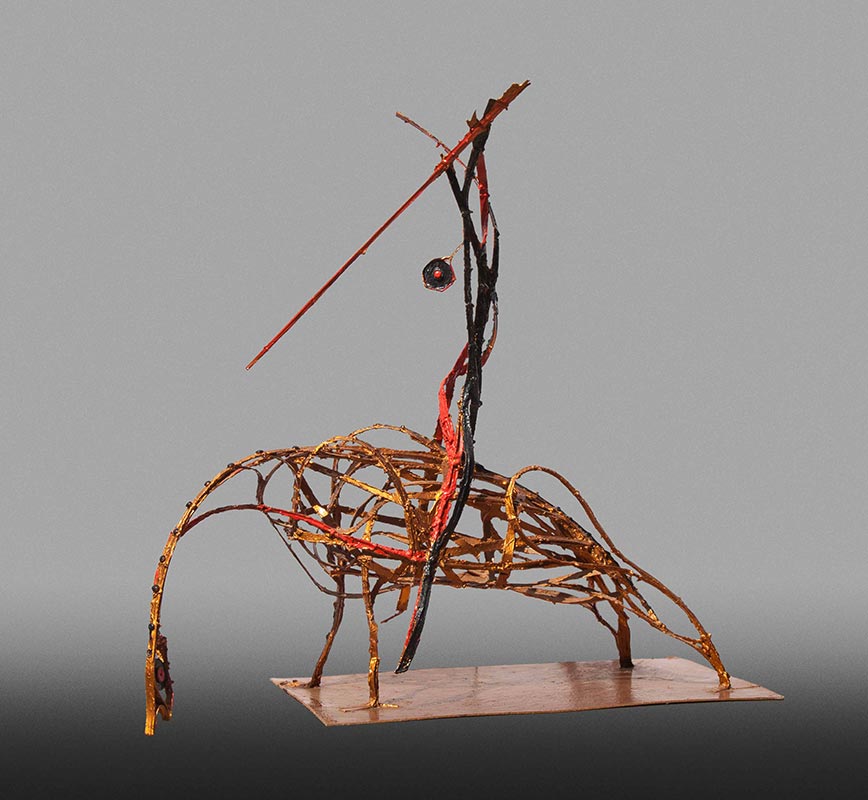
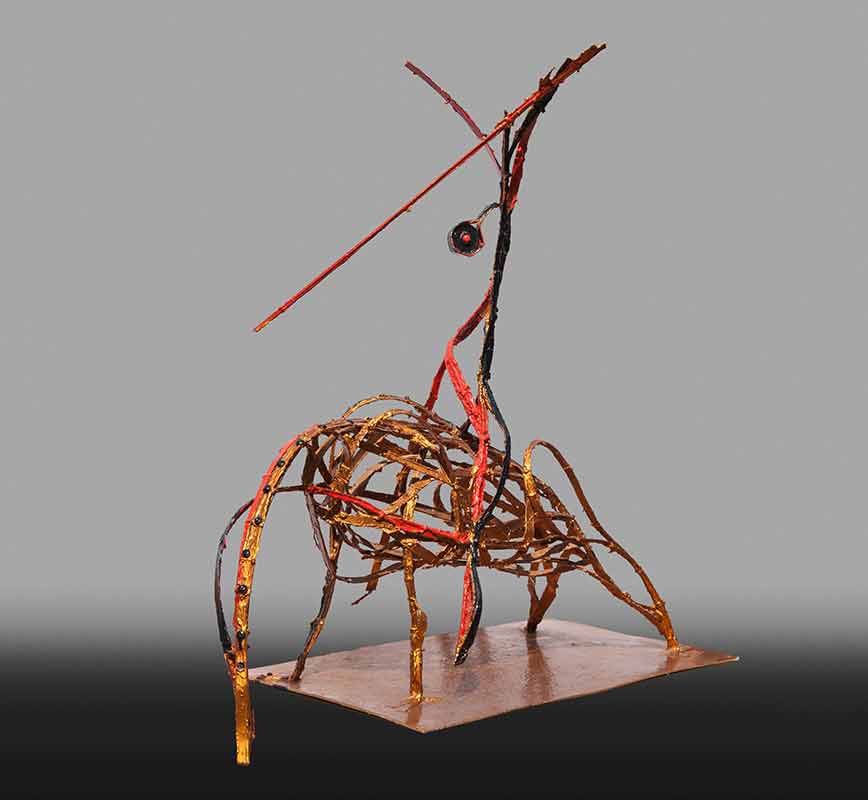
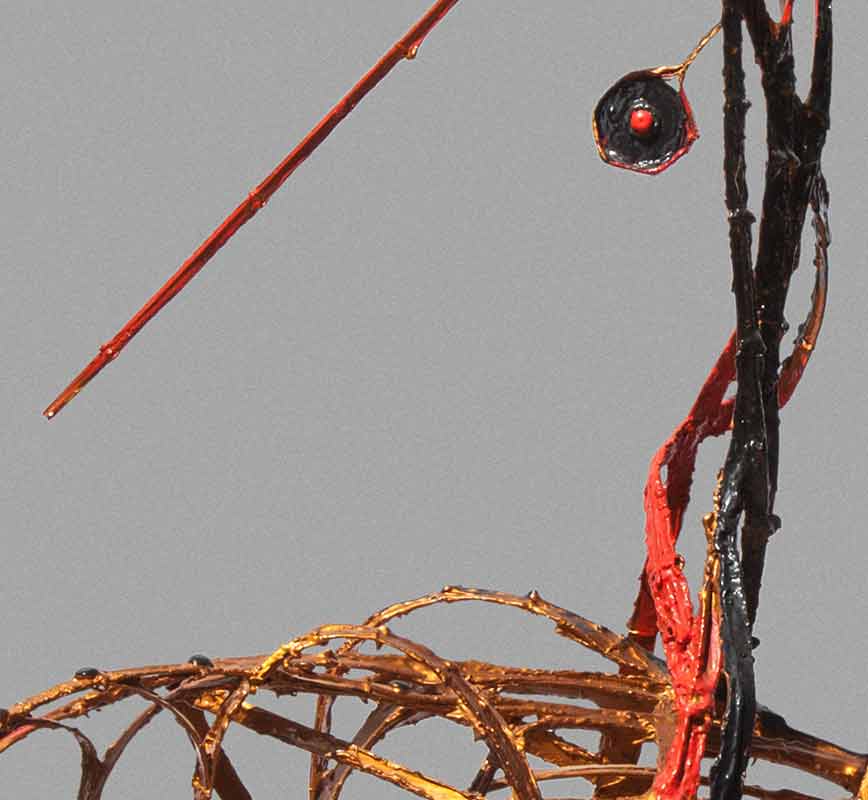
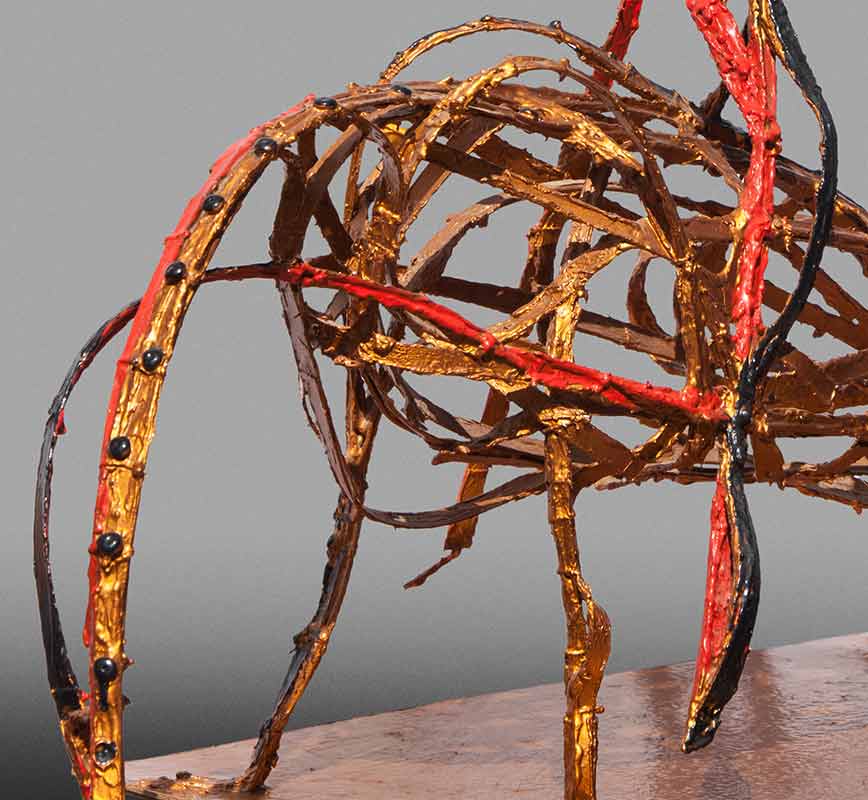
Gold leans into the arena: the horse's legs splay wide and low, the whole composition locked in the instant of bearing down. The open construction generates tension rather than lightness, the gaps in the horse's body wounds waiting to happen. At the apex two straight elements cross, lance and pic, the only straight lines in a composition otherwise given entirely to curves, and a single red sphere marks the rider's head, the fixed point from which the forward force radiates.
Gold leans into the arena: the horse's legs splay wide and low, the whole composition locked in the instant of bearing down. The open construction generates tension rather than lightness, the gaps in the horse's body wounds waiting to happen. At the apex two straight elements cross, lance and pic, the only straight lines in a composition otherwise given entirely to curves, and a single red sphere marks the rider's head, the fixed point from which the forward force radiates.
What Canevari achieves formally is what the corrida achieves ritually: a compression of controlled energy into a single suspended instant. The horse does not fall; it lunges, perpetually. The crossing of the two straight elements at the apex is not resolved but aimed: two vectors locked at the point of maximum tension, the moment before contact. Gold is the dominant substance of the work, soaked into the surface as the arena soaks into everything that enters it; red marks the weapon, the eye, the specific points where force and consciousness are concentrated.
The chivalric and equestrian program here has roots in Canevari's earlier Erme, which he described as a rereading of the chivalric poem in graphic and plastic terms, taking its cue from the cubo-futurist lesson. The Strutture push that rereading further into improvisation: where the Erme retained heraldic composure, the equestrian works are kinetic, almost explosive in their lateral energy. Canevari's engagement with the corrida and the picador connects to Picasso's lifelong preoccupation with the bullring, most formally compressed in the Vallauris ceramics of the early 1950s, where picador and bull are rendered as black silhouettes against washed color grounds: figure stripped to its essential gesture, the combat present as pure compositional tension. Canevari arrives at the same subject with the same economy, the open construction reducing the figures to their essential structural logic.
The horse in motion under the weight of a rider was one of the central structural problems of Renaissance bronze casting. Here the problem is not concealed beneath a finished bronze skin but left permanently open, the weave of the horse's body an engineering question offered as the work itself rather than resolved before the work begins. Canevari brought to this a knowledge that was technical as much as historical: from a family of bronze sculptors active in Rome since the seventeenth century, with a career built on lost-wax casting, he understood the structural demands of the equestrian form from the inside. The open weave is not improvisation born of ignorance but exposure chosen by a master of the closed surface.