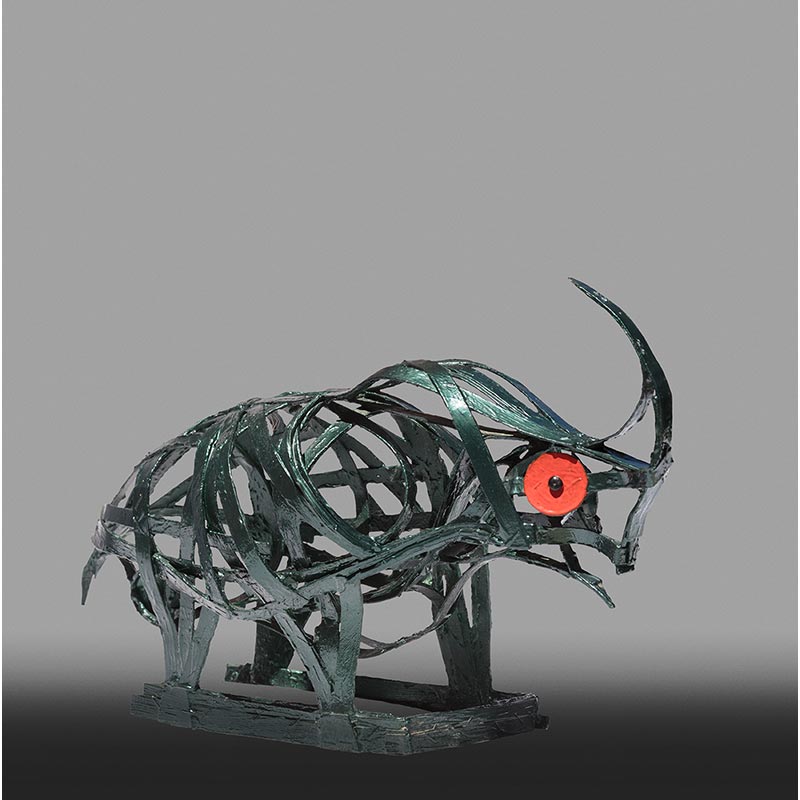
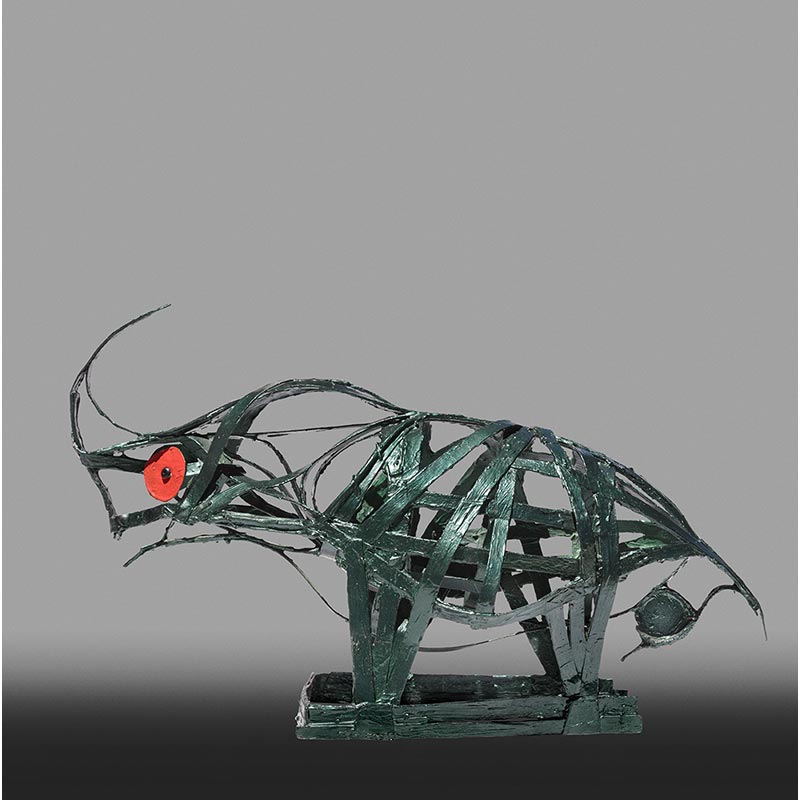
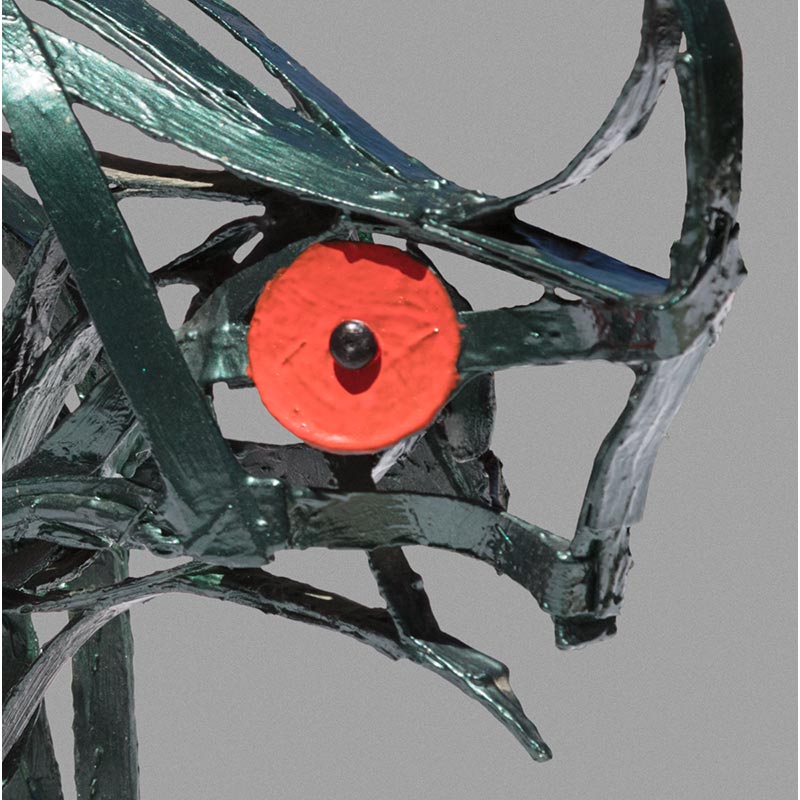
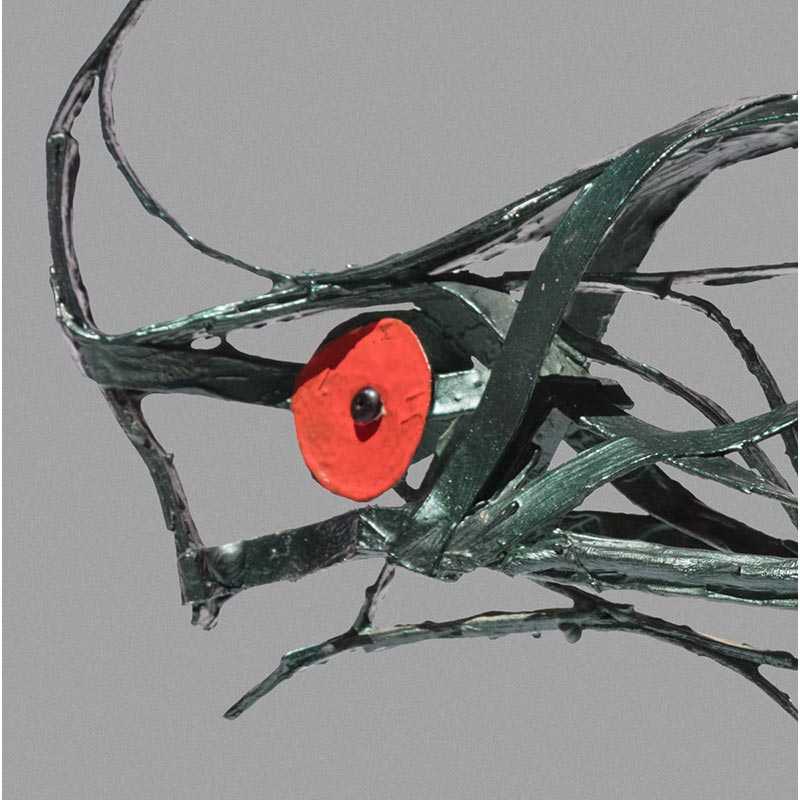
Built in dark verdigris green, horizontal and four-legged: curved strips of metal and cardboard forming the barrel of the body, the arch of the back, the wide splay of the legs. The entire construction is open throughout, light passing from every angle. The horn sweeps up and back in a long open arc, the most gestural and elongated element in the work, built from the same strips as everything else but extended far beyond the body's scale. A single large red eye is set precisely into the head, looking out.
Built in dark verdigris green, horizontal and four-legged: curved strips of metal and cardboard forming the barrel of the body, the arch of the back, the wide splay of the legs. The entire construction is open throughout, light passing from every angle. The horn sweeps up and back in a long open arc, the most gestural and elongated element in the work, built from the same strips as everything else but extended far beyond the body's scale. A single large red eye is set precisely into the head, looking out.
The rhinoceros has been a subject of Western art for five centuries as a figure of received knowledge: the image copied and recopied, the animal known entirely through intermediaries, never directly encountered. That tradition of mediated representation produced its own conventions and errors, accumulating through each transmission. The open skeletal construction here is the formal opposite of that tendency: the animal present through its structure rather than its skin, nothing between the viewer and the physical logic of the form. The gap that the tradition of mediated representation cannot help but fill, Canevari leaves open. Dürer's rhinoceros woodcut of 1515, made from a written description without ever seeing the animal and inaccurate in almost every detail, is the founding document of that tradition; this work is its structural counterargument.
The horn is not the exception to the open construction but its most extreme expression. Where the body is a compact weave, the horn extends the same strip logic into a sweeping open arc that dominates the silhouette: the method taken to its furthest point, the drawn line carried furthest from the body before it must return. The single large red eye carries the same weight here as in the figurative works: a center of consciousness within a form that might otherwise read as pure structural exercise, insisting that this is not an abstract animal but a specific one, looking back. Between the eye and the horn, the work holds the animal's two essential facts: the gaze that establishes presence and the projection that establishes power, both built from the same open logic, neither solid, neither closed.