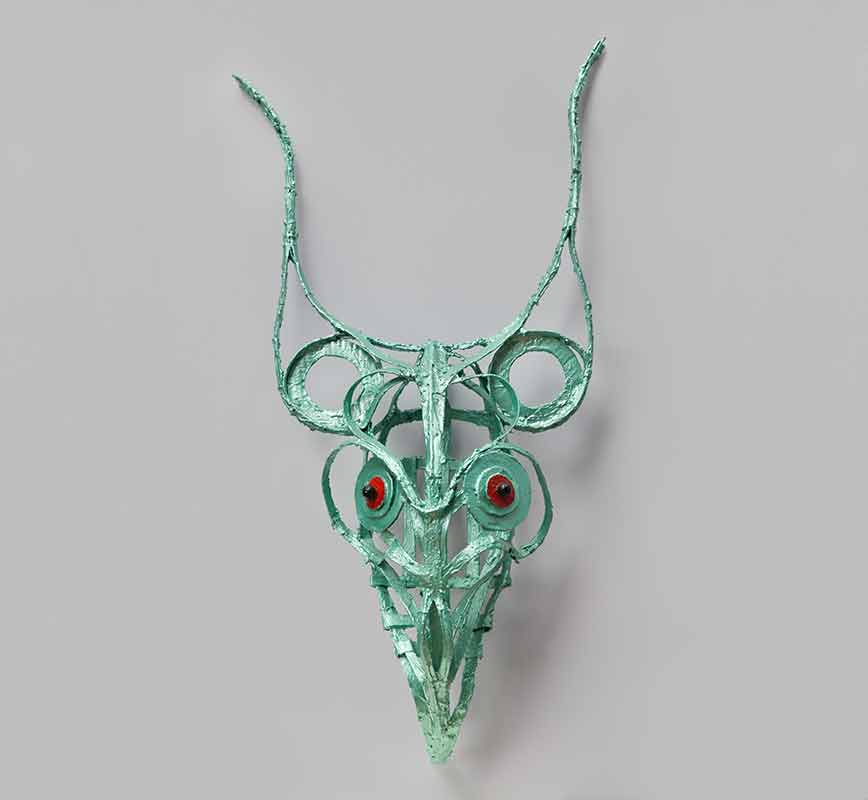
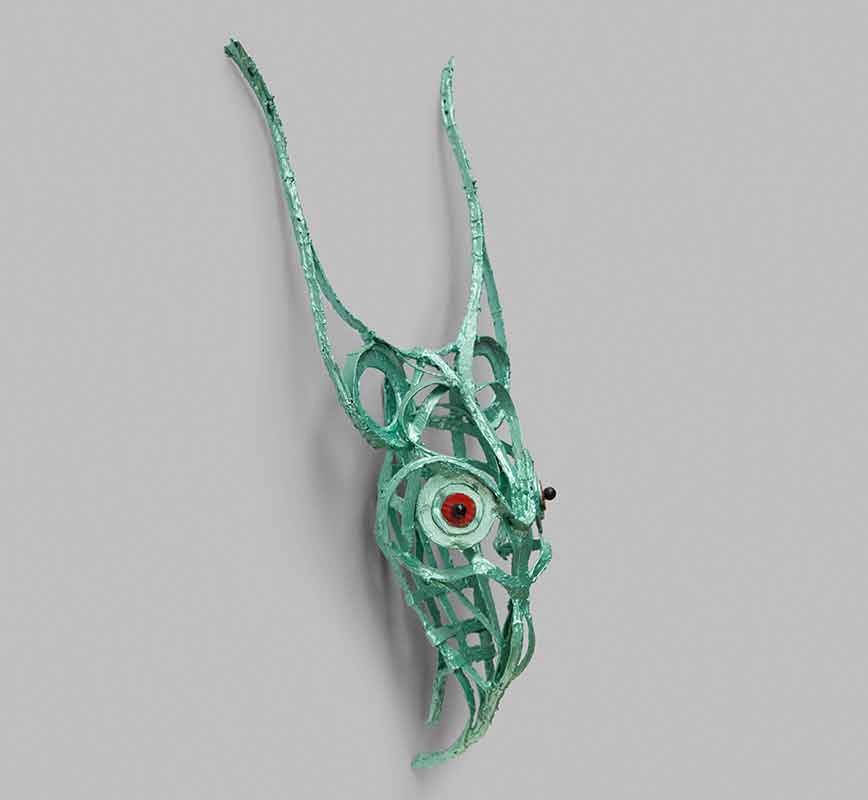
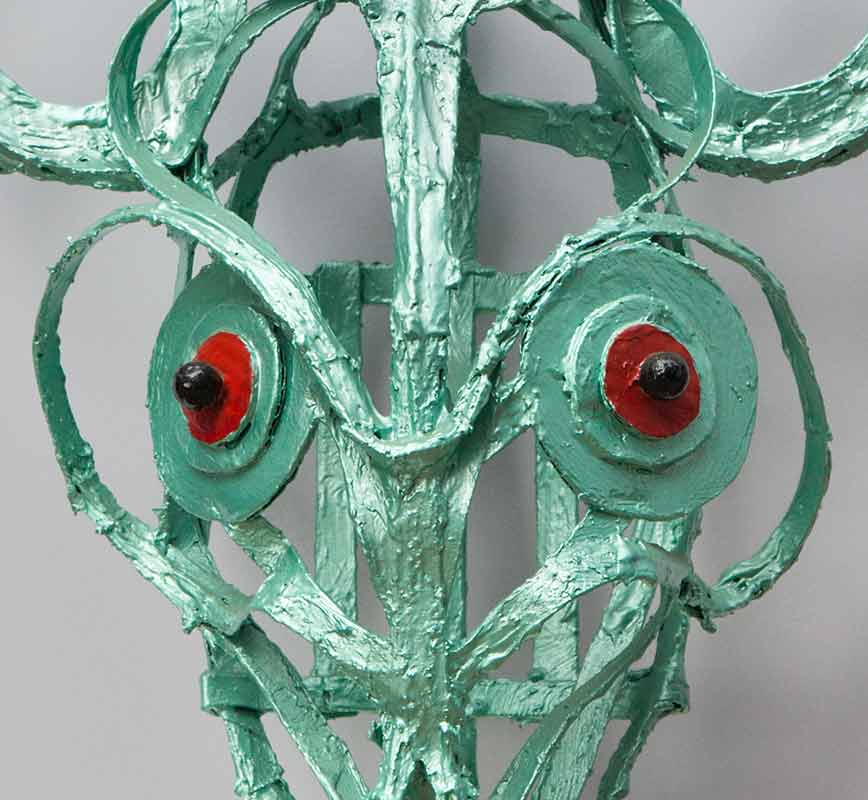
The condottiere is made of silver, built from metal strips coated in silver-white metallic paint that gives the surface a hammered, almost liquid quality. The form appears to spiral upward from a circular base, strips wound and overlapping as they rise and extend backward, the figure formed in the act of ascending rather than presented complete. Red and black spheres distributed across the body at intervals read as wounds, medals, the residue of a long military career: the red still raw, the black spent.
The condottiere is made of silver, built from metal strips coated in silver-white metallic paint that gives the surface a hammered, almost liquid quality. The form appears to spiral upward from a circular base, strips wound and overlapping as they rise and extend backward, the figure formed in the act of ascending rather than presented complete. Red and black spheres distributed across the body at intervals read as wounds, medals, the residue of a long military career: the red still raw, the black spent.
Silver is the right color for a mercenary: neither the heraldic warmth of gold nor the primary vitality of a committed cause, but something cooler and more ambiguous, armor both polished and spent. The condottiere of the Italian Renaissance was simultaneously celebrated and mistrusted, his loyalty purchased rather than sworn, his authority always contingent. That ambivalence is carried in the surface: the form winds upward in continuous exposure, showing its own making rather than presenting a sealed, finished presence. Canevari's own formation in lost-wax casting, from a lineage of Roman bronze sculptors active since the seventeenth century, gave him intimate knowledge of what the sealed equestrian monument required: the Gattamelata and the Colleoni, in which silver ambivalence had no place. The Condottiere refuses that composure entirely.
Andrea Camilleri and Canevari worked together across decades: two creators whose friendship produced not patronage but genuine exchange, the novelist bringing his own formal intelligence to bear on the sculptural practice as Canevari brought his visual thinking to Camilleri's theatrical productions. Camilleri wrote of Canevari's practice as a sculpture that uses not only space but above all time as an essential compositional element. The silver condottiere is a figure made of elapsed time: the upward movement carrying a whole career's accumulation, campaign by campaign, toward an open top that refuses completion. The red and black spheres do not celebrate; the red records what still bleeds, the black what has long since closed.