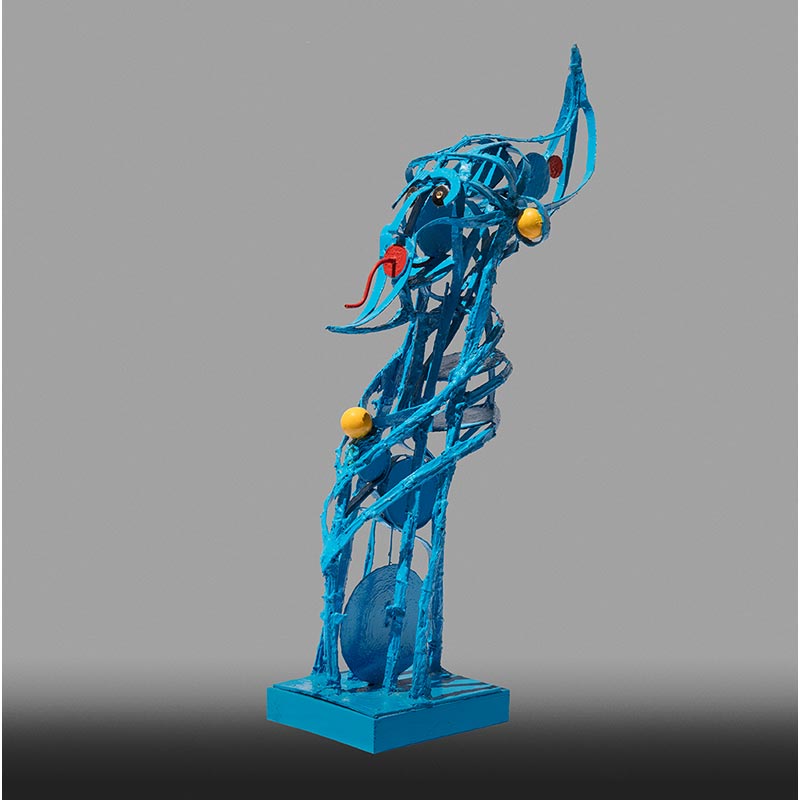
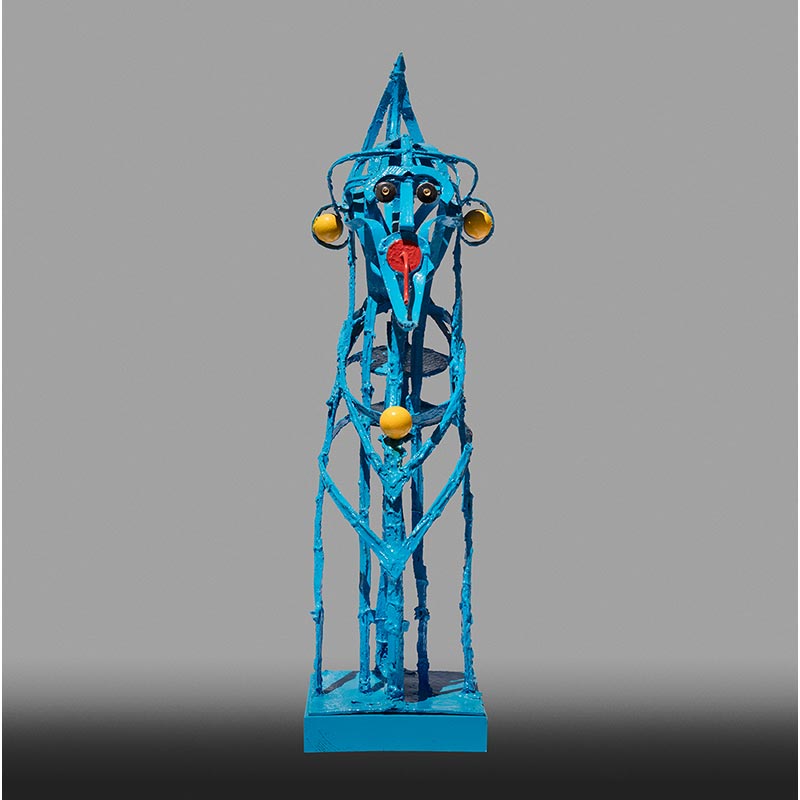
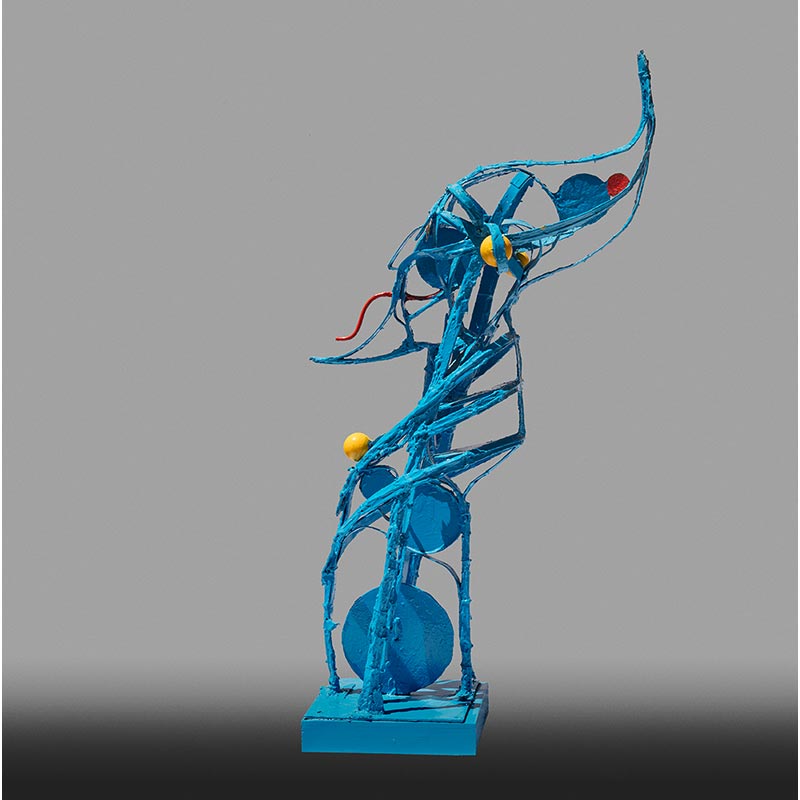
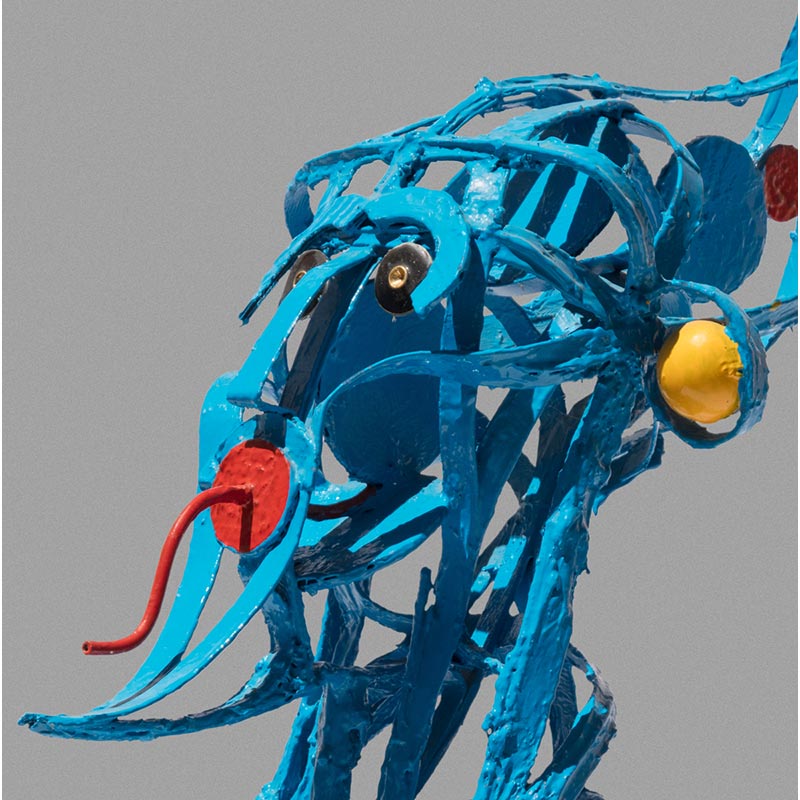
The High Priest rises in turquoise blue from a square base, the lower body an open architectural cage, the upper portion dissolving into a conical headdress with strips of metal curling outward like liturgical smoke. Two small eyes with gold centers look forward from within the dense tangle of the head; a red disc with a tubular extension marks the mouth. Yellow spheres at shoulder height and mid-body are the only warm notes in an otherwise cool field.
The High Priest rises in turquoise blue from a square base, the lower body an open architectural cage, the upper portion dissolving into a conical headdress with strips of metal curling outward like liturgical smoke. Two small eyes with gold centers look forward from within the dense tangle of the head; a red disc with a tubular extension marks the mouth. Yellow spheres at shoulder height and mid-body are the only warm notes in an otherwise cool field.
The turquoise blue is not cobalt but something warmer and more ambiguous, closer to the blue of faience, the glazed ceramic used across the ancient Mediterranean from Egypt through Mesopotamia for objects of ritual and protective significance. The chromatic kinship is not accidental: it places the figure in a visual register that connects it directly to the material culture of antiquity, where the same hue appeared on amulets, funerary objects, and the glazed bricks of sacred architecture. Italian architect and architectural historian Paolo Portoghesi, writing of Canevari's practice, identified a sculptor pursuing not the revival of historical heritage but its appropriation: the ancient form entering through a modern sculptural intelligence and emerging transformed.
The Strutture [Structures] series constitutes an encyclopedic survey of human authority across civilizations and centuries, and this work belongs to its sacred register: the Muezzin, the Brahman, the Caliph, the Pope, and here the High Priest, each figure representing a distinct tradition of spiritual power. Canevari does not rank these traditions hierarchically: each receives the same open skeletal construction, the same chromatic intensity, the same red focal point. The series is a democracy of the sacred, and the High Priest, dissolving upward into his own headdress, is its most formally complete expression of consecrated authority becoming ornament.
The assembled figurative form that carries sacred iconographic weight through the logic of its construction rather than the likeness of its depiction has a specific precedent in Cagli's practice. Cagli's A Ganesh, built from leather and metal in a vertical assemblage of overlapping planar elements with an ornamental upper zone, occupies the same formal and iconographic territory: the sacred figure present through the organization of its materials rather than through resemblance to any known image of the deity. The lower body as architectural cage, the upper zone as accumulated ornament, the whole reading as a figure of authority rather than a portrait: this is the structural logic Canevari learned in Cagli's studio and extended into the Strutture series. In the High Priest, that inheritance is at its most visible: the open cage below, the headdress-as-dissolution above, the red focal point at the mouth as the sole chromatic marker in an otherwise unified field.