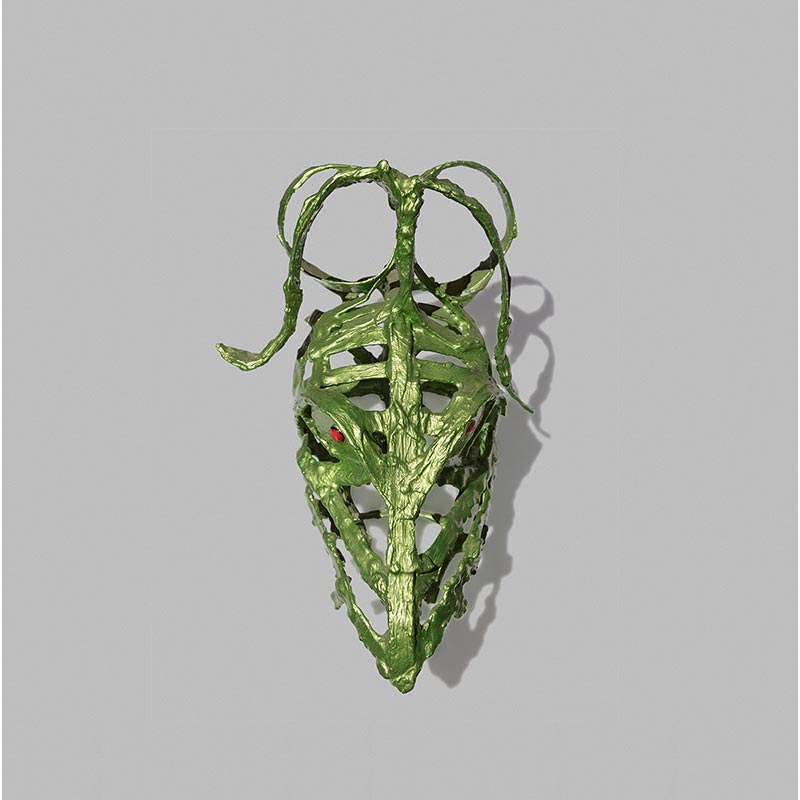
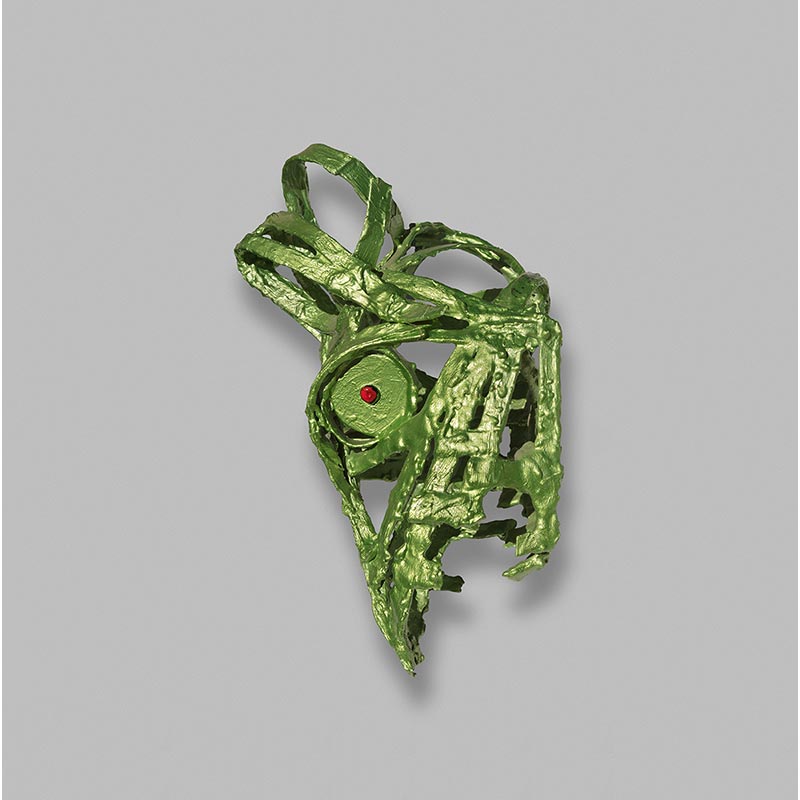
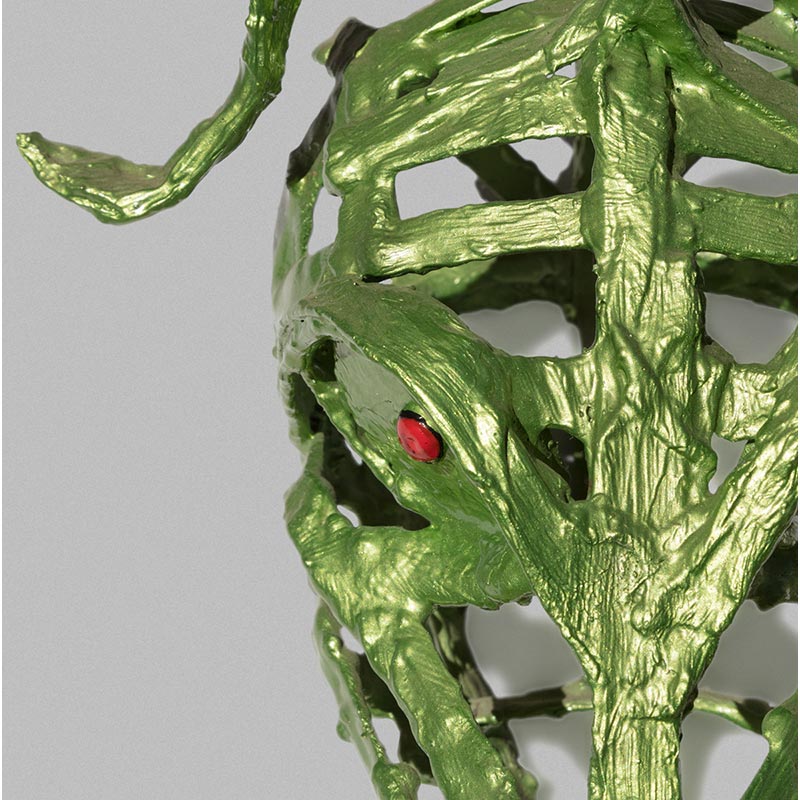
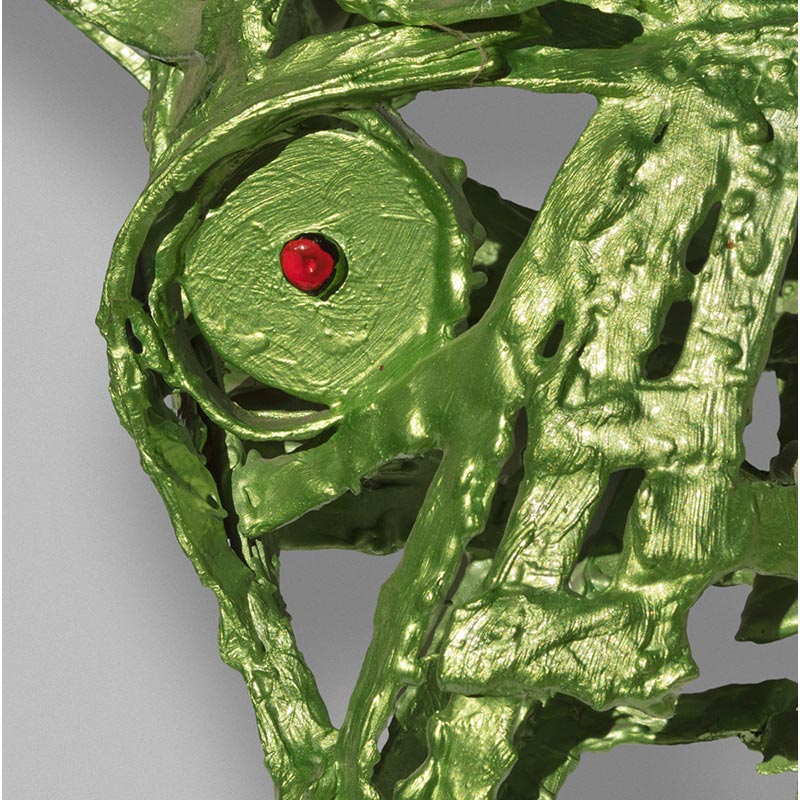
Bucranium III is fully three-dimensional and volumetric: a form that reads as skull from the front and as vessel from the side, the open construction casting its own complex shadow against the wall behind it. The upper elements, whether horns or tendrils, spiral and diverge rather than projecting symmetrically outward. A single small red point is visible deep within the dense interior of the form, a mark of presence almost absorbed by the structure surrounding it. The gold-green metallic surface gives the work the quality of bronze at a particular moment in its aging.
Bucranium III is fully three-dimensional and volumetric: a form that reads as skull from the front and as vessel from the side, the open construction casting its own complex shadow against the wall behind it. The upper elements, whether horns or tendrils, spiral and diverge rather than projecting symmetrically outward. A single small red point is visible deep within the dense interior of the form, a mark of presence almost absorbed by the structure surrounding it. The gold-green metallic surface gives the work the quality of bronze at a particular moment in its aging.
The bucranium is among the oldest decorative and symbolic motifs in the Mediterranean world, present in Etruscan funerary contexts, Roman architectural friezes, and the ritual vocabulary of sacrifice wherever that vocabulary required a sign simultaneously animal and emblem. This work occupies that symbolic weight as a sculptural object rather than a heraldic device: it projects from the wall, occupies depth, and the shadow it casts participates in the composition. Art historians Giuseppe Marchiori and Enrico Crispolti consistently identified the Etruscan and Mediterranean substrate as central to Canevari's sculptural program. Here that substrate is present not as citation but as material memory.
Brancusi's Sculpture for the Blind of 1916 is a marble ovoid designed to be held and experienced through touch rather than observed through sight: a form that reads simultaneously as head and as smooth continuous object, the two readings inseparable from each other. Bucranium III occupies the same formal territory through opposite means: not smooth and closed but open and textured, not designed for the hand but projecting its own shadow as a second compositional element. The skull that reads as vessel from the side, the vessel that reads as skull from the front: these are not competing interpretations but the same form insisting on its dual nature. The gold-green surface, bronze in its aging, connects the work to the ancient tradition of the bronze vessel and the bronze portrait head simultaneously: the same material, the same color, the same tradition, held in permanent formal tension.
The gold-green palette sits in a chromatic range that belongs specifically to bronze at a particular moment in its aging: warm and metallic simultaneously, neither the cool blue of new bronze nor the fully oxidized green of great age, but the color of a surface in transformation. It is the most materially specific palette in the series, connecting this volumetric form directly to the casting tradition Canevari had practiced across his career: the Bucranium III carries the chromatic identity of the bronze objects it formally refuses to be.