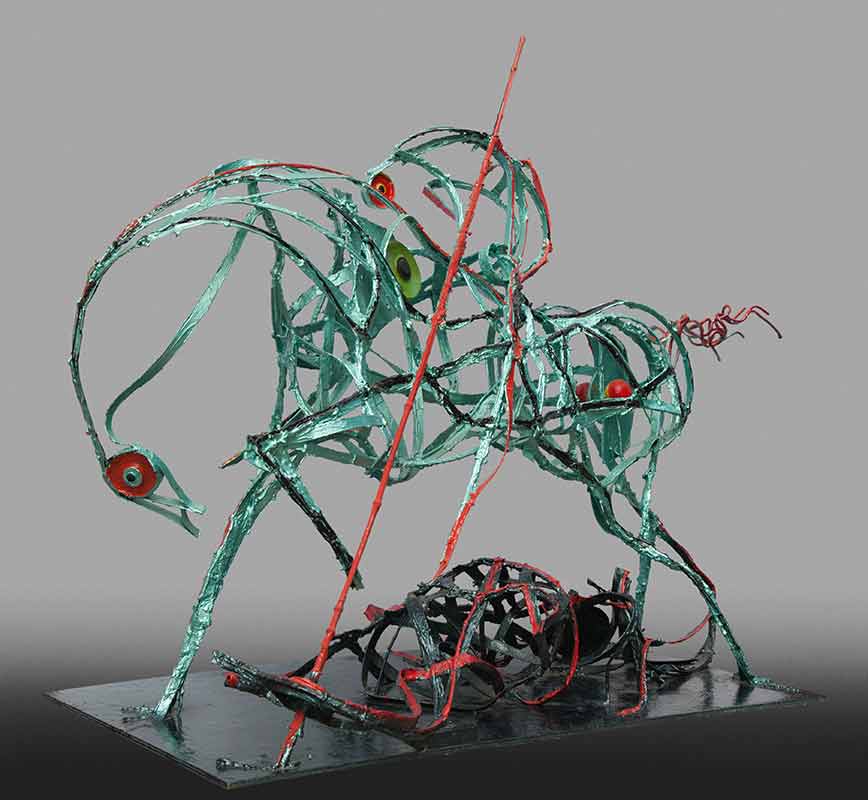
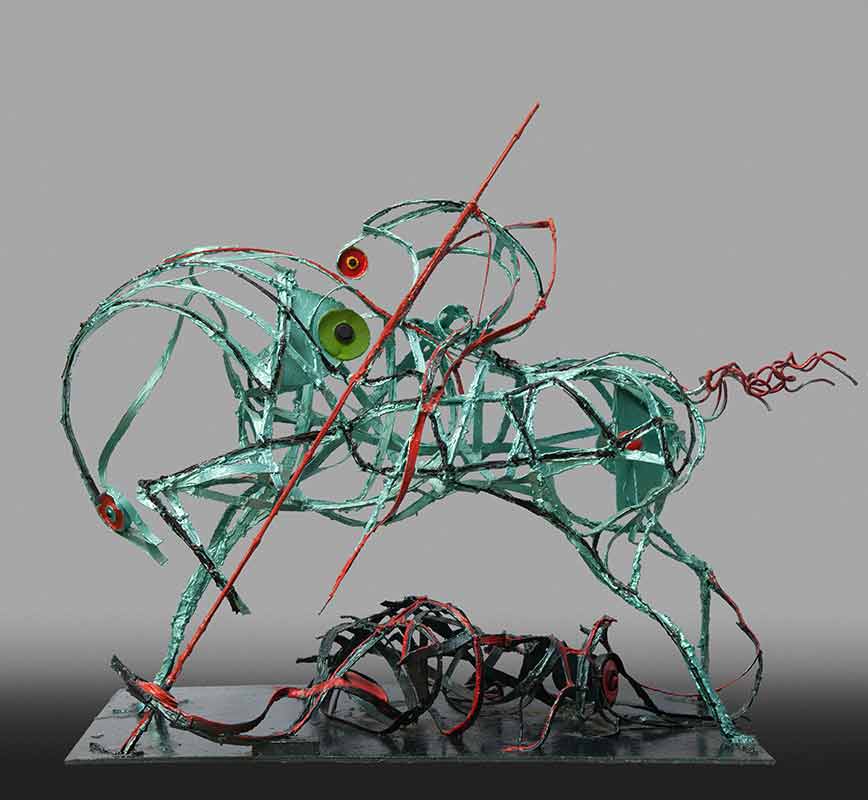
The dragon is already down, its strips tangled in a last convulsion at the base, red and black within the dominant green: the colors of decay. Above, horse and rider lean forward still, their metallic strips flowing with a different logic, elegant, directional, the posture of a force that has not yet registered its own victory. The structure is entirely open, light passing through from every angle, so the sculpture reads simultaneously as object and as drawing extended into three dimensions.
The dragon is already down, its strips tangled in a last convulsion at the base, red and black within the dominant green: the colors of decay. Above, horse and rider lean forward still, their metallic strips flowing with a different logic, elegant, directional, the posture of a force that has not yet registered its own victory. The structure is entirely open, light passing through from every angle, so the sculpture reads simultaneously as object and as drawing extended into three dimensions.
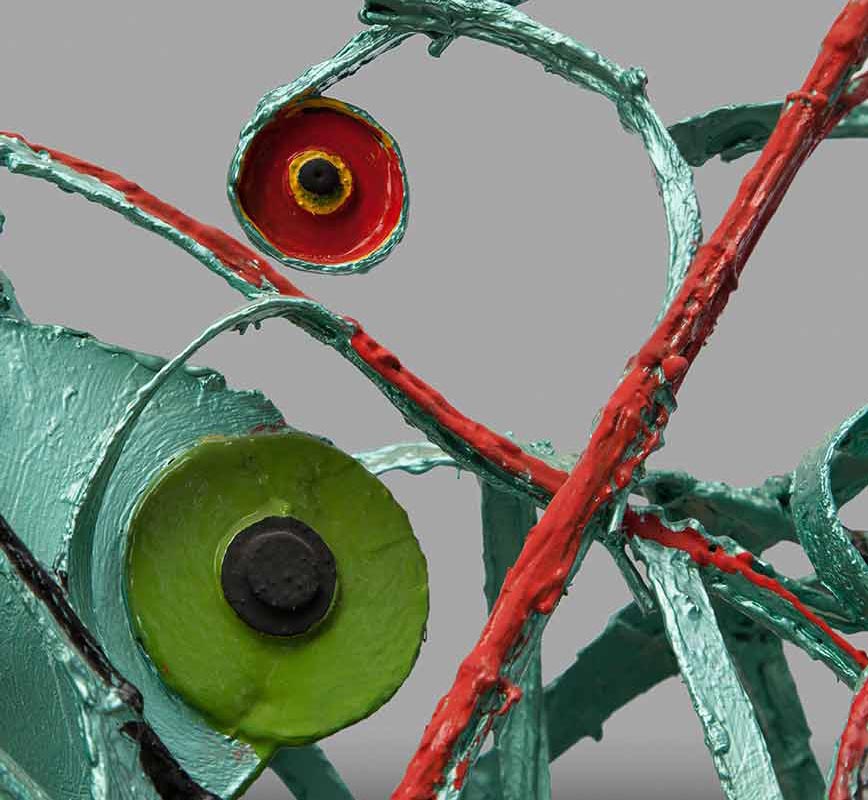
The red runs through the entire work: it knots through the dragon's collapsed strips at the base, it runs the length of the lance aimed above, and it returns threaded into the green body of the horse itself, in small disc-like accents distributed across its surface. The weapon is made of the same chromatic substance as what it destroys. Saint and dragon are built by the same hand from the same strips and the same additive technique; what separates them is entirely a matter of how that matter is organized and in what direction. The metallic green unifies the construction but not the color: the dragon is predominantly red and black, the colors of its dissolution, while the horse and rider carry the dominant green. The shared matter is structural, not chromatic, and that distinction is precisely the work's argument.
Canevari holds this suspended instant with a precision that has a long precedent. Paolo Uccello's panel in the National Gallery fixes the same aftermath, the saint's lance still extended, the beast wounded and kneeling but not yet fully vanquished, the narrative paused between act and consequence. Where Uccello's dragon is a heraldic creature painted with medieval taxonomic exactness, Canevari's is dissolution itself, form giving way to tangle, the energy of the beast dissipating back into the strips from which it was built.
The open construction is the formal conviction of a sculptor formed within a tradition of three centuries of Roman artistic practice and sharpened by the most demanding of masters. Canevari spent years in Corrado Cagli's studio, absorbing what he described as un senso religioso del mestiere, a sacred regard for the craft. Crispolti, writing of Cagli's cardboard-strip sculptures of 1961-62, describes exactly the method Canevari would extend into the Strutture forty years later: sottili strisce articolate per aggiunzione, thin strips articulated by addition, a single primary element repeated and built up until it becomes a figure. The metallic skin that unifies the armature into a heraldic object is Canevari's own contribution to that inheritance: medieval iconography and a lifelong sculptural intelligence arriving together at a figure simultaneously ancient and entirely of its moment.