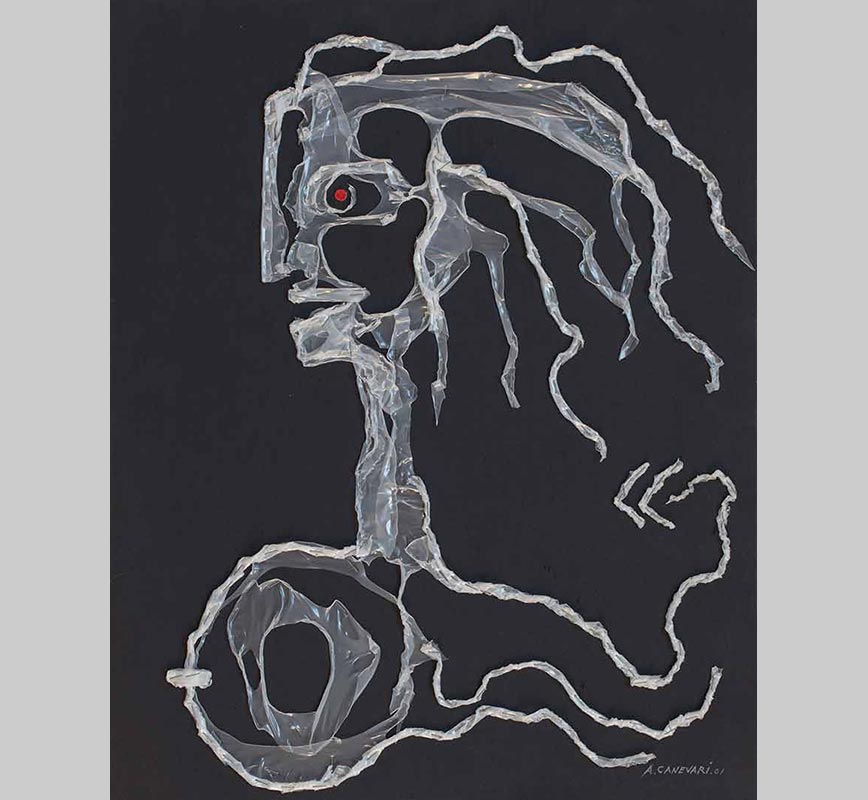
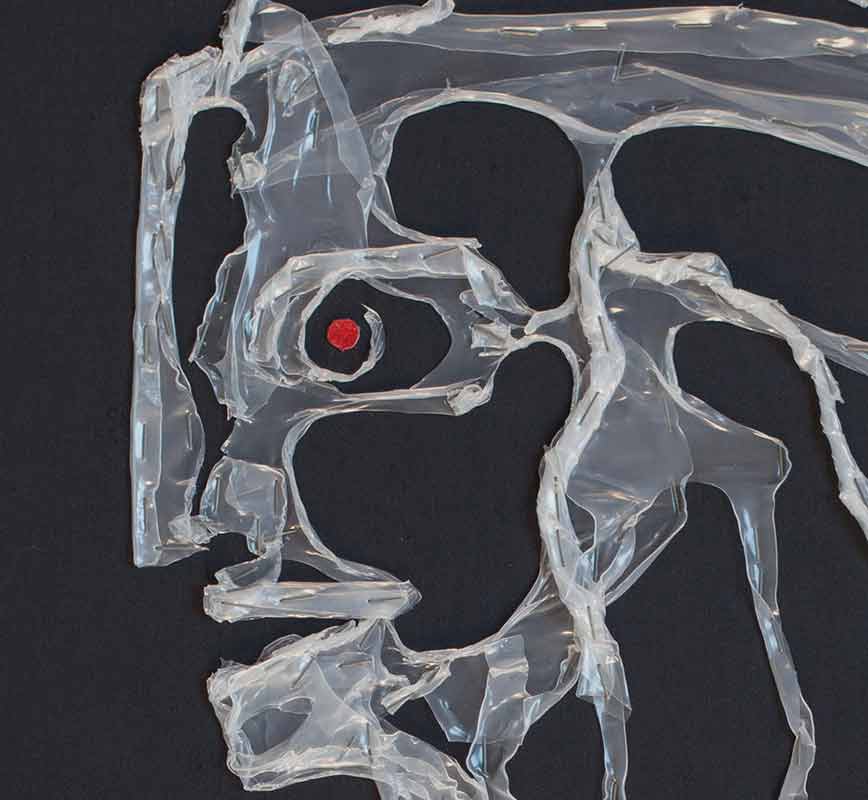
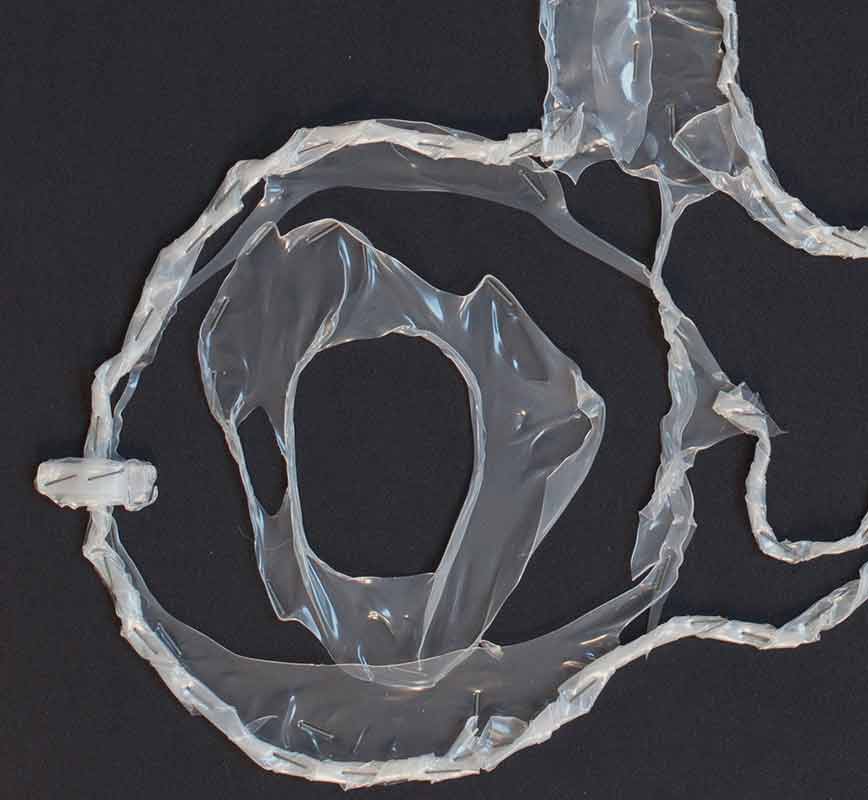
Mounted on the wall like a heraldic device, Bucranium I presents two registers: above, abstracted horns curve outward from a central spine, flanking two large circular eye-forms built from concentric rings with red glass beads at center; below, the skull continues into a long trailing fringe of splaying strips that forms a substantial part of the object's height. Bilateral symmetry governs the overall logic, though hand-fabrication prevents mechanical regularity: every curve slightly different, every form slightly asymmetric.
Mounted on the wall like a heraldic device, Bucranium I presents two registers: above, abstracted horns curve outward from a central spine, flanking two large circular eye-forms built from concentric rings with red glass beads at center; below, the skull continues into a long trailing fringe of splaying strips that forms a substantial part of the object's height. Bilateral symmetry governs the overall logic, though hand-fabrication prevents mechanical regularity: every curve slightly different, every form slightly asymmetric.
The bucranium is among the oldest decorative and symbolic motifs in the Mediterranean world: it appears in Etruscan funerary contexts, in Roman architectural friezes, on the metopes of Greek temples, wherever the ritual vocabulary of sacrifice and commemoration required a sign that was simultaneously animal and emblem. This work occupies that symbolic weight directly. The open construction neither softens nor distances the motif: the verdigris surface, metallic and ancient simultaneously, places the object in a visual register that runs from the painted walls of the Villa of the Mysteries through to the architectural ornament of the Roman forum. Art historian Giuseppe Marchiori described Canevari's work as opening a new region of plastic imagination, and the Bucrania demonstrate precisely what he meant: the ancient sign enters through a modern sculptural intelligence and returns transformed, neither archaeological quotation nor contemporary abstraction but something between those positions.
The animal head reduced to essential form, carrying the weight of archaic tradition without quoting it literally, has its most sustained modern exploration in Brancusi's practice. The series of bird and fish forms through which Brancusi pursued the essential sculptural statement of flight or aquatic movement represents one answer to the question of what an ancient symbol looks like when stripped of its historical costume. The Bucrania are a different answer to the same question: not the smooth continuous surface of Brancusi's reductions but the open armature, the construction exposed, the ancient sign returned not as polished essence but as structural argument. Both occupy the territory between the naturalistic and the abstractly decorative, and both refuse to let the ancient subject become merely ornamental.
Within the Strutture [Structures] series the Bucrania occupy a different formal register from the equestrian and figurative works. Where those pieces are dynamic, laterally extended, charged with directional energy, the Bucrania are frontal, emblematic, still. They function as the heraldic counterpart to the series' kinetic works: the signum to the cavalry, the device that names the force rather than embodying it.