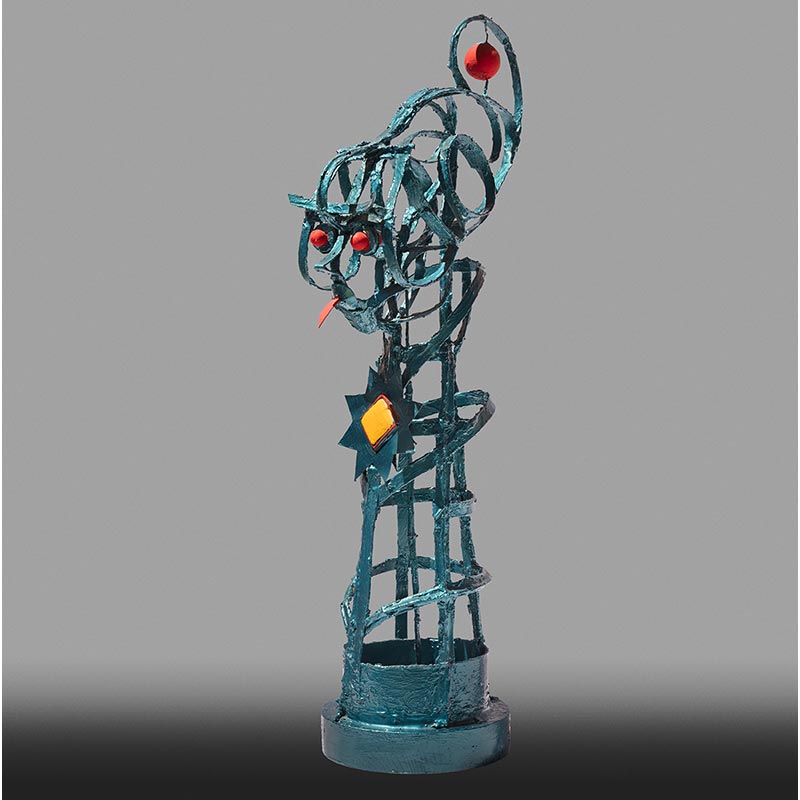
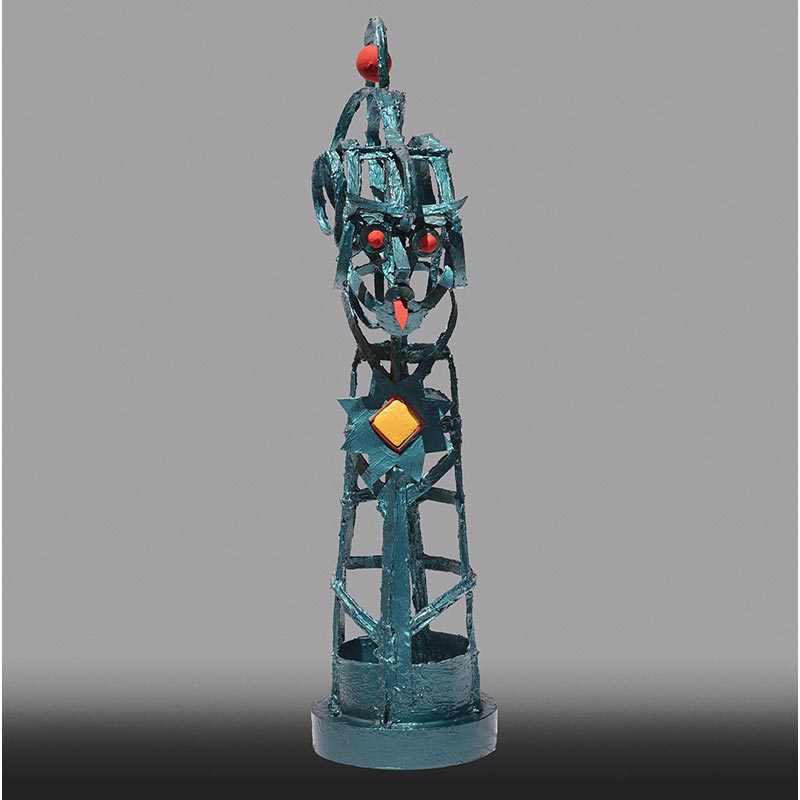
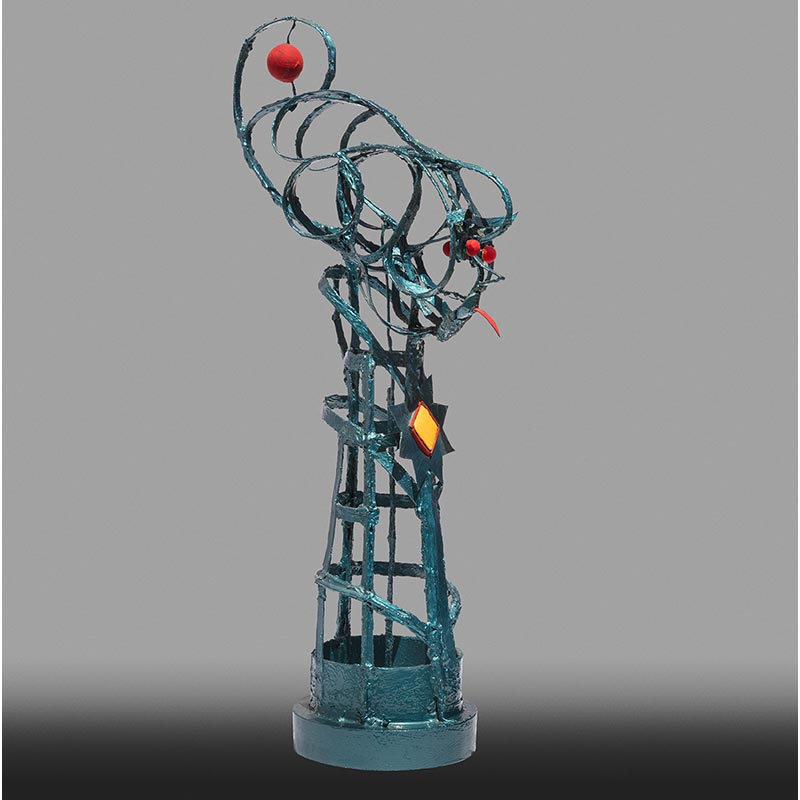
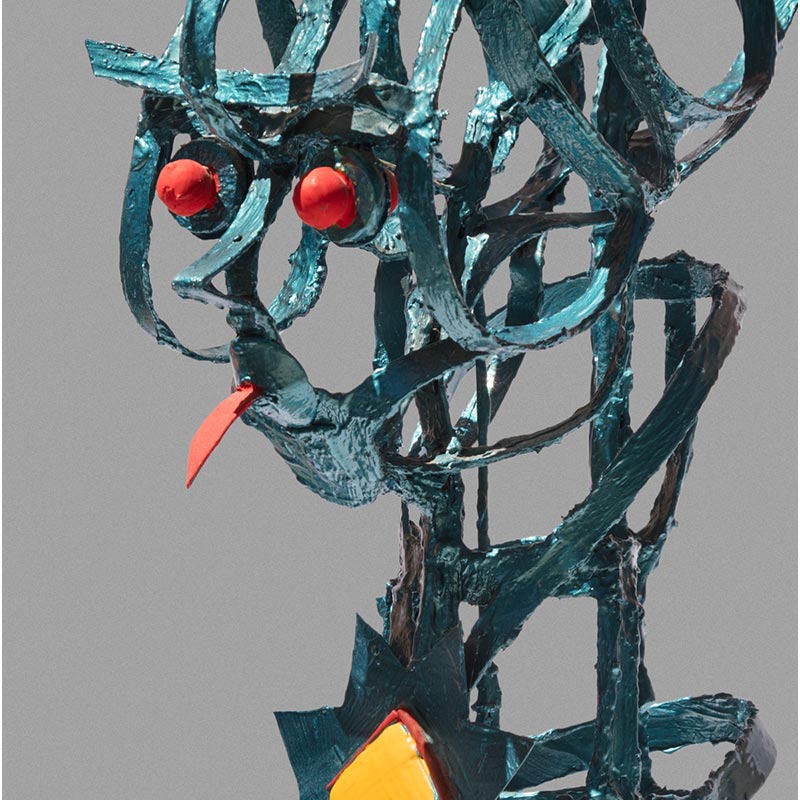
Pilate's Servant is built in teal, between the military green of the warrior figures and the sacred blue of the priestly ones: the color of a figure serving at the intersection of Roman administrative power and religious authority. The form is vertical and columnar on a circular base, the body a tightly wound cage. At mid-body a star-shaped element carries a yellow square, the only heraldic badge of office in the series. Red spheres cluster at the upper structure, reading simultaneously as eyes and as focal markers of office, the same sign doing double work; a red tubular element extends from the face zone.
Pilate's Servant is built in teal, between the military green of the warrior figures and the sacred blue of the priestly ones: the color of a figure serving at the intersection of Roman administrative power and religious authority. The form is vertical and columnar on a circular base, the body a tightly wound cage. At mid-body a star-shaped element carries a yellow square, the only heraldic badge of office in the series. Red spheres cluster at the upper structure, reading simultaneously as eyes and as focal markers of office, the same sign doing double work; a red tubular element extends from the face zone.
The servant is the figure of delegated authority, the one who acts in another's name without bearing the weight of the decision. In the Passion narrative, Pilate's servant occupies a hinge position: present when the machinery of Roman administration and the demands of religious authority converge, carrying out orders whose consequences neither he nor his master fully controls. Canevari's choice of this marginal figure over Pilate himself is consistent with the series' logic: it is the functionary, the intermediary, the figure at the threshold between power and its execution, who carries the formal and historical interest.
The star badge reads as a sign of that delegated function, an emblem of office without the weight of the office itself. Medieval and Renaissance heraldry operated on precisely this logic: identity carried by device rather than by likeness, institutional function made visible through a system of signs that anyone within the tradition could read. The teal surface extends that semiotic argument to the color itself, verdigris and patina, the hue of metal exposed over time, appropriate for a figure whose historical moment has been weathered by two millennia of interpretation. The work is a constellation of signs, badge, color, focal point, that locates a figure in history through attributes alone.
The logic of identity carried entirely by sign rather than by organic form or likeness has its most rigorous modern articulation in the work of Oskar Schlemmer, whose figures for the Bauhaus stage were built from geometric costume elements that defined the character through their visual syntax rather than through any facial or physical resemblance: the functionary, the mechanical man, the court figure, each legible through their formal attributes alone. The problem is the same: how to render a figure whose identity is entirely institutional, whose meaning resides in the office rather than the person, through a formal vocabulary of signs rather than a vocabulary of bodies. The star badge, the teal surface, the red upper markers: these are Canevari's version of Schlemmer's costume logic, the figure assembled from its attributes rather than depicted from its appearance.