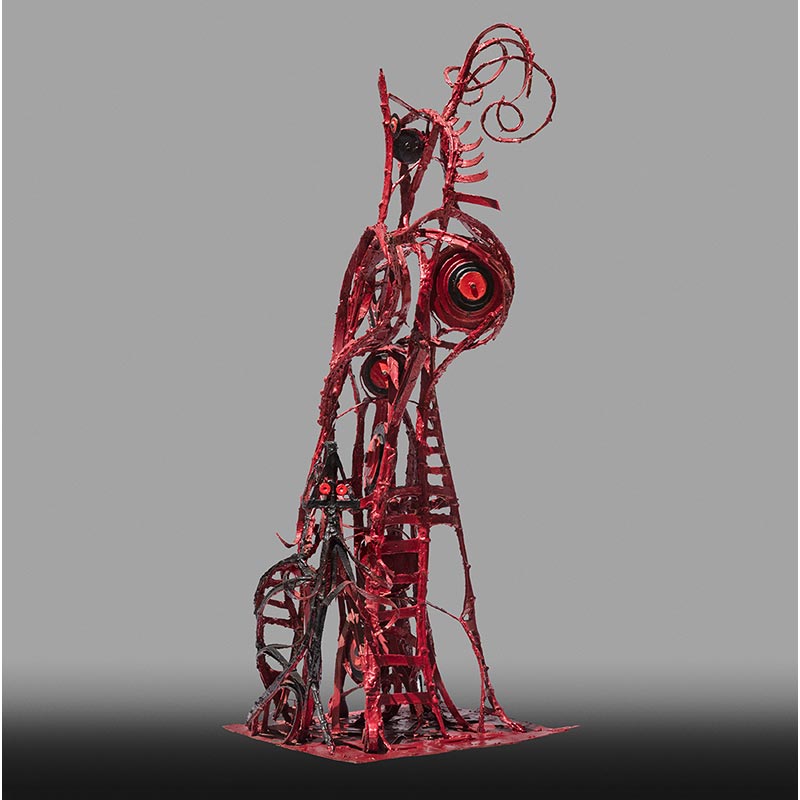
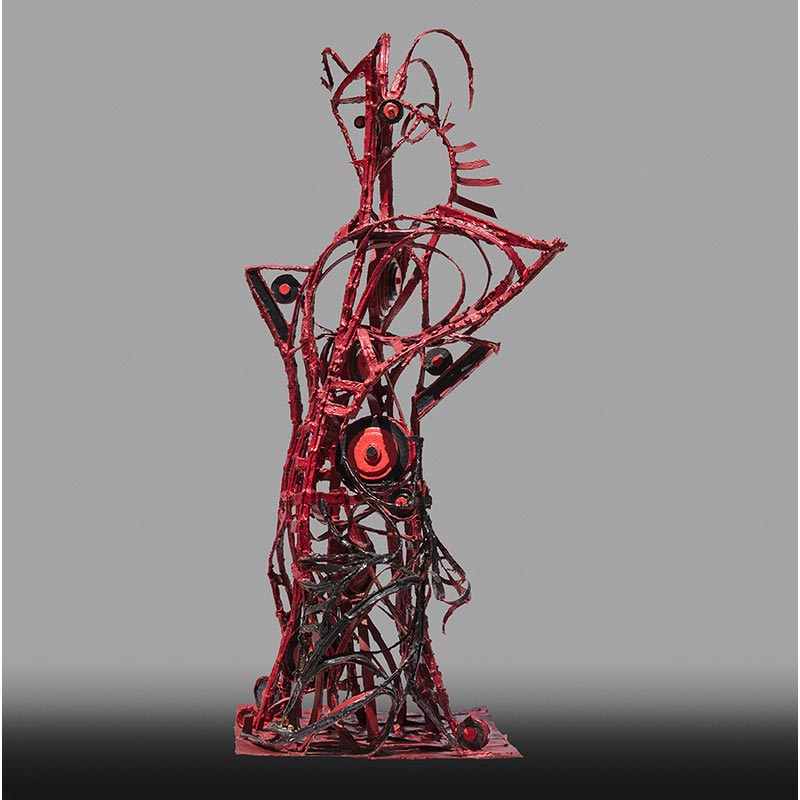
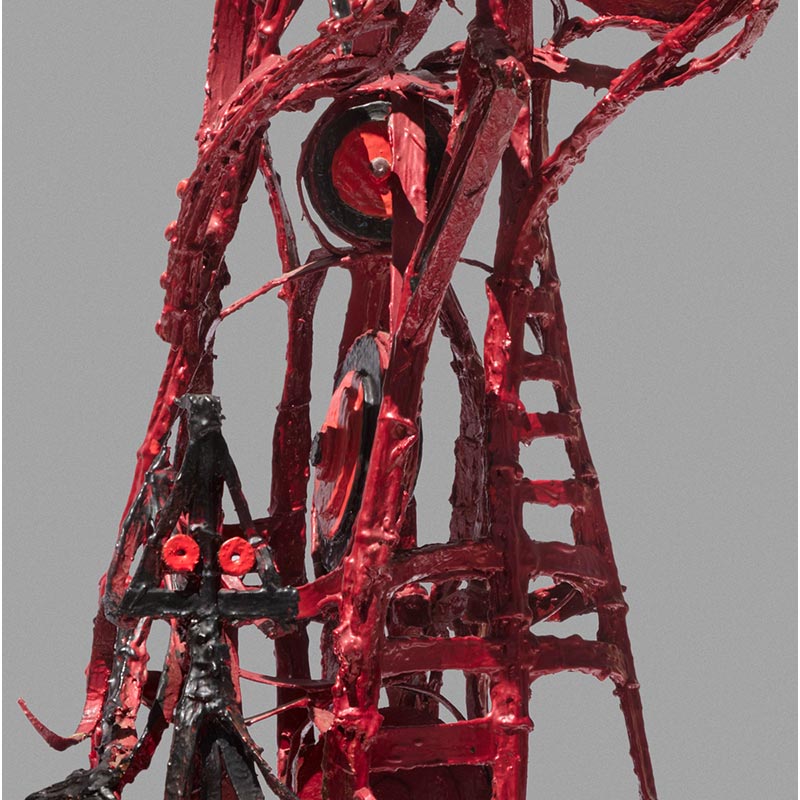
A pyramidal red mass rises from a flat base: interlaced strips dense at the lower body, a large spiral disc at mid-body, and an upper zone of concentric rings and coiling forms that resolve into an ambiguous head, animal and human simultaneously, in three-quarter view. At the lower left a separate dark figure with red eyes presses against the base, suspended between attack and embrace. A ladder is built into the lower right, the only rectilinear element in a composition otherwise given over to spirals.
A pyramidal red mass rises from a flat base: interlaced strips dense at the lower body, a large spiral disc at mid-body, and an upper zone of concentric rings and coiling forms that resolve into an ambiguous head, animal and human simultaneously, in three-quarter view. At the lower left a separate dark figure with red eyes presses against the base, suspended between attack and embrace. A ladder is built into the lower right, the only rectilinear element in a composition otherwise given over to spirals.
The ladder is the compositional spine of the work, the axis along which two forces are held in relationship: one rising and dissolving into the dense upper zone above, one low and insisting at the base. The chromatic contrast between the deep red of the dominant mass and the near-black of the lower figure is the sharpest tonal opposition in the series, and it drives the compositional drama entirely: ascent against gravity, the cosmological against the earthbound.
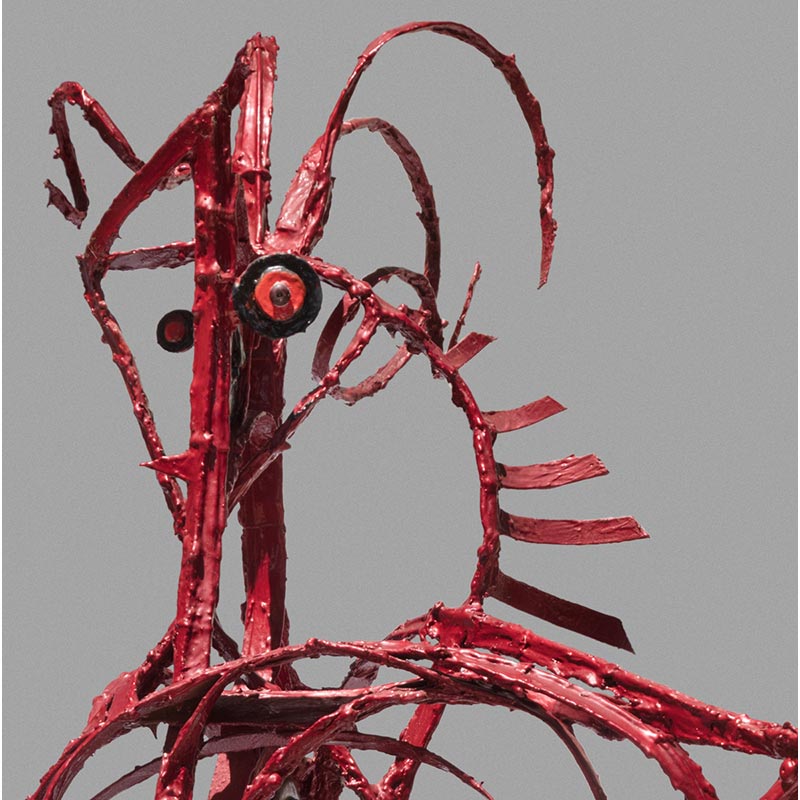
The upper zone resolves, depending on the angle of view, into a form that carries animal and human associations simultaneously: concentric discs, a lateral projection, a loose coiling upper element. The ambiguity is formal rather than a failure of resolution: the work holds multiple readings open rather than closing them down into a single named subject. In Legna per Ardere, Canevari placed Picasso among the protagonists of modernity, specifying that to claim him as an ancestor one had to extract the histrionics. The Vallauris ceramics are exactly the Picasso this upper zone recalls: forms that emerge from the material process with the combined disc element and lateral projection of an animal or human face without committing to either, formal compression without theatrical declaration. The Picasso reference arrives not to identify the subject but to locate the formal proposition: the open form that holds multiple associations simultaneously without resolving them.