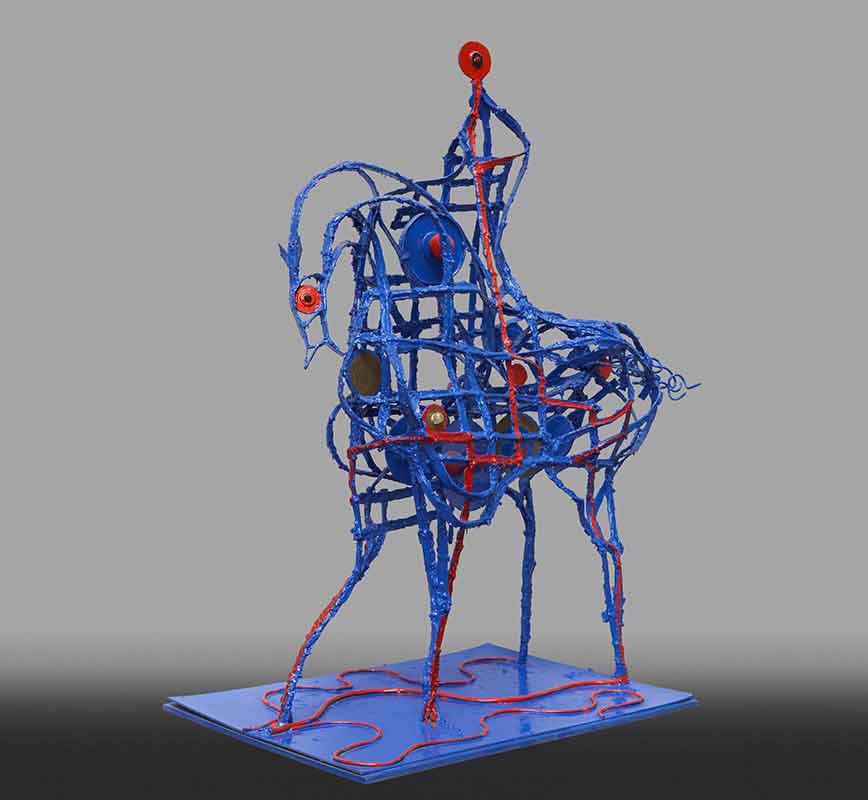
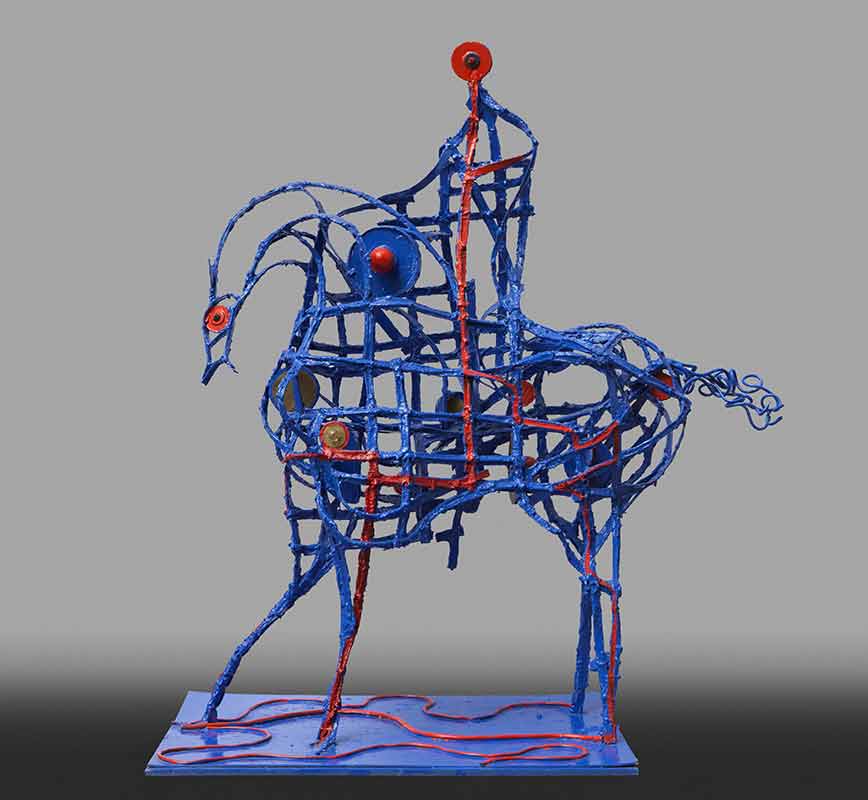
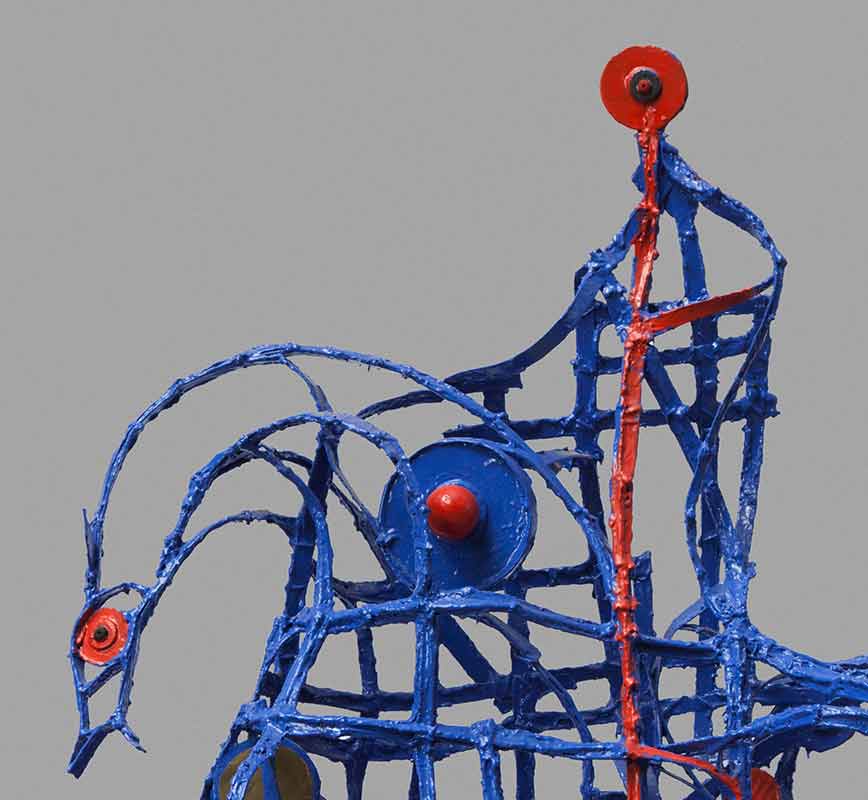
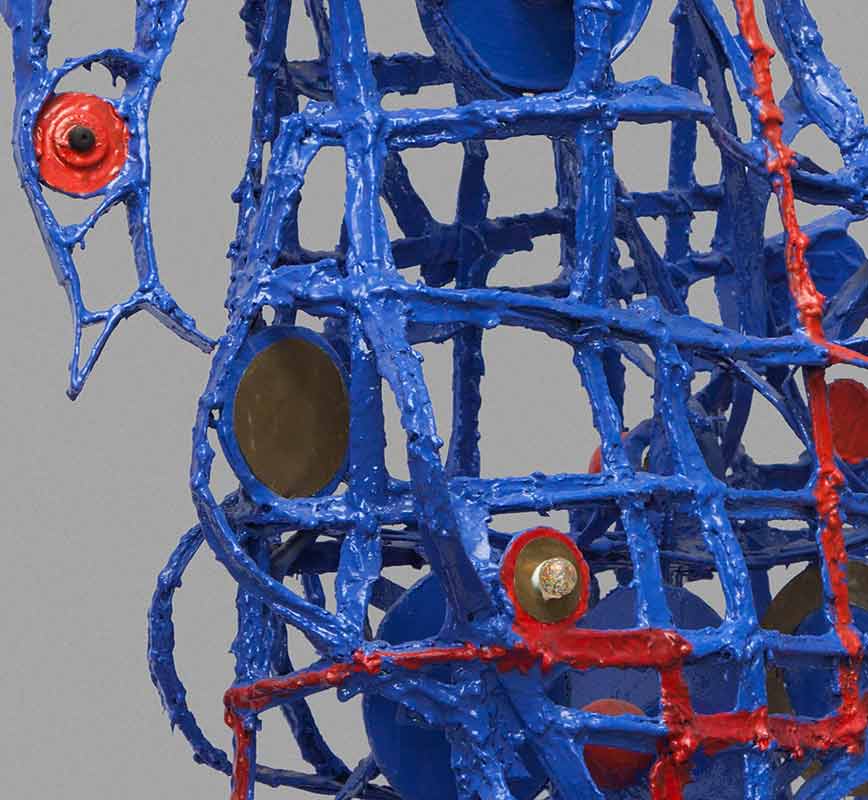
Don Quixote is rendered in cobalt blue from base to lance-tip, horse and rider merging into a single towering presence before the eye begins to separate them. Canevari builds the figure from interlaced strips of cardboard and metal into a cage-like armature that is simultaneously portrait and prison. Red runs through the entire composition: a heavy line threaded through the body of the horse, up through the rider, and loose coils pooling across the base like something the structure cannot hold.
Don Quixote is rendered in cobalt blue from base to lance-tip, horse and rider merging into a single towering presence before the eye begins to separate them. Canevari builds the figure from interlaced strips of cardboard and metal into a cage-like armature that is simultaneously portrait and prison. Red runs through the entire composition: a heavy line threaded through the body of the horse, up through the rider, and loose coils pooling across the base like something the structure cannot hold.
Cervantes' subject has always demanded an art that holds the heroic and the absurd in the same breath, and Canevari's open construction manages exactly this. The cage suggests both the protective enclosure of armor and the confining lattice of an obsession that will not release its prisoner. But the red that runs through the figure is not imprisoned: it threads the body, snakes through the legs, and overflows onto the base in loose coils, a circulatory energy that the blue cage cannot contain. The knight believes himself free; the red says otherwise. Identity lives in the title and the chromatic code alone: the figure abstracted to the degree where anything more specific would be a reduction.
Italian art critic Luigi Lambertini, writing of Canevari's practice in 1990, described a sculptor whose work remains in a state of permanent becoming, resistant to any codification that passes for stylistic unity. Don Quixote is the ideal subject for that sensibility: a figure who cannot be fixed, who exists only in the gap between what he believes and what the world presents back to him. The lateral extensions of the construction, strips reaching beyond the body's core, enact this perpetual incompleteness formally: the knight always in the act of tilting, never having arrived. The equestrian monument tradition, from the Marcus Aurelius on the Capitoline through the great Renaissance bronze casters, built the man on horseback in sealed, impenetrable metal to signal sovereignty and permanence. Here the same subject is all exposure and open lattice, authority dissolved into the transparency of its own construction.