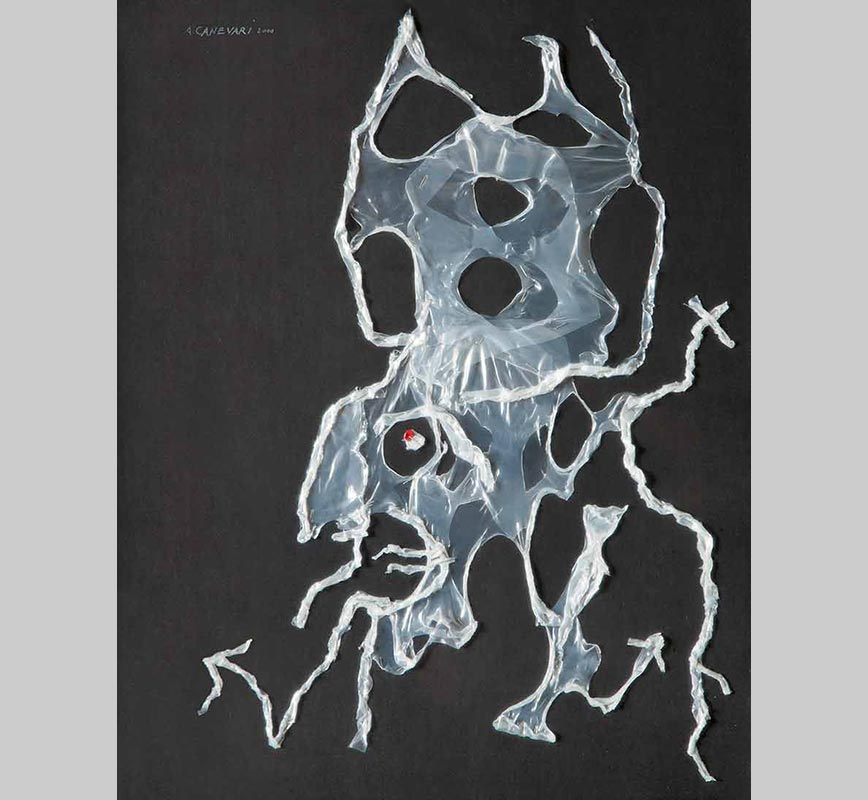
Entirely red, a deep saturated red applied uniformly to every strip of metal and cardboard, Bucranium II announces itself from across a room before any detail registers. The skull reads loosely and with gestural freedom: the horns rise asymmetrically, the body is open rather than dense, and the two large circular eye-discs sit high in the form, just below the asymmetric horns, their centers a hotter glowing orange-red against the body red, giving the figure its confrontational stare: not from position alone but from the luminous intensity of those lit pupils.
Entirely red, a deep saturated red applied uniformly to every strip of metal and cardboard, Bucranium II announces itself from across a room before any detail registers. The skull reads loosely and with gestural freedom: the horns rise asymmetrically, the body is open rather than dense, and the two large circular eye-discs sit high in the form, just below the asymmetric horns, their centers a hotter glowing orange-red against the body red, giving the figure its confrontational stare: not from position alone but from the luminous intensity of those lit pupils.
Red as the dominant chromatic identity activates the ritual dimension of the bucranium rather than its memorial one. Blood, sacrifice, the bull in the arena rather than on the frieze: this is not the patinated, archaeological tone of a museum object but something more urgent, still charged with the energy of the arena. The Etruscan substrate that Canevari's critics consistently identified in the practice is present here not as learned quotation but as embedded instinct: the bucranium as threshold marker, placed at the entrance to a sacred space to announce what it contains.
The open wire-like construction holds the form while making no pretense of solidity, enacting what Italian art critic Luigi Lambertini called realtà in fieri, reality always in the making, never fully arrived, never quite resolving into the ancient symbol it invokes. Brancusi described his own practice as the pursuit of forms that do not imitate nature but search for what is essential in it, the form that has always been there beneath the surface of appearance. The Bucrania occupy a related conviction from a different material logic: where Brancusi reached toward the essential through polished reduction, the open construction here reaches toward it through structural transparency, the ancient sign held in a form that is permanently in the act of becoming itself rather than having arrived. This is what Lambertini called realtà in fieri extended from the individual work to the ancient symbol itself: the bucranium not as a fixed heraldic device but as a form that insists on remaining open to the ritual energy it was always meant to contain.