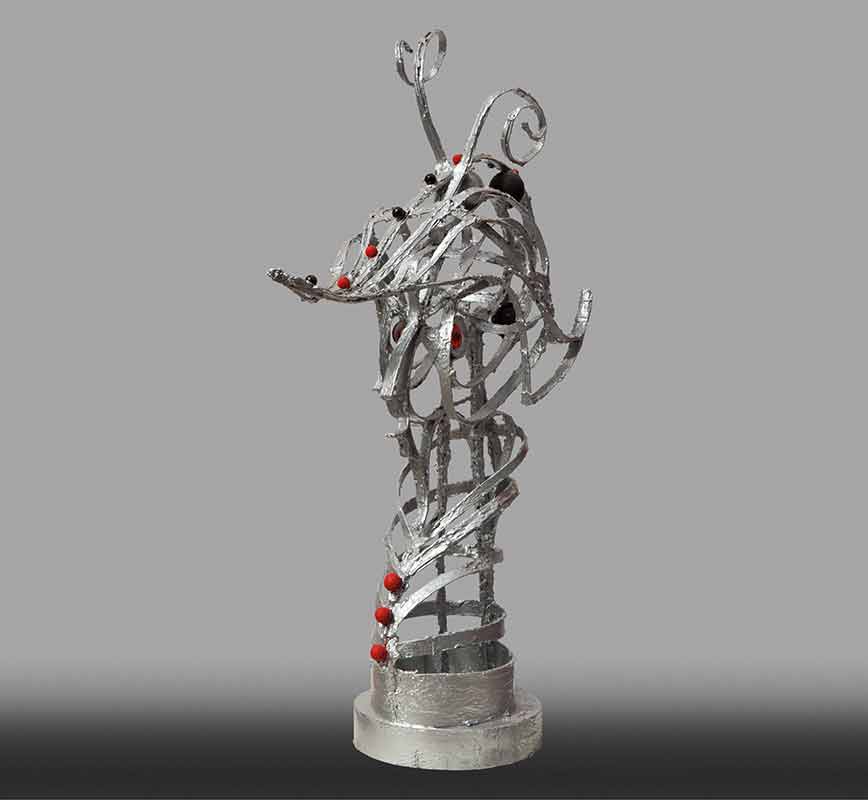
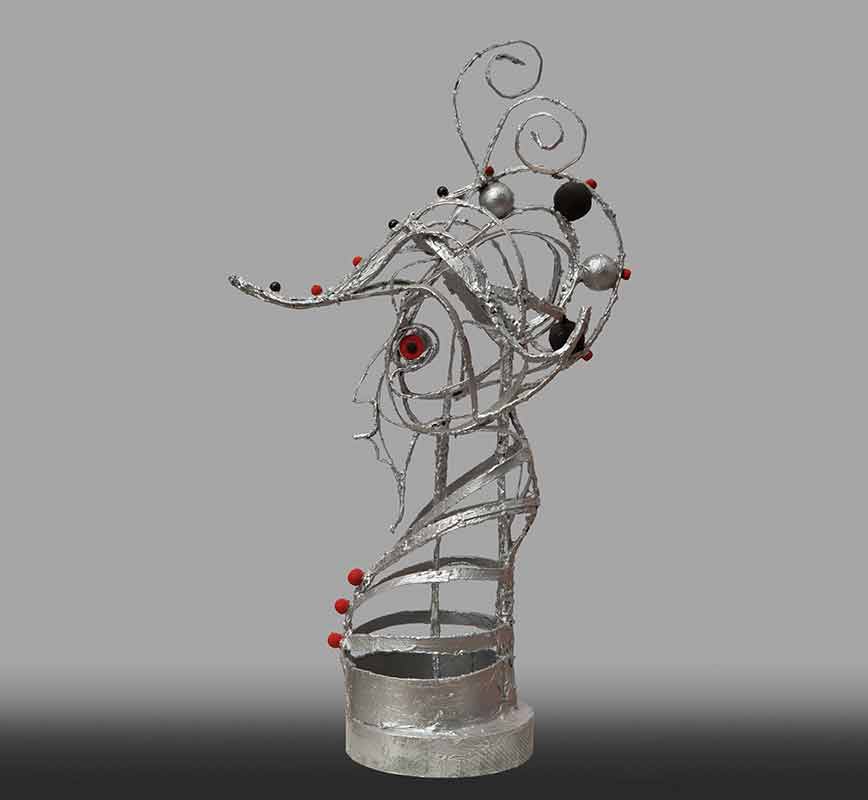
Guinevere stands as a column. The lower body is a cage: a regular palisade of vertical gold bars curving up from a circular drum base, ordered and architectural, the structure of a figure held in place. Above it the form erupts into turbulence, a dense swirling nest of strips that reads as head and crown simultaneously. Two red spheres set as eyes and a third marker below are the only chromatic notes in an otherwise unbroken field of worked gold.
Guinevere stands as a column. The lower body is a cage: a regular palisade of vertical gold bars curving up from a circular drum base, ordered and architectural, the structure of a figure held in place. Above it the form erupts into turbulence, a dense swirling nest of strips that reads as head and crown simultaneously. Two red spheres set as eyes and a third marker below are the only chromatic notes in an otherwise unbroken field of worked gold.
The division is the whole argument. Enclosure and elevation are not two competing ideas about this queen; they are the bottom and top of a single vertical form. Guinevere's story is one of a woman held in place, by marriage, by court, by loyalty to competing loves, and the lower body gives that confinement its exact form: a cage you can see through but not leave, light passing between the bars while the perimeter stays fixed. The head refuses that order. Raised on the column of the body, all motion and interlace, it is a relic lifted into view above its own prison. The shadows the structure throws shift with every angle, so the figure is never quite the same twice: a formal restlessness that suits a queen whose meaning has been contested and rewritten for eight centuries.
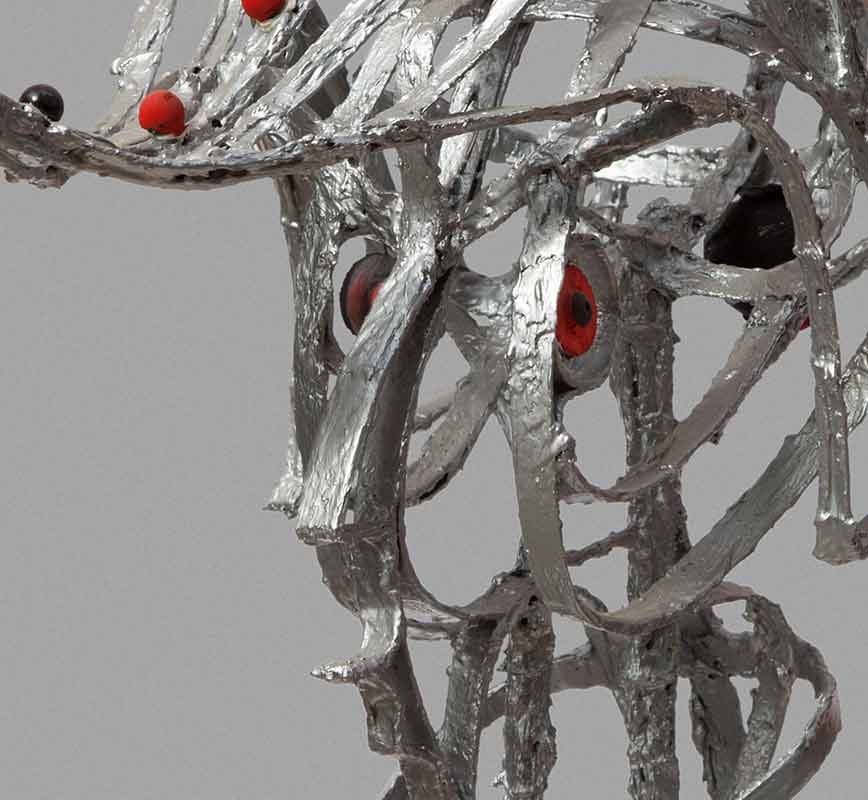
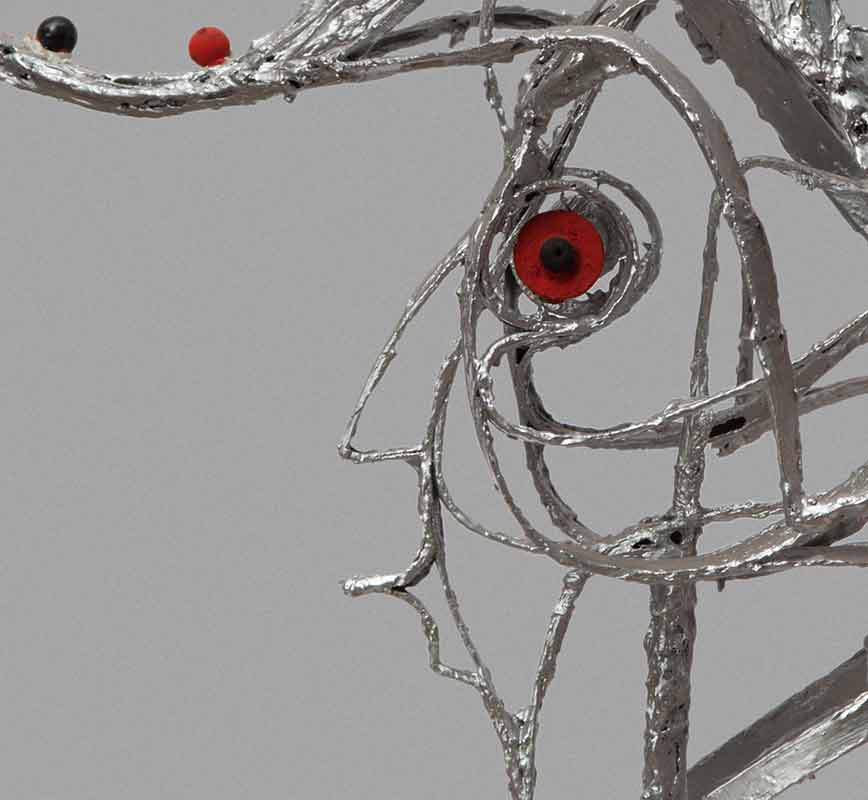
The face within the turbulent upper zone is schematic and frontal, and its frontality is the deeper reference. The red spheres are not eyes in any naturalistic sense: they are presence compressed into sign, the device of the Byzantine icon, where a face is established by a few fixed marks rather than by description. The Greek portrait herm and the medieval reliquary bust had already established the head as the sufficient container of identity, the part that carries the whole: from the Archaic kouroi through the Hellenistic portrait heads, Western sculpture has treated the isolated head as the complete statement of personhood. Guinevere's upper zone carries that tradition while refusing its closed, modeled surface, the legend held in a structure you can see straight through.
The gold surface settles which register the work belongs to. Handworked and uneven, dragged across the strips and pooling at the joints, it is gold as substance rather than color, the medieval goldsmith's claim that what is held within exists outside ordinary time. That claim connects Guinevere across the Strutture [Structures] to the Canopi, the polished bronze reliquary forms that occupied Canevari in the 1970s. The two bodies of work are formal opposites, the Canopi sealed and closed, the Strutture open and seen-through, yet the gold skin carries the same conviction across both: a statement about the status of what the structure contains. In the Canopi the container is shut around its contents. Here the container is opened, and the claim of value is made on a structure that hides nothing.