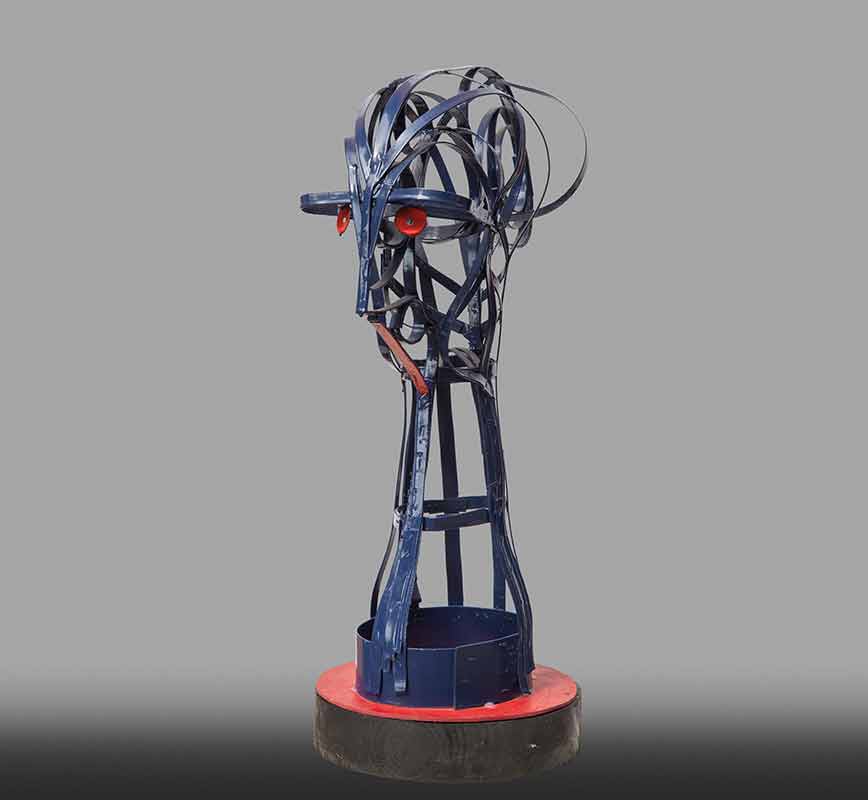
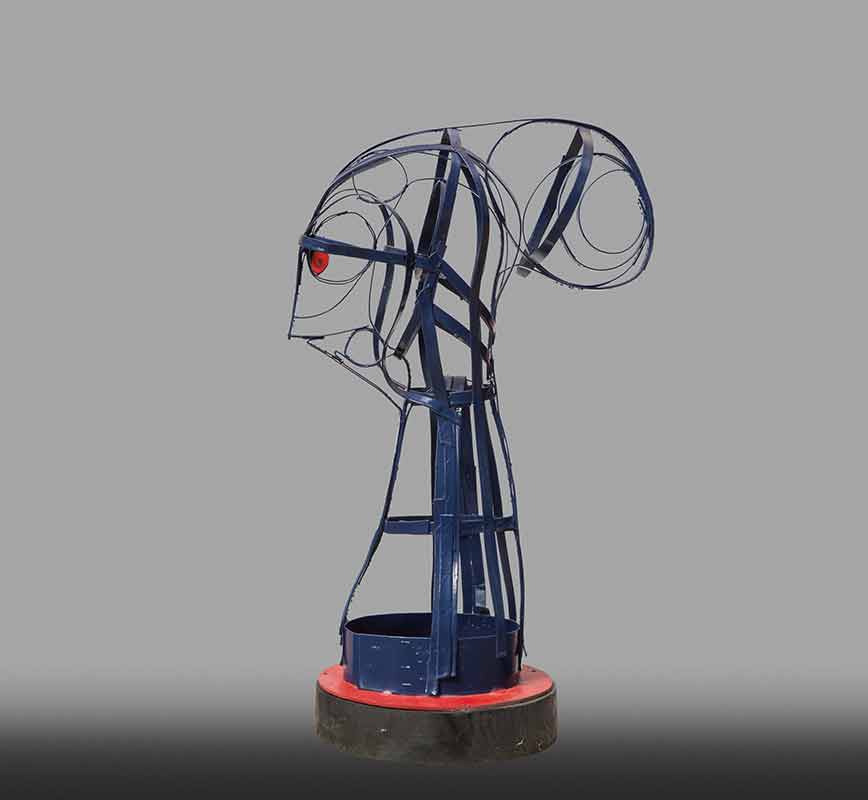
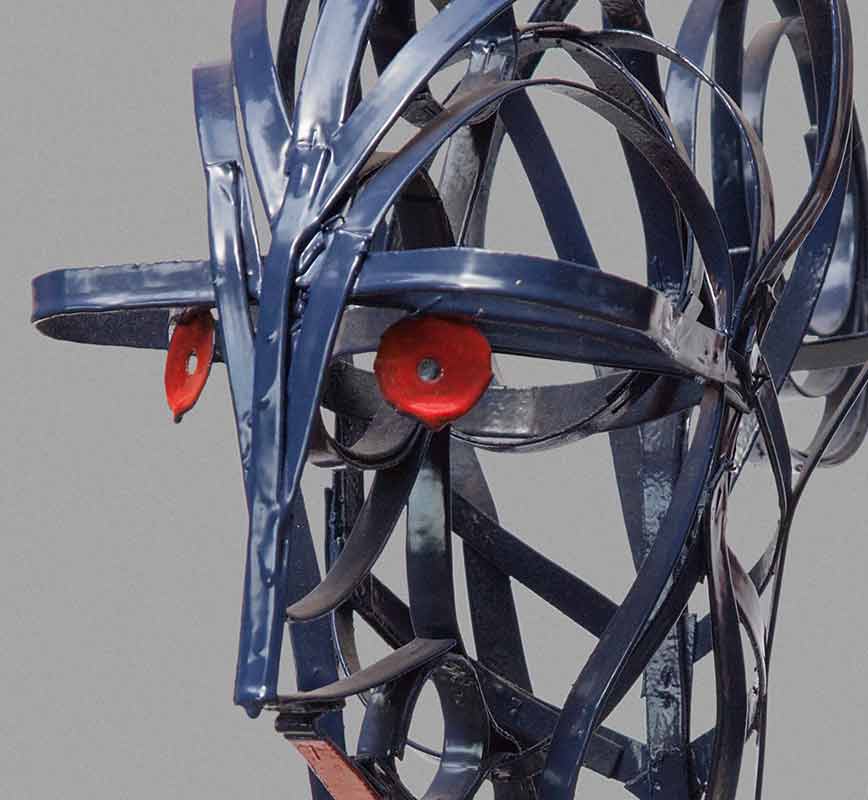
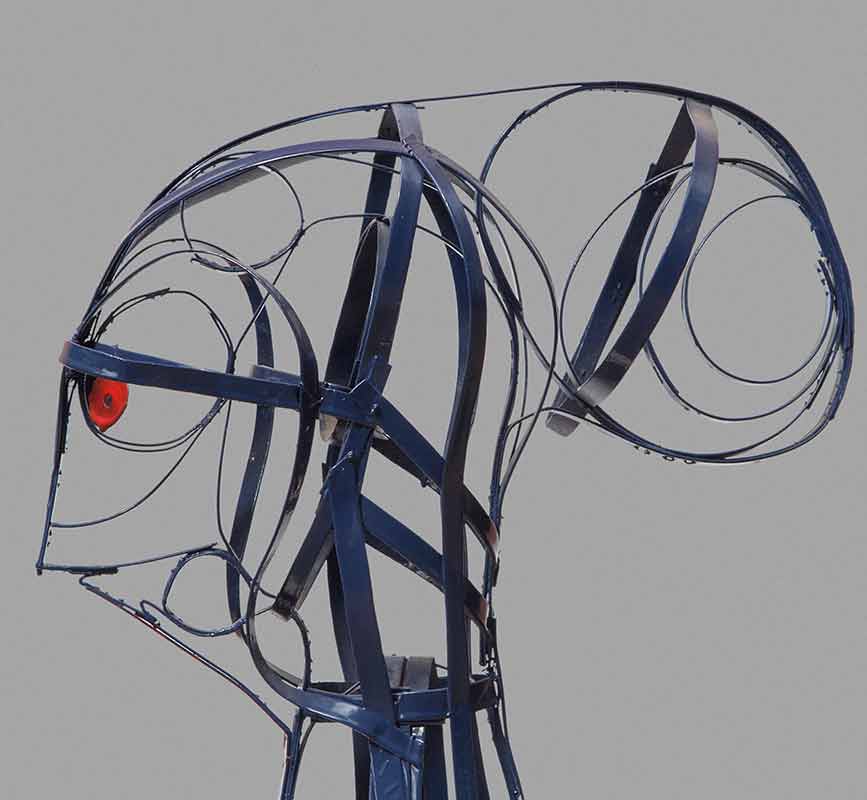
A single upright form rises from a circular base, its upper portion dissolving into a swirl of metallic green ribbons that could be a crown, a headdress, or the visual residue of authority itself. The work is entirely and uniformly green, base to crown, without chromatic relief: no accent, no focal point, no exception to the dominant field. What other works in the series reserve for the red marker of consciousness, this work withholds entirely. Authority here is total and unbroken.
A single upright form rises from a circular base, its upper portion dissolving into a swirl of metallic green ribbons that could be a crown, a headdress, or the visual residue of authority itself. The work is entirely and uniformly green, base to crown, without chromatic relief: no accent, no focal point, no exception to the dominant field. What other works in the series reserve for the red marker of consciousness, this work withholds entirely. Authority here is total and unbroken.
The abstraction is not simplification but intensification: Canevari removes everything that would make the figure a specific individual and retains only what makes him an archetype. The swirling upper structure suggests Assyrian headdresses without imitating them, a formal echo rather than a quotation. The complete absence of chromatic relief gives the condition-of-kingship reading its force: no surface differentiation, no hierarchy of detail, no point of entry. The ancient king does not invite the eye; he occupies the field.
The upper bust as a sculptural form carries a specific weight in the ancient tradition. The silver-gilt bust of the Sasanian king Shapur II, produced in the fourth century, is among the most concentrated surviving images of royal authority in the ancient world: a face rendered with absolute frontality, the eyes forward, the beard stylized into formal waves, the crown absent because the face alone carries the full weight of kingship. It is a portrait not of a person but of a function, exactly the distinction Canevari draws here between the specific individual and the archetype. The bust format, which concentrates authority in the face and upper body while eliminating the contingent particularity of the body below, has served this purpose from Assyrian palace reliefs through Roman imperial portraiture to the medieval reliquary bust. Italian architect and architectural historian Paolo Portoghesi identified in Canevari a sculptor pursuing not the revival of historical heritage but its appropriation: the ancient form entering through a modern sculptural intelligence and emerging changed by the encounter.
The column logic of the standing figure connects this work to the tradition of the herm and the stele, forms Canevari had explored explicitly in earlier series. In the Strutture [Structures] that logic loosens at its upper register: the base remains, but the body above refuses the closed, contained presence of the monument and spirals outward, animated by what Canevari himself described as the Icaro impulse, sollevare l'insollevabile, to make the heavy thing fly. In the Assyrian King that impulse takes the form of pure ornamental excess, authority dissolving upward into its own symbols, nothing withheld, nothing reserved.