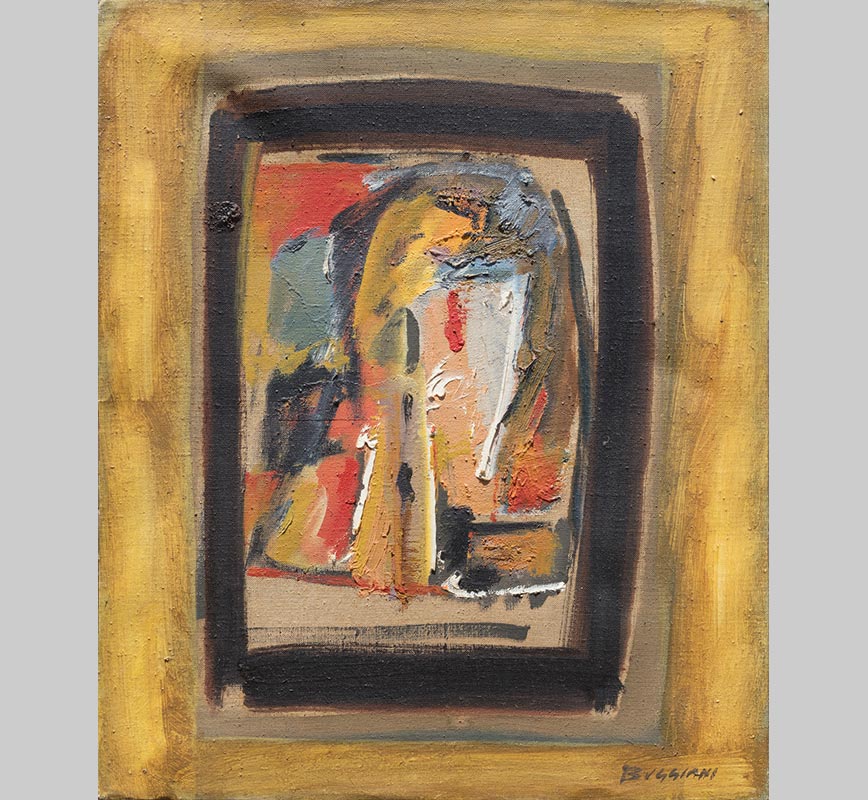
The oval format of Tuscany – Italian Landscape is not a neutral choice. The ellipse carries a long history in Italian painting, from Mannerist cabinet pictures through the devotional tondo to the landscape roundels of the Seicento, and Buggiani’s decision to use it for a contemporary fresco landscape places the work in deliberate dialogue with that tradition. Within the oval, the Tuscan hills unfold in a warm palette of deep brown, yellow-orange, and flat primary accents punctuating the horizon.
The oval format of Tuscany – Italian Landscape is not a neutral choice. The ellipse carries a long history in Italian painting, from Mannerist cabinet pictures through the devotional tondo to the landscape roundels of the Seicento, and Buggiani’s decision to use it for a contemporary fresco landscape places the work in deliberate dialogue with that tradition. Within the oval, the Tuscan hills unfold in a warm palette of deep brown, yellow-orange, and flat primary accents punctuating the horizon.
The oval imposes a centripetal spatial logic quite different from the open panoramic works, the horizontal registers curving gently at the edges to follow the ellipse, producing a landscape that feels held rather than expansive. A ridge of dark cypresses at the center horizon, the only moment of figural specificity in the painting, anchors the composition with the precision of an ideogram: Buggiani has described “the ideograms that flower from the canvas” as the synthesis of his pictorial language, and nowhere is that synthesis more compact than here.
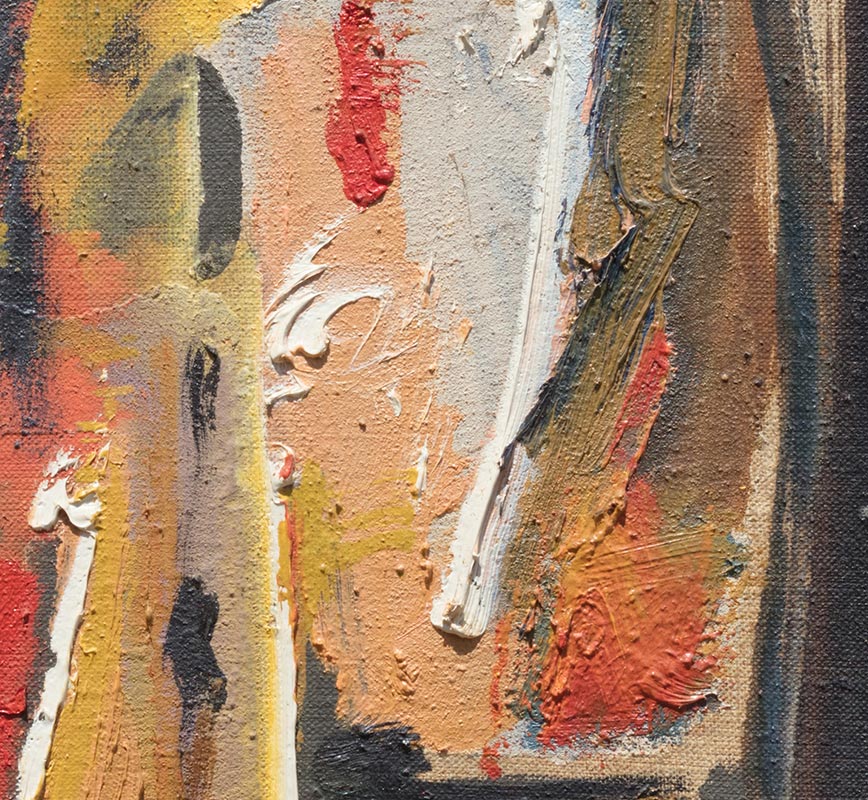
The fresco surface takes on a particular archaic warmth in this format, the sand-and-pigment mixture tending toward amber and terracotta in keeping with the historical resonance of the oval. The form and the technique are in agreement: both reach back before the modern, connecting Buggiani’s Informale formation to a tradition of Italian pictorial making that runs from Mannerism through the Seicento landscape roundel to the present.