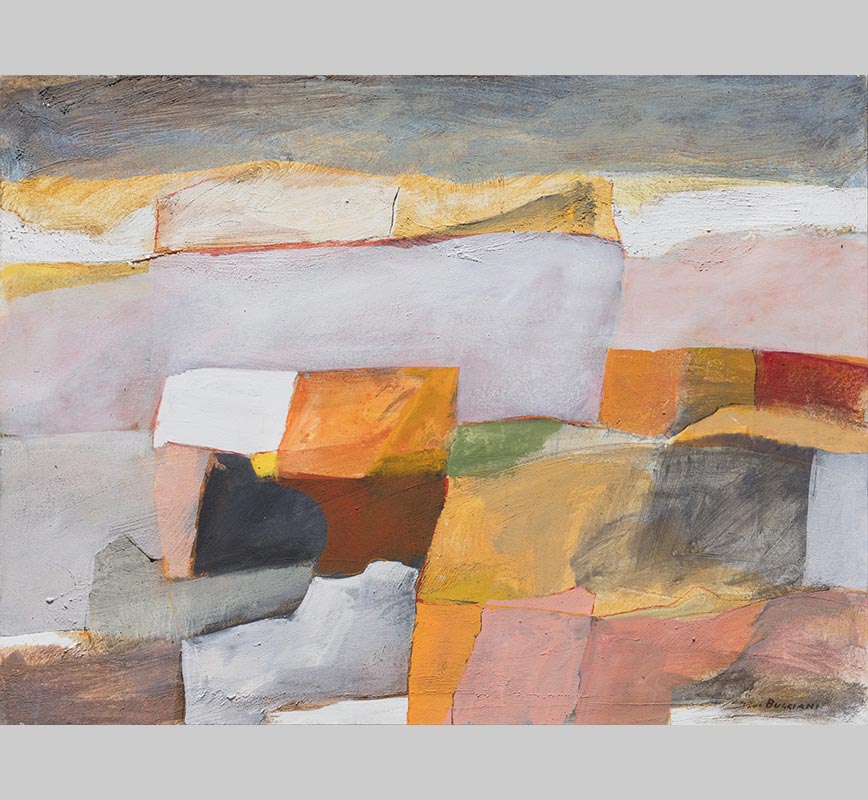
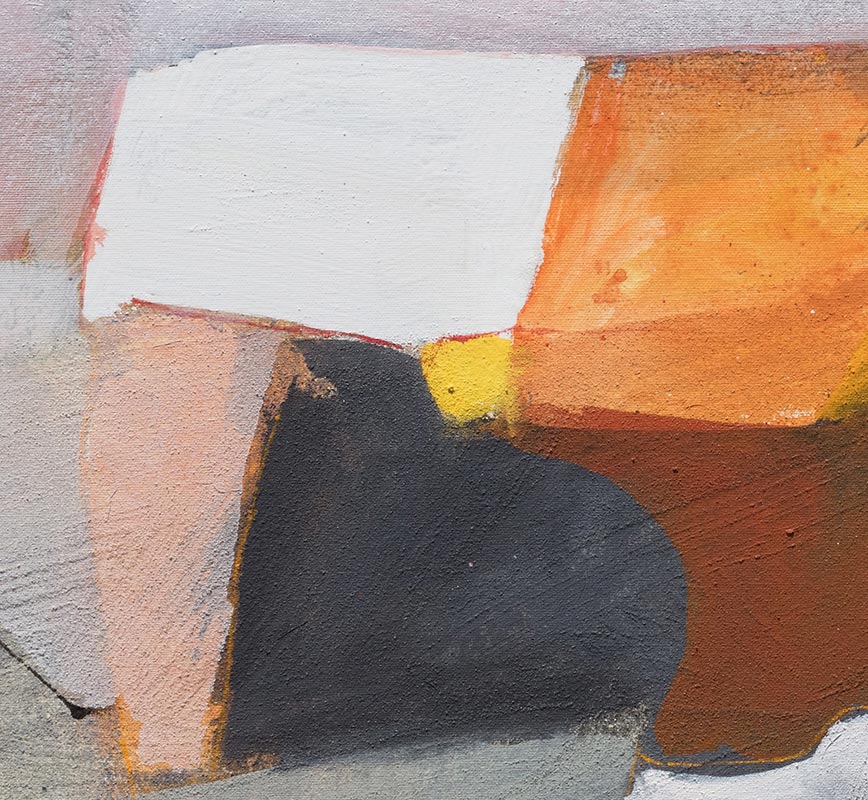
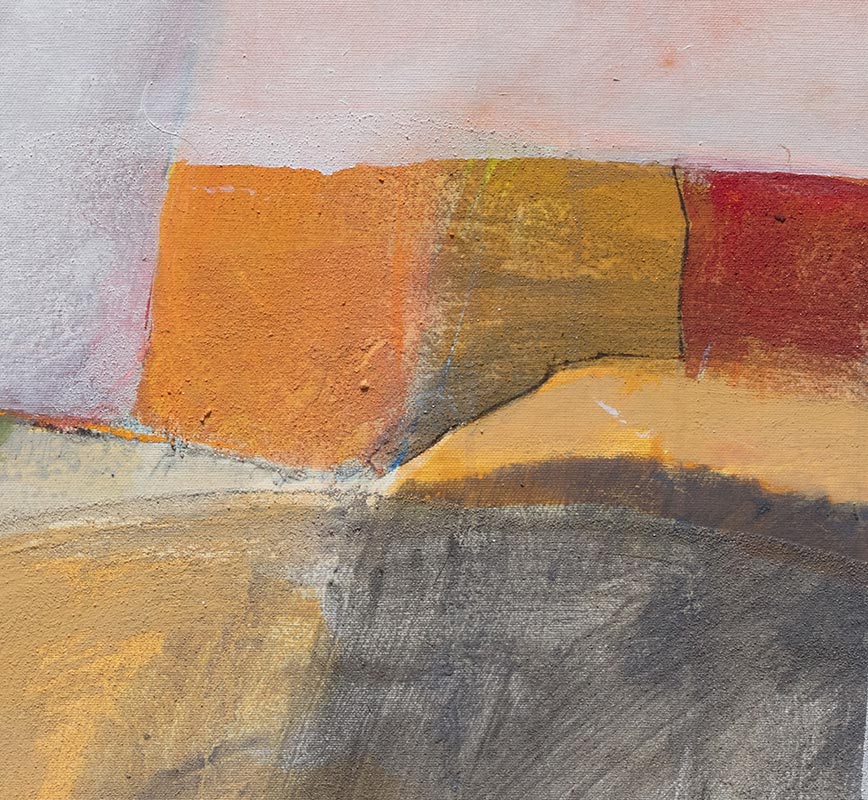
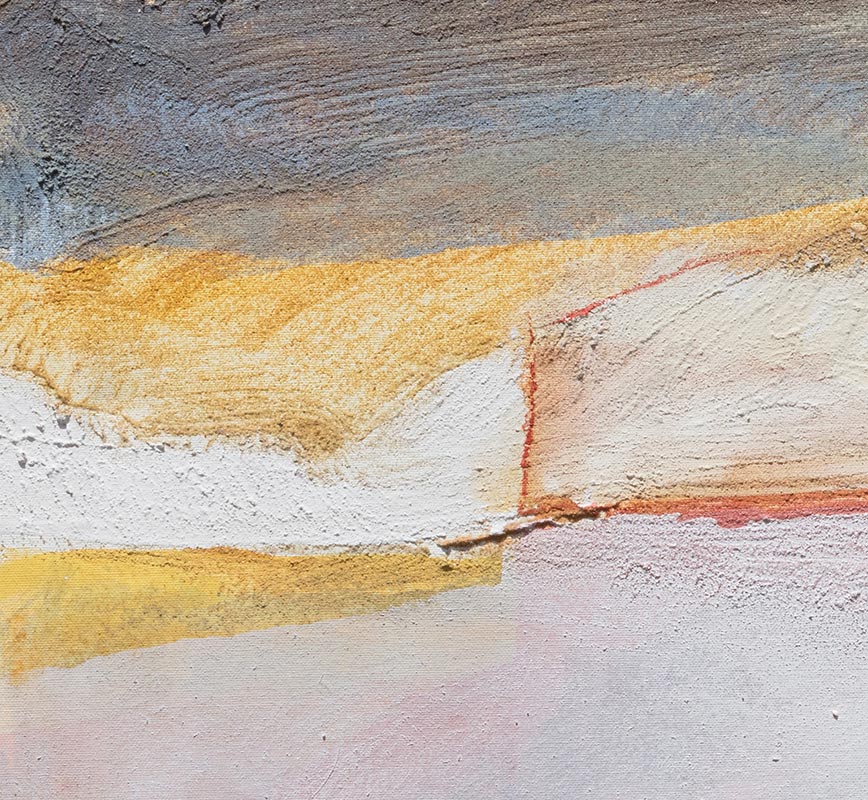
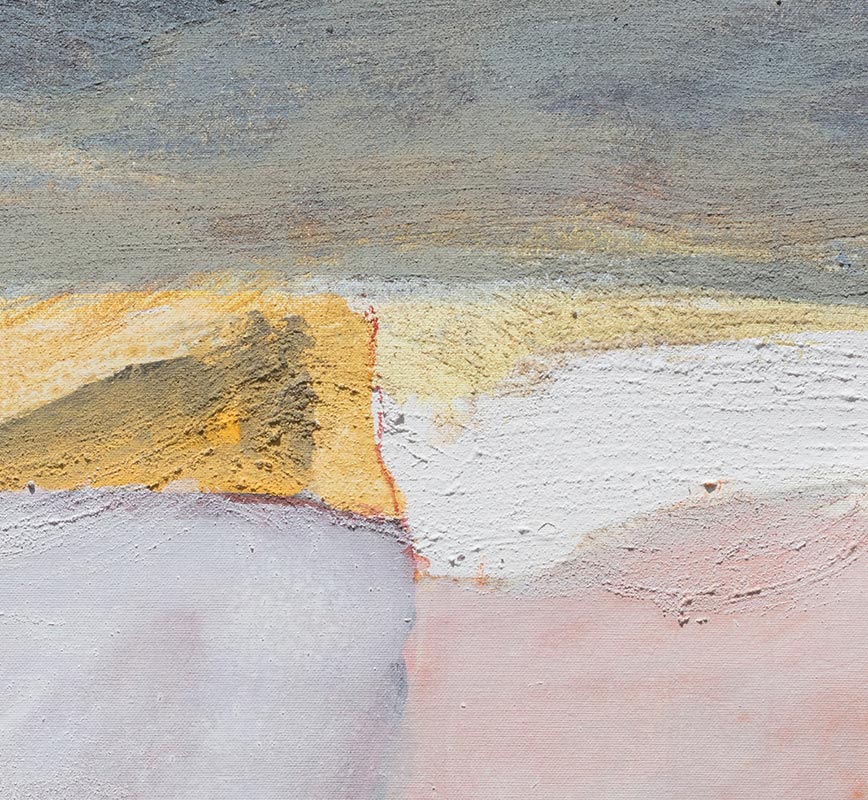
The Shadows of the Hills is among Buggiani’s most expansive landscape paintings, the Tuscan hill country opened into a panoramic sequence of color zones moving from warm black foreground through ochres, terracotta, and orange to a cool blue-grey sky. Architecture appears in the middle distance as a near-abstract mass of red and grey, a Roman arch half-legible against the hillside, anchoring the composition without interrupting the long lateral breath of the hills.
The Shadows of the Hills is among Buggiani’s most expansive landscape paintings, the Tuscan hill country opened into a panoramic sequence of color zones moving from warm black foreground through ochres, terracotta, and orange to a cool blue-grey sky. Architecture appears in the middle distance as a near-abstract mass of red and grey, a Roman arch half-legible against the hillside, anchoring the composition without interrupting the long lateral breath of the hills.
The fresco-on-canvas technique, sand mixed with pigment, gives the surface a matte, porous quality that absorbs rather than reflects light, producing a Mediterranean luminosity that clarifies rather than dramatizes, burning out superfluous details and reducing landscape to its essential chromatic truth. “Tuscany is my land,” Buggiani has written, “beyond the hills that form a curtain on the horizon, I know that there is the sea”: that knowledge, the sea always present but always hidden, is precisely the tension this painting holds.
The horizontal registers and the underlying neoplastic spatial order connect this work to the constructive color discipline Buggiani absorbed in the Roman circle around Burri and Cagli in the 1950s: a sensibility in which color zones are not painted but placed, each carrying its own spatial weight. It is a tradition in which landscape is never merely scenery but a structure of feeling, and this panoramic canvas holds that tradition with quiet authority.