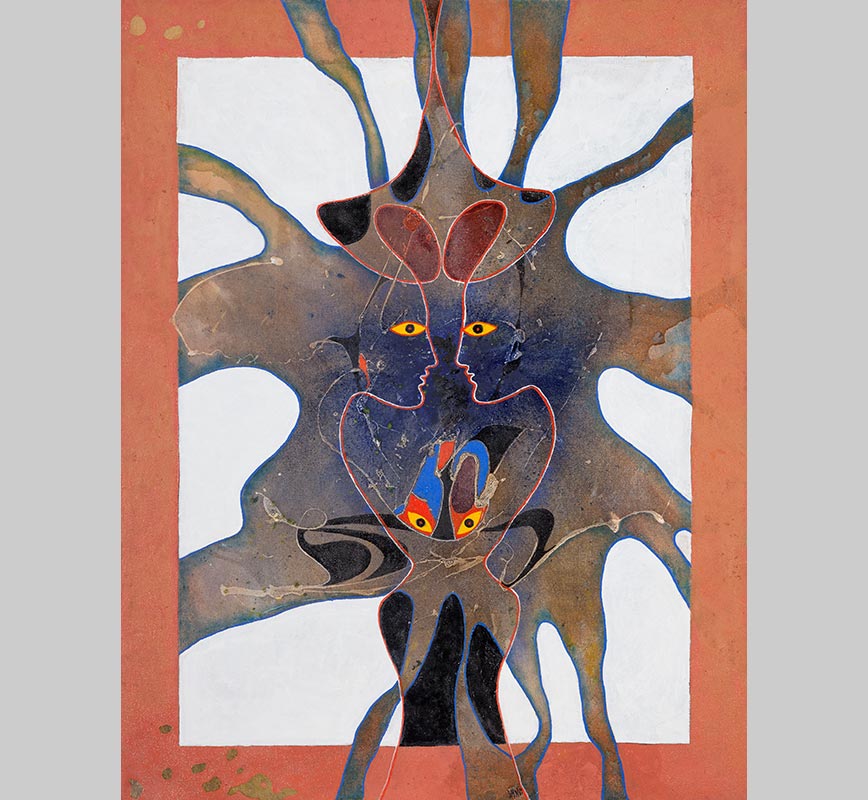
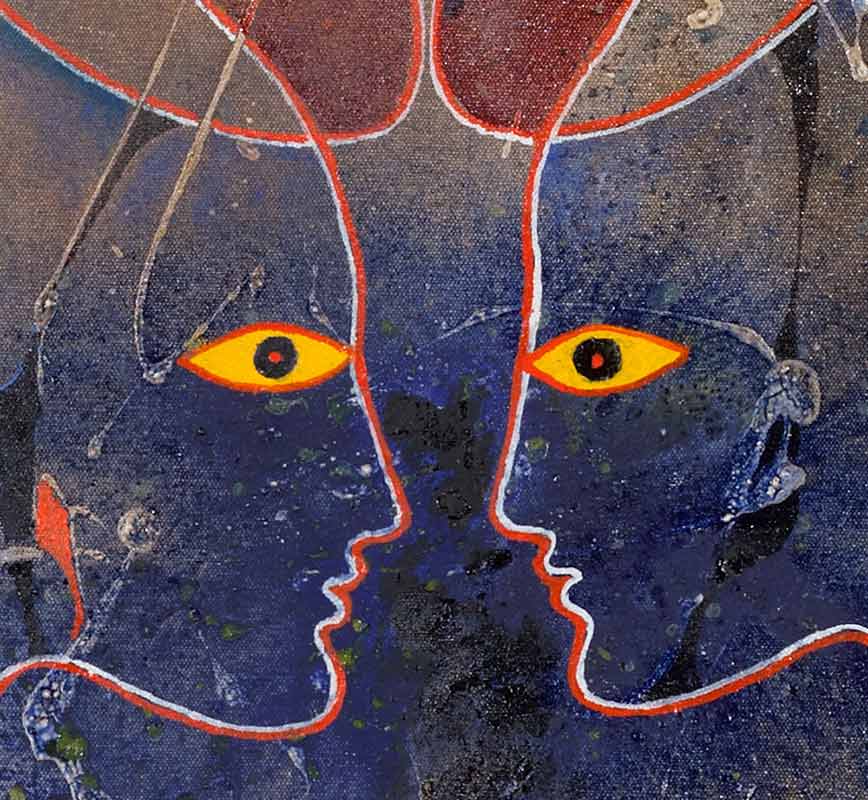
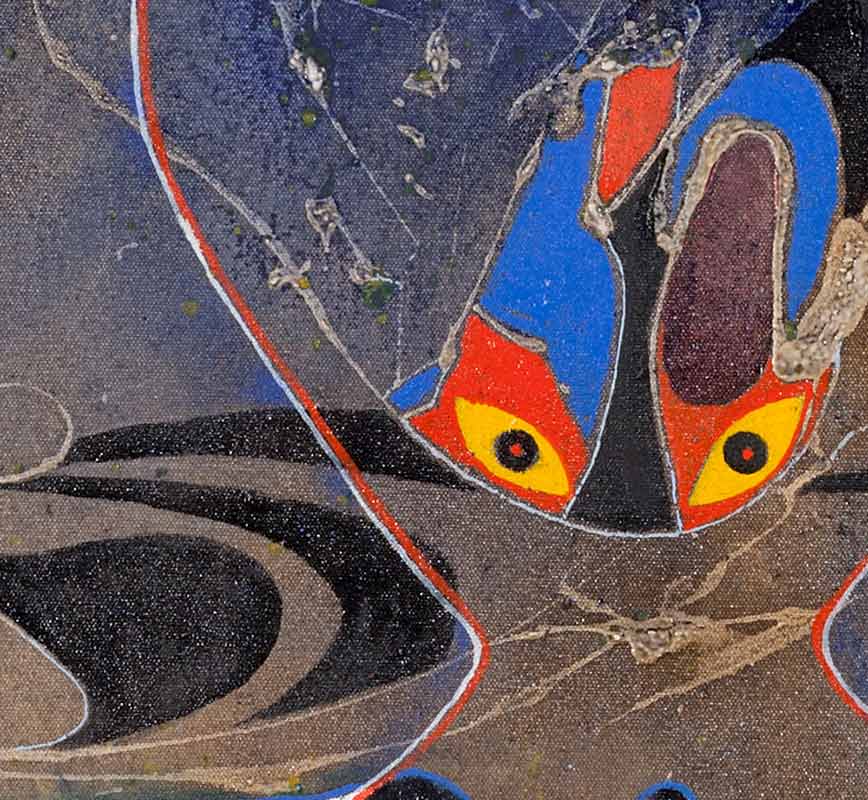
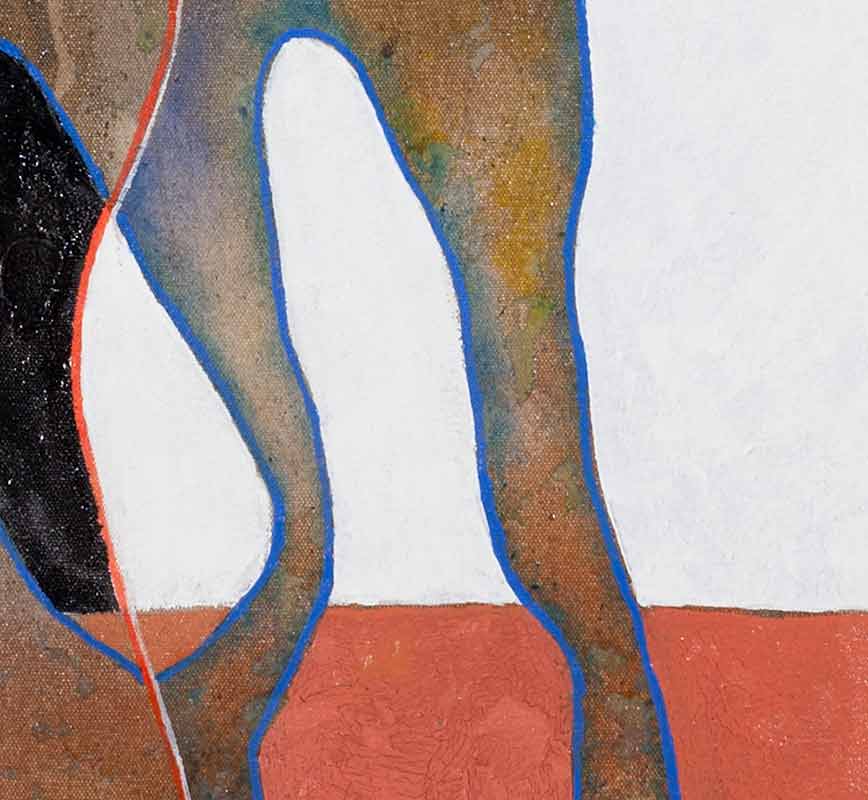
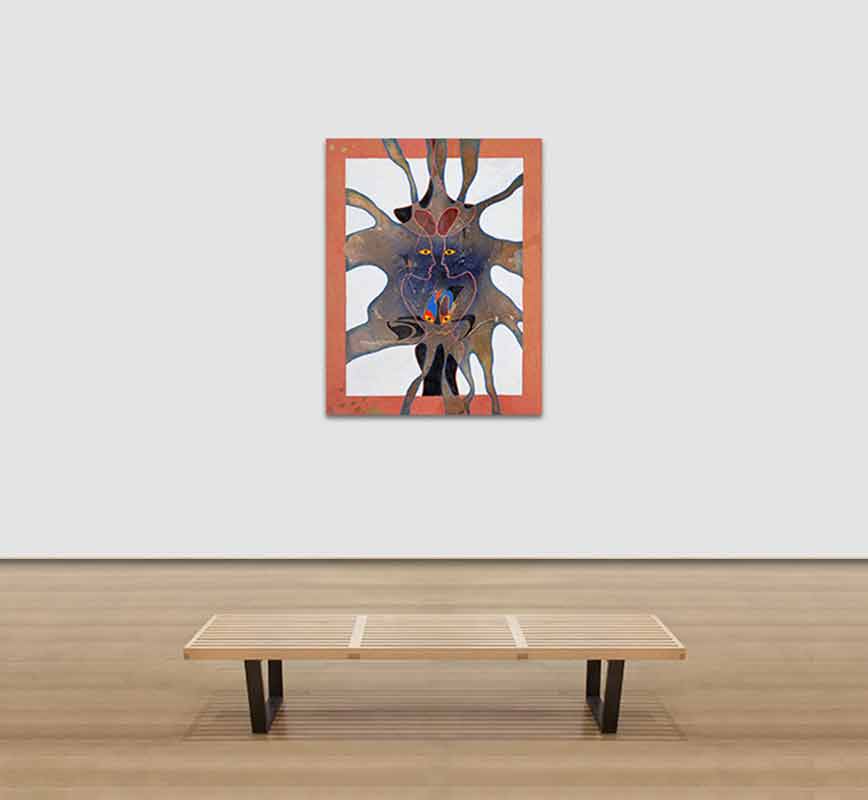
A luminous center, pale, almost blank, breathing with barely perceptible tonal variation, draws the eye through twenty-five curved biological forms that converge toward it from all sides, each carrying vivid blues, yellows, and whites within their brown masses. The convergence is not decorative: these are forms moving toward a center, organized by it, held in a gravitational relationship with it that determines their angle, their density, and their distance from the void at the composition's heart.
A luminous center, pale, almost blank, breathing with barely perceptible tonal variation, draws the eye through twenty-five curved biological forms that converge toward it from all sides, each carrying vivid blues, yellows, and whites within their brown masses. The convergence is not decorative: these are forms moving toward a center, organized by it, held in a gravitational relationship with it that determines their angle, their density, and their distance from the void at the composition's heart.
Rudolf Arnheim's The Power of the Center (1982), the only book Vanni named as a formal intellectual authority for a specific work in his documented statements, provides the theoretical framework. Arnheim argued that the center of a visual field exercises a specific gravitational force on the forms arranged around it: not merely compositional balance but a fundamental perceptual dynamic in which energy radiates outward from and is drawn inward toward the central axis simultaneously. The brown tendrils are both organized by the center and moving toward it, their convergence creating the tension between centripetal pull and centrifugal resistance that Arnheim identified as the organizing principle of visual composition.
The work carries the designation soffitto, ceiling painting, without fixed gravitational orientation, which transforms the central void into an omnidirectional source rather than an upward or downward force. The intricate biological marks along the outer perimeter, richly detailed and internally varied, recall the ornamental logic of Art Nouveau in their density and commitment to biological form as the source of decorative pattern; but where Art Nouveau ornament serves a decorative function, these forms serve a spatial one: they are the dense perimeter against which the emptiness of the center is defined.