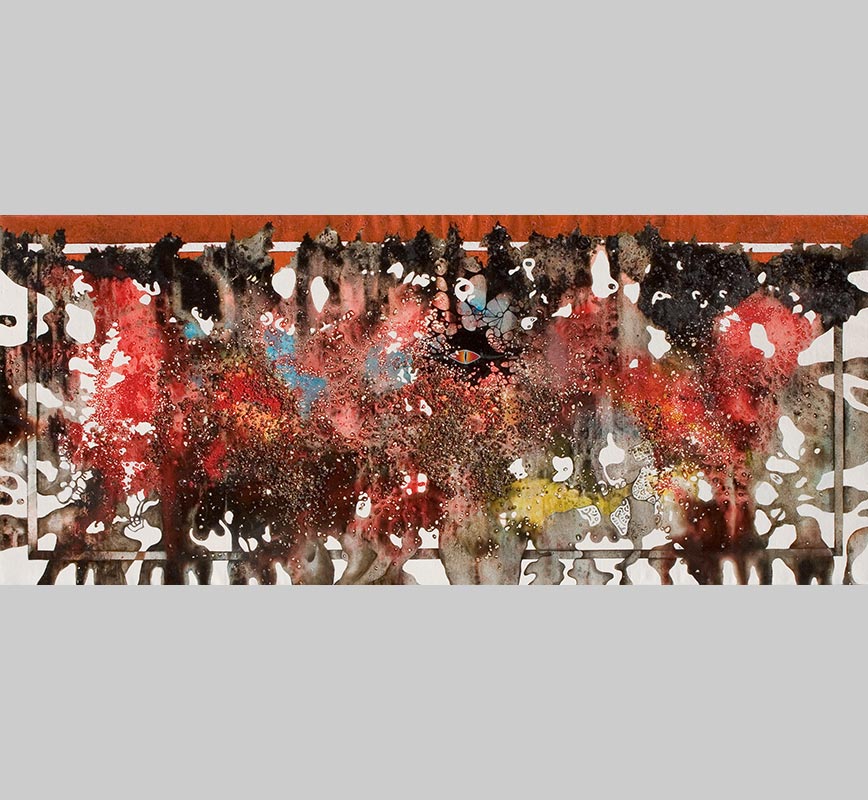
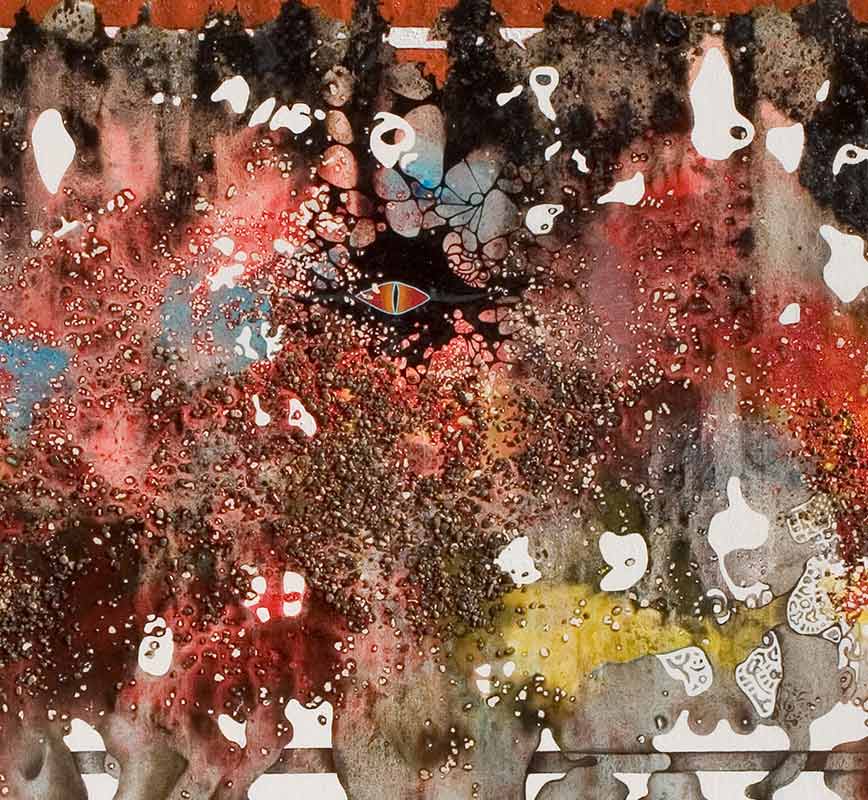
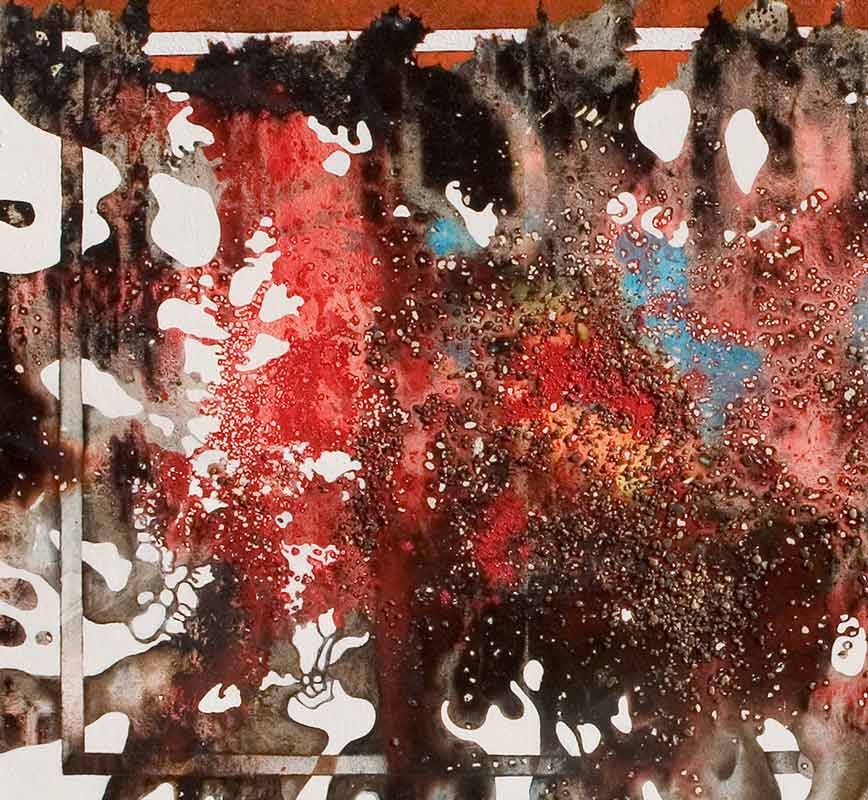
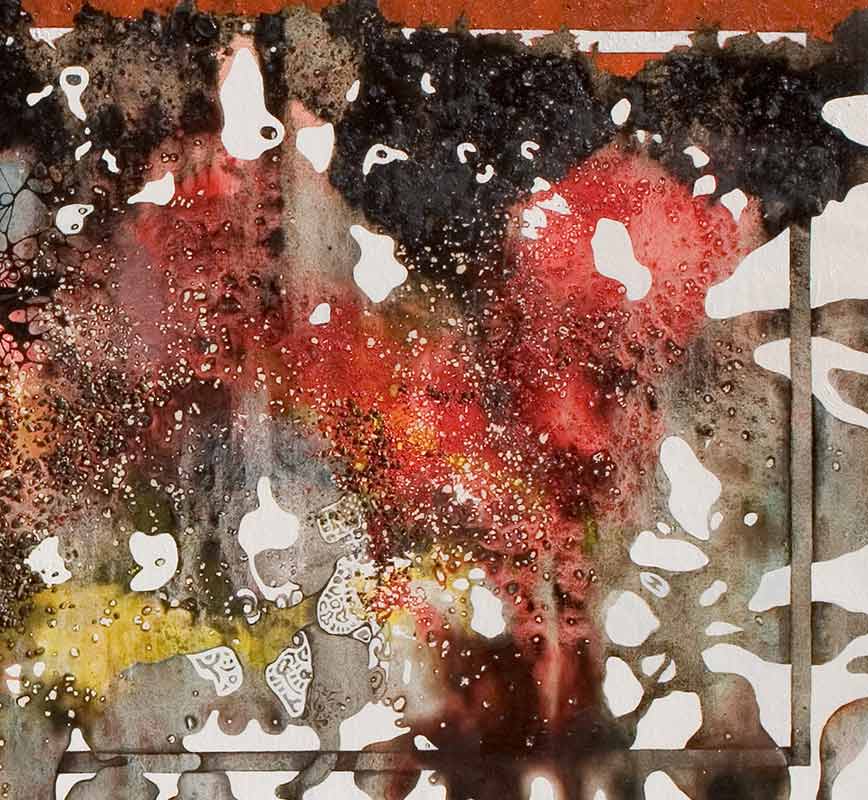
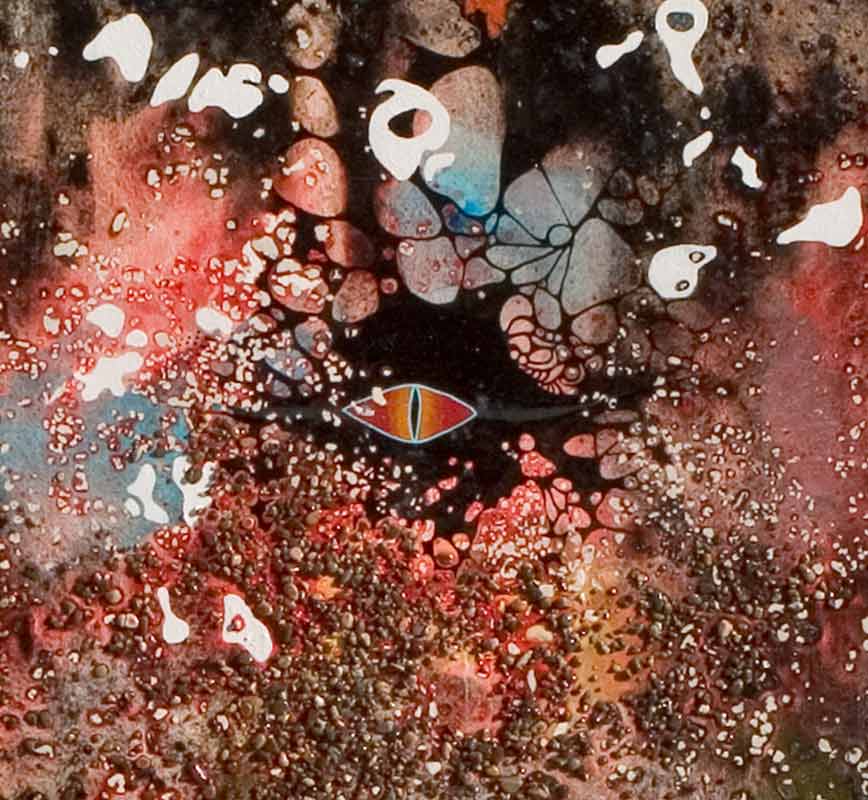
Two large organic forms face each other across the vertical axis of this tall canvas: earthy and stone-like in texture, their contours working against the white ground in deep red and black. They are not symmetrical, but they rhyme; each carries the marks of biological process, the granular and pitted surfaces, the small polychrome events embedded in the texture, without declaring themselves as anything identifiable. Between them, a vertical aperture opens, and within it: a rainbow, a band of pure spectral sequence.
Two large organic forms face each other across the vertical axis of this tall canvas: earthy and stone-like in texture, their contours working against the white ground in deep red and black. They are not symmetrical, but they rhyme; each carries the marks of biological process, the granular and pitted surfaces, the small polychrome events embedded in the texture, without declaring themselves as anything identifiable. Between them, a vertical aperture opens, and within it: a rainbow, a band of pure spectral sequence.
The title is the most precise critical description in the painting's record: curvilinear is not a subject but a formal principle, the governance of contour by curve rather than by angle. The two biomorphic forms are entirely curvilinear; the rainbow band within the aperture is entirely rectilinear. The painting's argument is the dialogue between these two formal regimes, held in suspension without resolution. The white ground is not empty: it is the field against which the two systems define themselves in relation to each other and to the void between them.
The forms carry a quality of bodily inevitability: their contours look as though they could not have been otherwise, as though any alternative configuration would have been a violation of some structural imperative within the material. This is the same formal necessity that Henry Moore pursued in large organic forms held in perpetual dialogue with the open spaces they create and contain. The material character differs fundamentally: where Moore's bronzes are cast from without, these forms feel dredged from within, their granular geological texture the evidence of an organic process working its way to the surface rather than a sculptor imposing shape from outside.