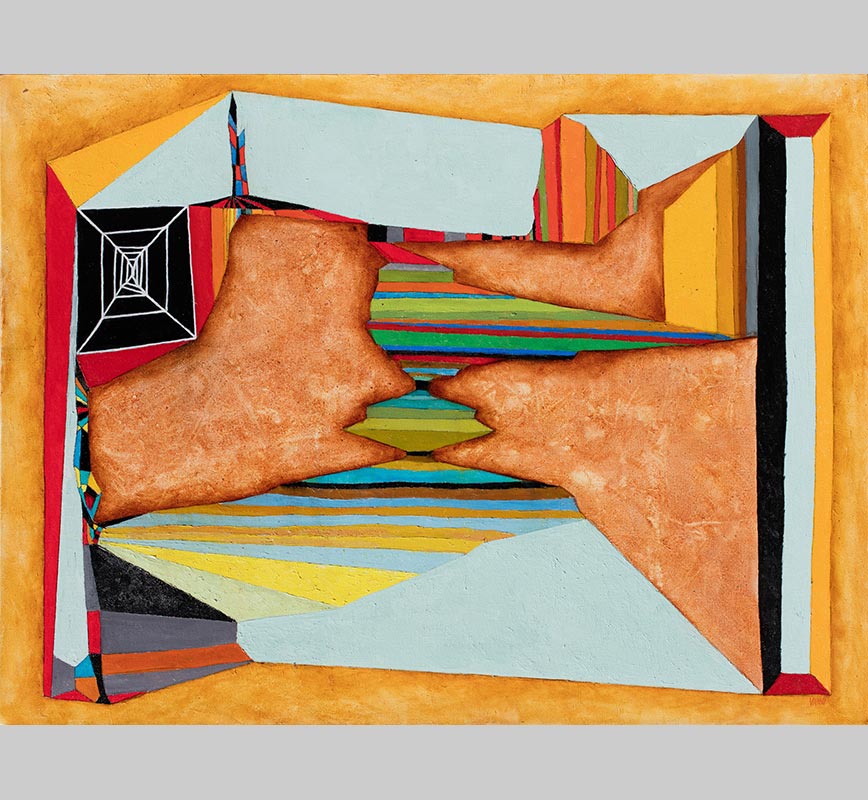
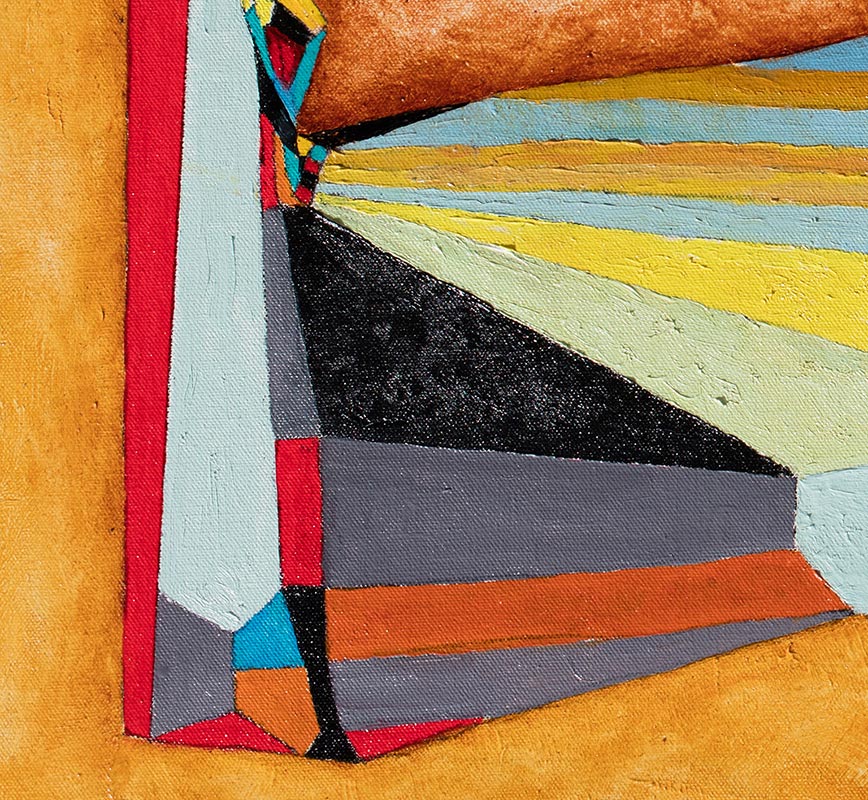
Eyes are everywhere. The hundred-eyed giant Argos inhabits this canvas not as a depicted figure but as a formal principle: the eye-forms distributed throughout Vanni's New York work cluster here with a density and deliberateness that cannot be accidental. They look outward from every register of the composition, from the upper zones in paired symmetry, from the middle section in concentrated rings, from the lower field in smaller scattered placements. The effect is of a field of consciousness: omnidirectional, inexhaustible.
Eyes are everywhere. The hundred-eyed giant Argos inhabits this canvas not as a depicted figure but as a formal principle: the eye-forms distributed throughout Vanni's New York work cluster here with a density and deliberateness that cannot be accidental. They look outward from every register of the composition, from the upper zones in paired symmetry, from the middle section in concentrated rings, from the lower field in smaller scattered placements. The effect is of a field of consciousness: omnidirectional, inexhaustible.
The composition shares the bilateral structure of its companion work, painted in the same year from the same formal premise: two mythological figures of Greek tradition, each defined by an excessive property, each mapped onto a vertical axis and organized in bilateral symmetry. Where the companion carries the hybrid logic of labyrinthine space, Argos carries the omniscient logic of the panoptic gaze. The chromatic vocabulary differs accordingly: where the companion's reds carry the urgency of blood and fire, this palette moves through yellows, blues, purples, and golds with the quality of variegated watching rather than concentrated force.
The vertical axis organizes a field of symbolic forms into a cosmological statement: the symmetry is not decorative but structural, a claim about the nature of omniscient vision as a formal and not merely mythological property. This is the same principle that Hilma af Klint employed, the vertical axis as the spine of a spiritually charged field. The position from which this work makes the same argument differs entirely: not theosophical but archaeological, grounded in the Greek mythological visual culture that Vanni absorbed through decades of direct engagement with the Mediterranean world. The title carries a double implication: Argos Panoptes, the many-eyed guardian, and Argos the ship on which Jason sailed. Both involve watching; both involve a journey. The painting holds both.