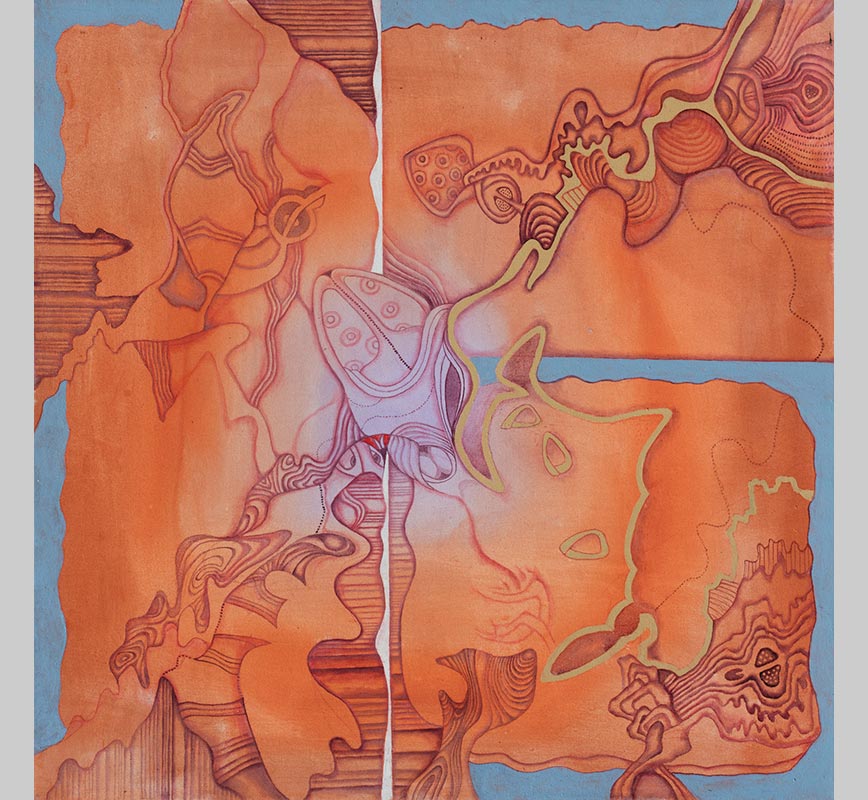
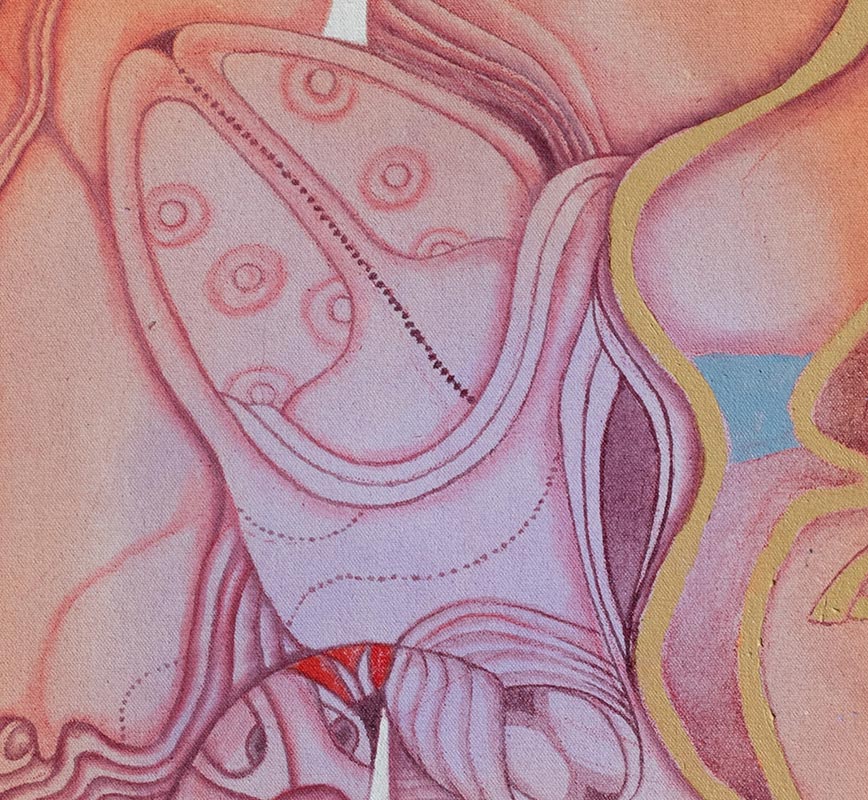
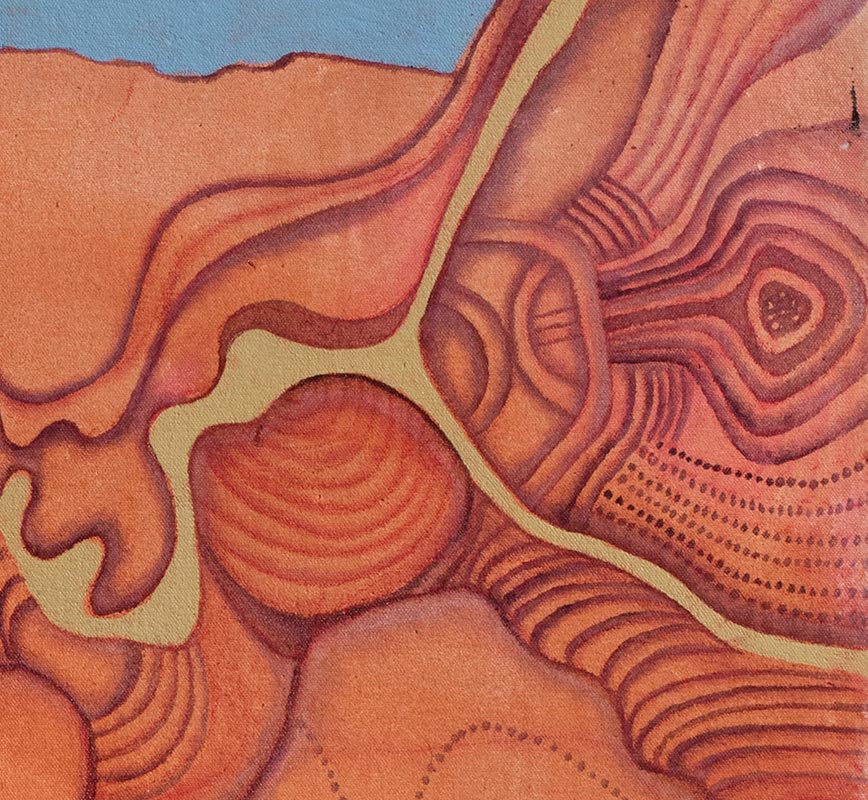
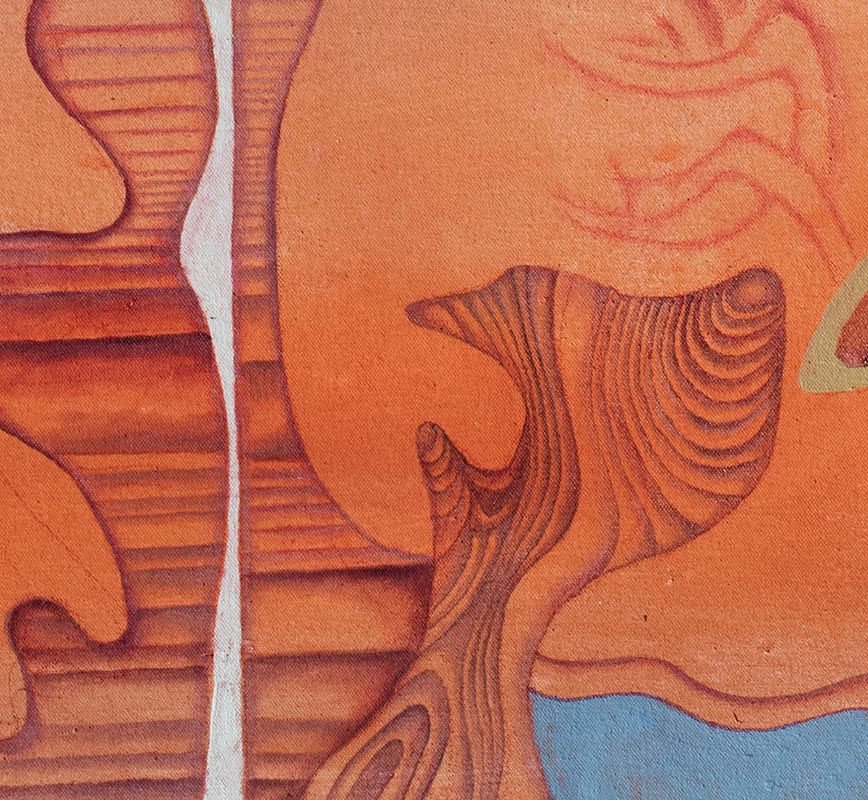
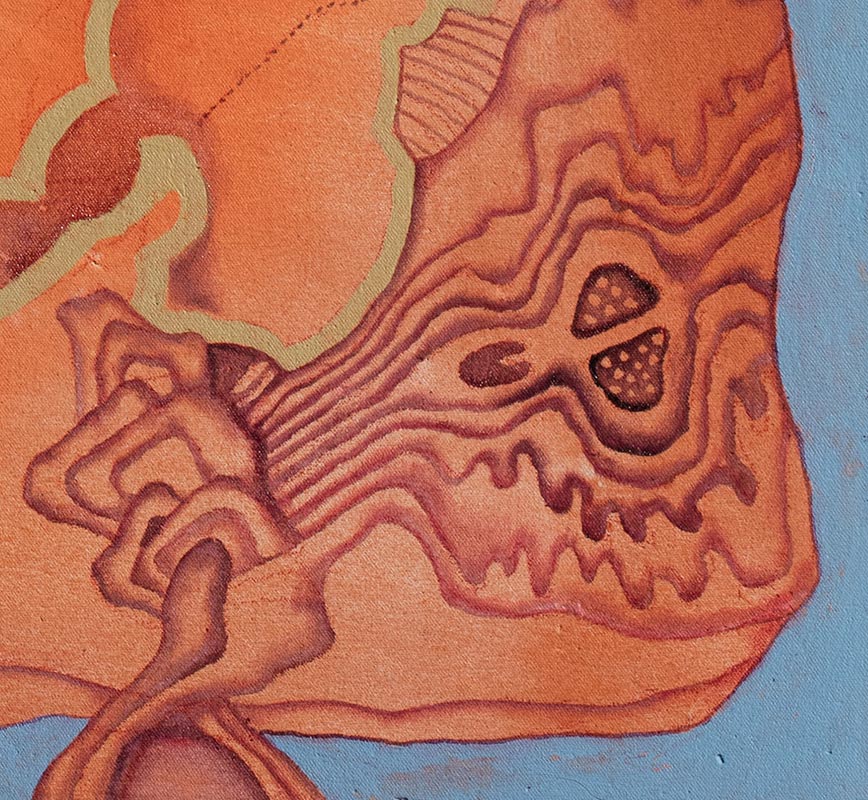
The canvas is divided between two visual worlds that are trying, formally, to become one. At lower left, a field of peach-red geological matter: rough, textured, splashed with dark marks. Through the center, rising on a diagonal from this earthy base, an ascending form of extraordinary chromatic intensity: blues, teals, yellows, and oranges packed into a sinuous column, each section internally complex, the whole reading as growth. At lower right, pale geometric fragments cascade downward, as if a prior order is falling away.
The canvas is divided between two visual worlds that are trying, formally, to become one. At lower left, a field of peach-red geological matter: rough, textured, splashed with dark marks. Through the center, rising on a diagonal from this earthy base, an ascending form of extraordinary chromatic intensity: blues, teals, yellows, and oranges packed into a sinuous column, each section internally complex, the whole reading as growth. At lower right, pale geometric fragments cascade downward, as if a prior order is falling away.
The geometric fragments descending at lower right are not incidental: they establish the formal argument of the canvas. Something geometric and prior is being displaced by something organic and ascending. The painting does not resolve this tension; the two systems coexist in the same field, each operating according to its own logic, neither subordinate. Multiple formal assumptions, often in contradiction with each other, held in productive equilibrium: this is the documented governing principle of Vanni's mature New York practice, and this canvas makes it visible at the level of compositional structure rather than color or surface alone.
The ascending central column presses upward with an insistence that makes it feel structural rather than observed: this is biological growth as a formal argument, the logic of a colony expanding against resistance rather than the logic of illustration. This is the same territory that Paul Klee mapped at the intersection of natural morphology and pictorial structure, though his version was lyrical and intimate. This form is not lyrical: it drives through the geological field from which it emerges with a weight Klee rarely sought. The childhood hours spent observing micro-organisms in his father's parasitology laboratory, watching colonies form and dissolve, gave Vanni a visual grammar in which biological growth and geological accumulation are not merely analogous but formally identical.