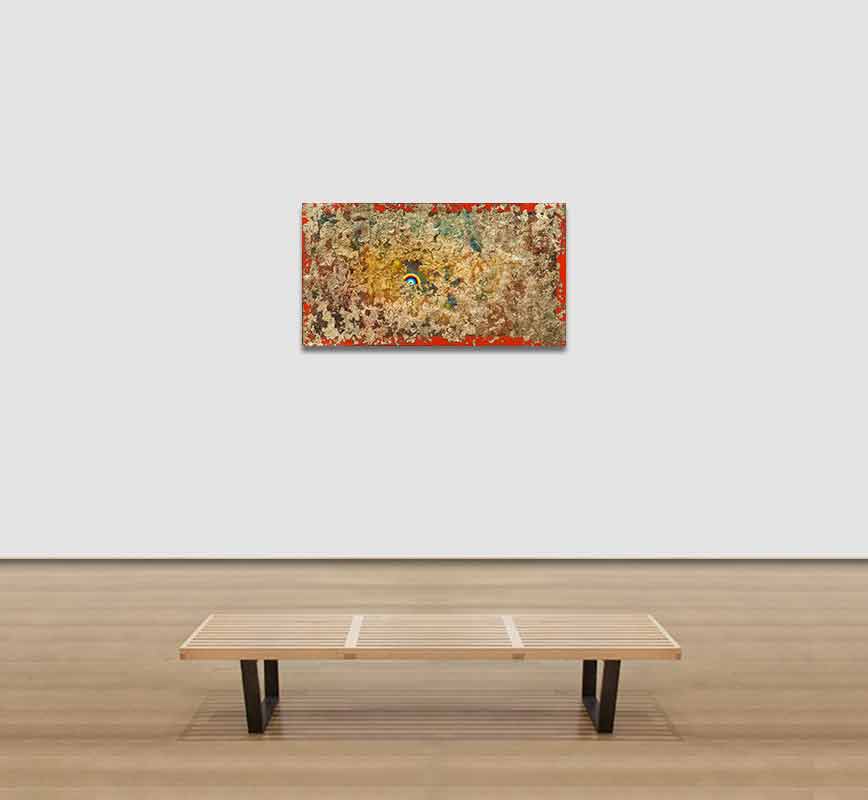
Red dominates, but red of many kinds: the dark red of old blood at the lower margins, the vivid crimson of the central vascular forms, the lighter pinks where the bilateral symmetry opens to reveal interior spaces. The composition is vertical and strictly symmetrical, organized on an axis that runs through a form both tree-like and body-like, its branching structure carrying blues, yellows, and whites. At the base, two large pale forms emerge like hooves or roots, ancient, calm.
Red dominates, but red of many kinds: the dark red of old blood at the lower margins, the vivid crimson of the central vascular forms, the lighter pinks where the bilateral symmetry opens to reveal interior spaces. The composition is vertical and strictly symmetrical, organized on an axis that runs through a form both tree-like and body-like, its branching structure carrying blues, yellows, and whites. At the base, two large pale forms emerge like hooves or roots, ancient, calm.
The Minotaur is the most hybrid of Greek mythological figures: half human, half bull, housed in a structure, the Labyrinth, that is itself a formal argument about the impossibility of linear progress through complex space. Vanni refuses the narrative in favor of the structural: the painting does not depict the creature but enacts its formal premise, organizing a complex field of biological and geological forms in bilateral symmetry that maps the labyrinth's logic onto a single vertical axis. The eye-forms distributed across the composition, concentric rings in teal, blue, and black, are his consistent marker for inhabited intelligence. On the Minotaur, they make the argument that the creature is not monstrous but aware: its hybrid nature is not a failure of form but a different kind of coherence.
The bilateral logic carries a psychological depth that the eye-forms intensify: each concentric ring at the axis of symmetry makes the composition feel inhabited from within by a consciousness that the formal structure only partially contains. This is the same weight that Max Ernst found the symmetrical vertical axis capable of bearing, building totemic structures from mythological and biological imagery without narrative illustration. The difference here is temperature: where Ernst's mythological constructions are cool, inventoried, surrealist in their clinical precision, this is a painting at blood heat, urgent, physically present, organized by the same forces that organize the body from within.