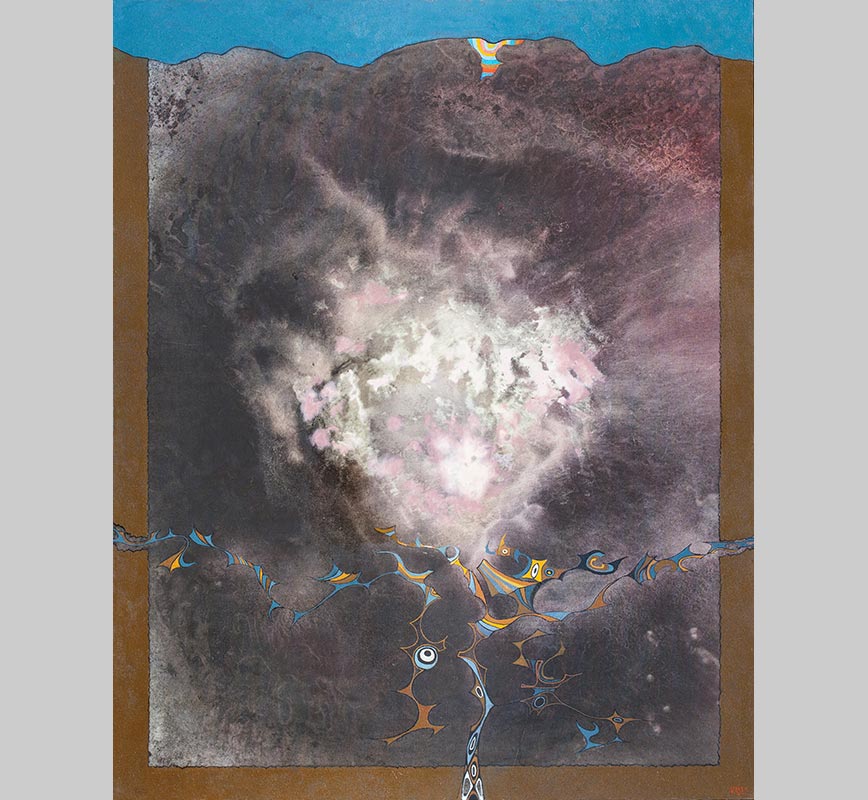
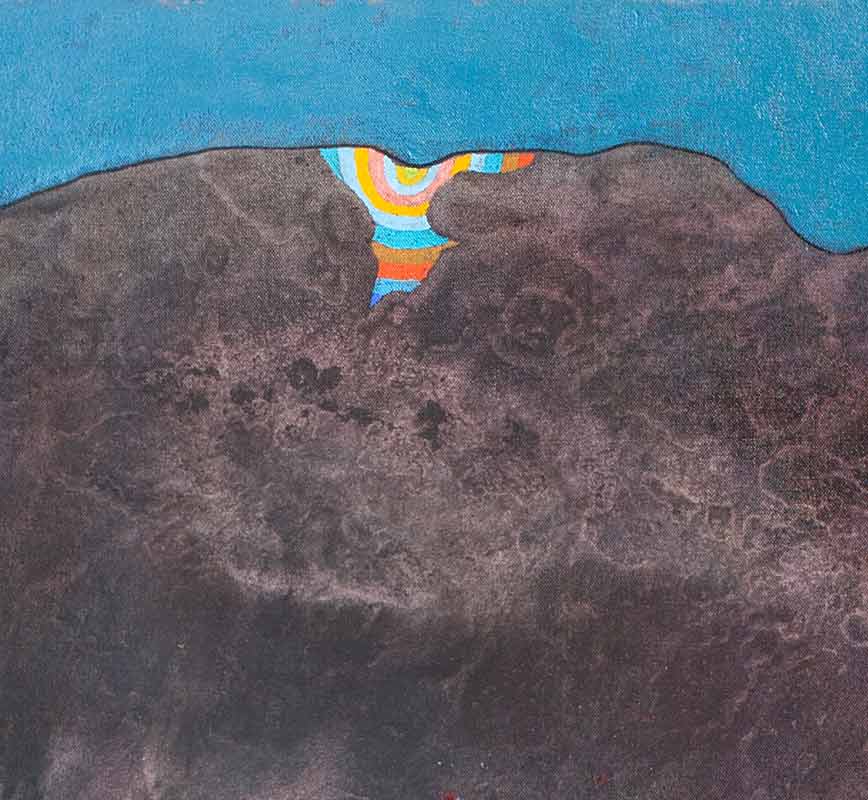
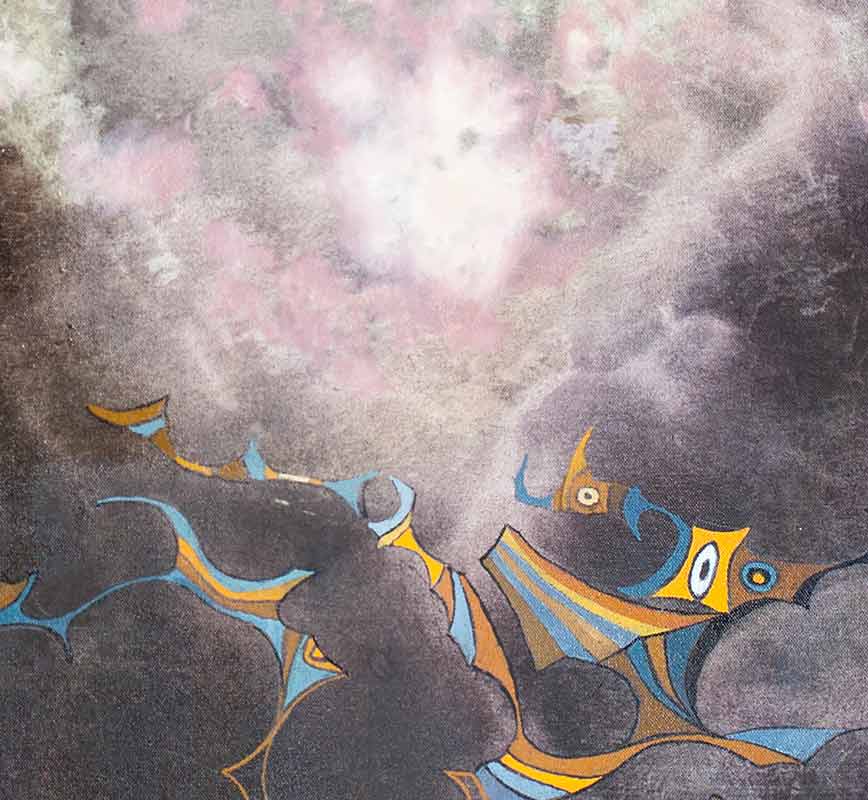
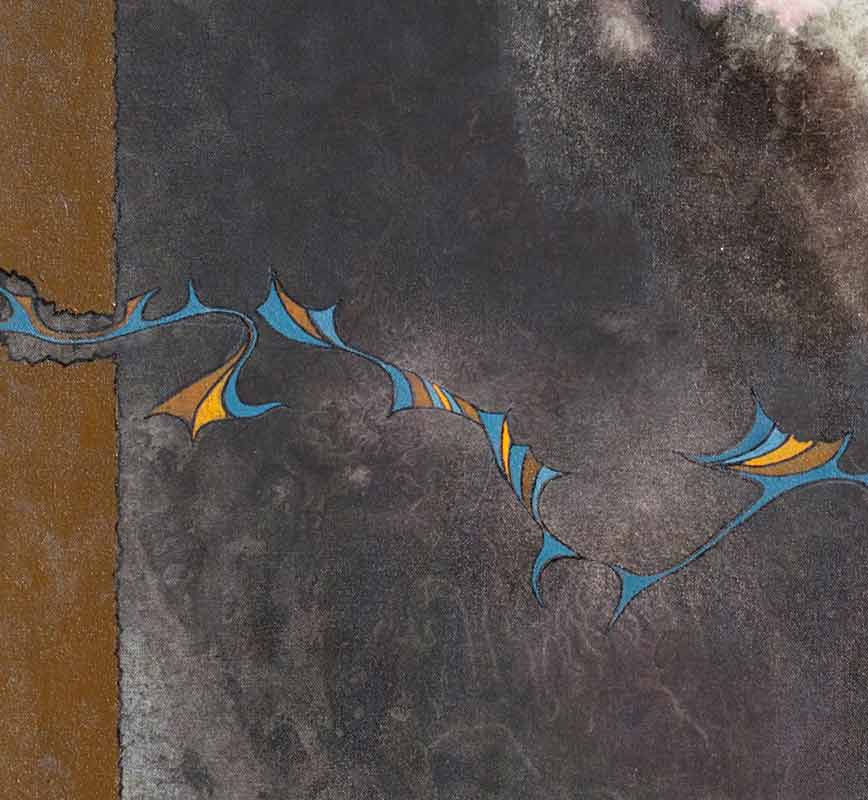
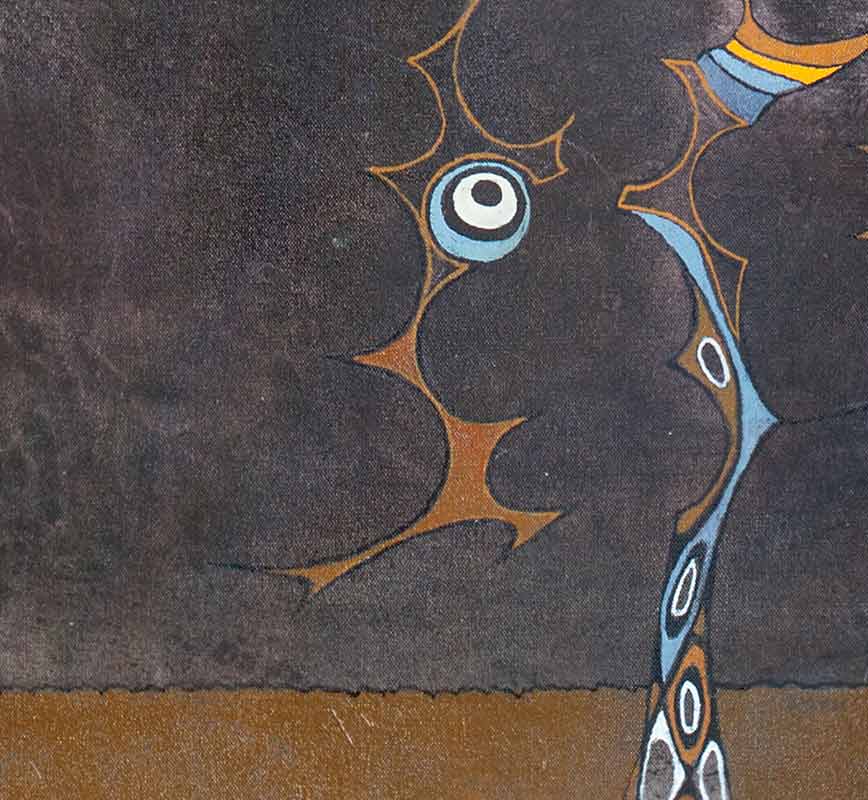
Something is happening at the center of this painting that the earthy field surrounding it cannot contain. A dense formation of vivid blue, simultaneously deep water, cellular colony, and neural structure, pushes against the warm rust-and-orange ground. Electric blue lines weave outward from this central event like filaments: part biological process, part cartographic notation. The muted warm field frames it in the manner of a painted cornice, making the interior event feel like a discovery rather than a display.
Something is happening at the center of this painting that the earthy field surrounding it cannot contain. A dense formation of vivid blue, simultaneously deep water, cellular colony, and neural structure, pushes against the warm rust-and-orange ground. Electric blue lines weave outward from this central event like filaments: part biological process, part cartographic notation. The muted warm field frames it in the manner of a painted cornice, making the interior event feel like a discovery rather than a display.
Vanni was a lifelong sailor and diver; the sea he knew was not the sea of landscape painting but the sea observed from within, whose forms, coral architectures, pelagic organisms, thermal stratifications, and the specific darkness of depth, became material for a visual vocabulary rooted as much in physical experience as in formal research. Made on Kythira, where the Mediterranean light produces spatial ambiguities that have no equivalent in northern latitudes, the palette carries that geography: the ochre of the rocky shore, the impossible blue of the Aegean at depth.
The blue formation has the spatial logic of geological survey, the depth and complexity of a landscape mapped from within rather than observed from without. This is the same grammar that Roberto Matta applied to the subconscious, though his terrain was colder and more cosmic. This one is warmer, more marine, more ambiguous about what kind of depth it is measuring.