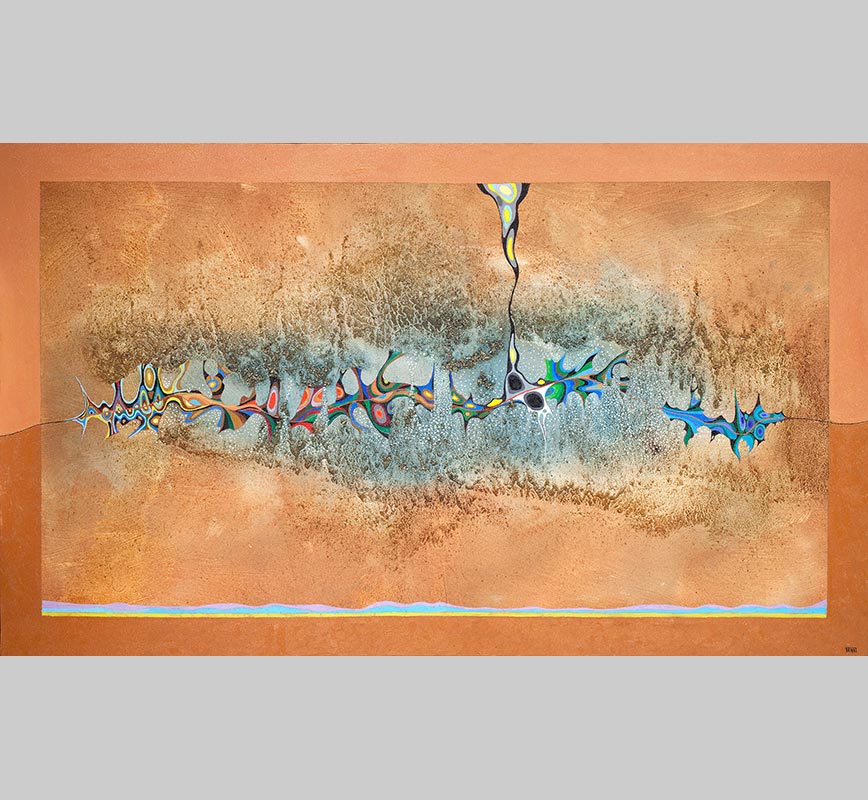
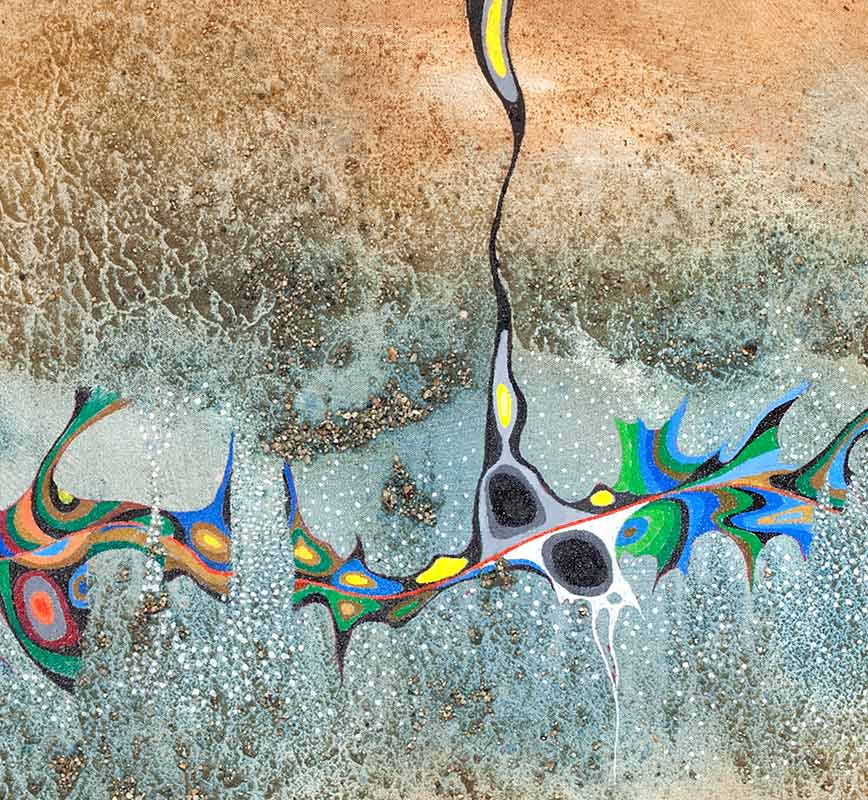
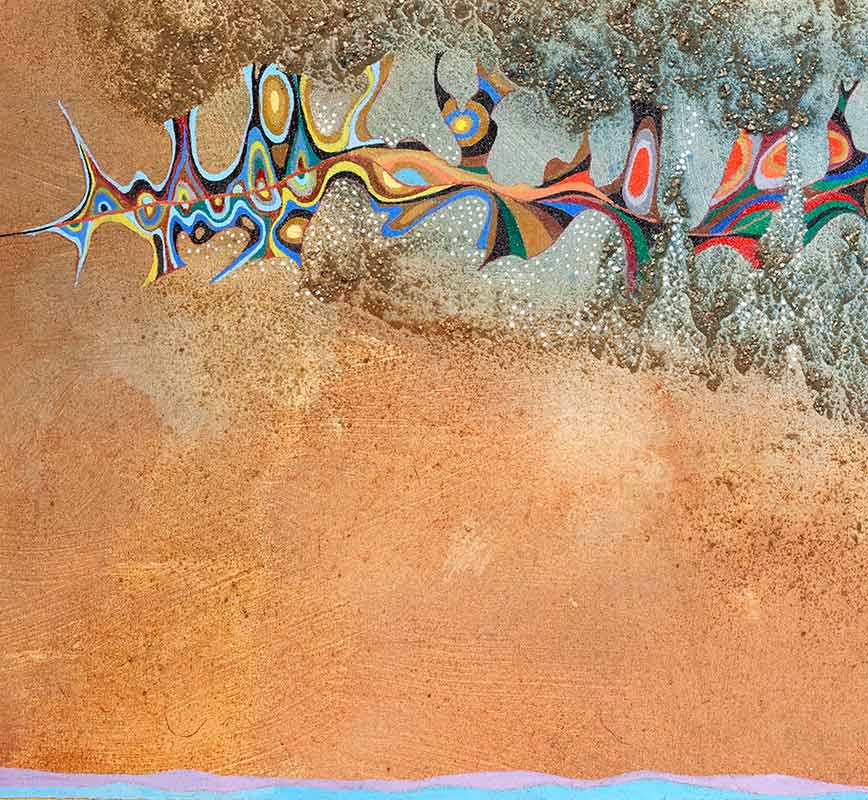
The canvas is almost entirely dark, and then it is not. Deep purples and earthy browns press in from all sides, their texture dense and striated. At the center, a luminous event: soft pinks and whites erupt in a diffuse radial formation, not yet light but already its anticipation. From below this luminosity, a tree-like form rises on the vertical axis in vivid orange, blue, and teal: organized energy moving toward the light above it.
The canvas is almost entirely dark, and then it is not. Deep purples and earthy browns press in from all sides, their texture dense and striated. At the center, a luminous event: soft pinks and whites erupt in a diffuse radial formation, not yet light but already its anticipation. From below this luminosity, a tree-like form rises on the vertical axis in vivid orange, blue, and teal: organized energy moving toward the light above it.
The dark perimeter is the containing boundary, making the luminous center a painting within the painting, a space of different properties made visible through the dark matter that surrounds it. This is the sforo su altro spazio, the aperture onto another spatial register, operating as atmospheric event rather than architectural device. The question the painting poses without answering: whether the luminous center is the real space and the dark surround the illusion, or whether we are watching the dark gradually give way to what it has been concealing.
The dark perimeter does not merely contain the luminous center: it generates it, the dense geological matter creating the conditions for the light to feel discovered rather than displayed. This is the emotional territory that Caspar David Friedrich mapped, in compositions where sky at the horizon or light through leaves is contained by dark framing matter. Friedrich's dark frame is naturalistic; this one is geological, and the difference matters: where Friedrich positions his viewer before a landscape, this painting makes the viewer feel the pressure from within the material itself.