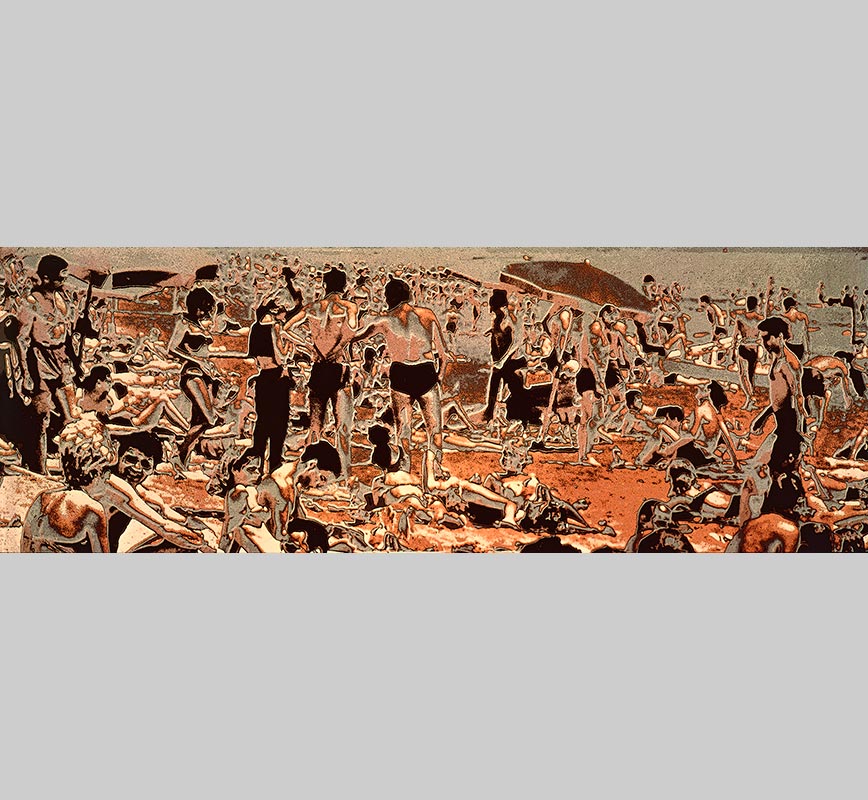
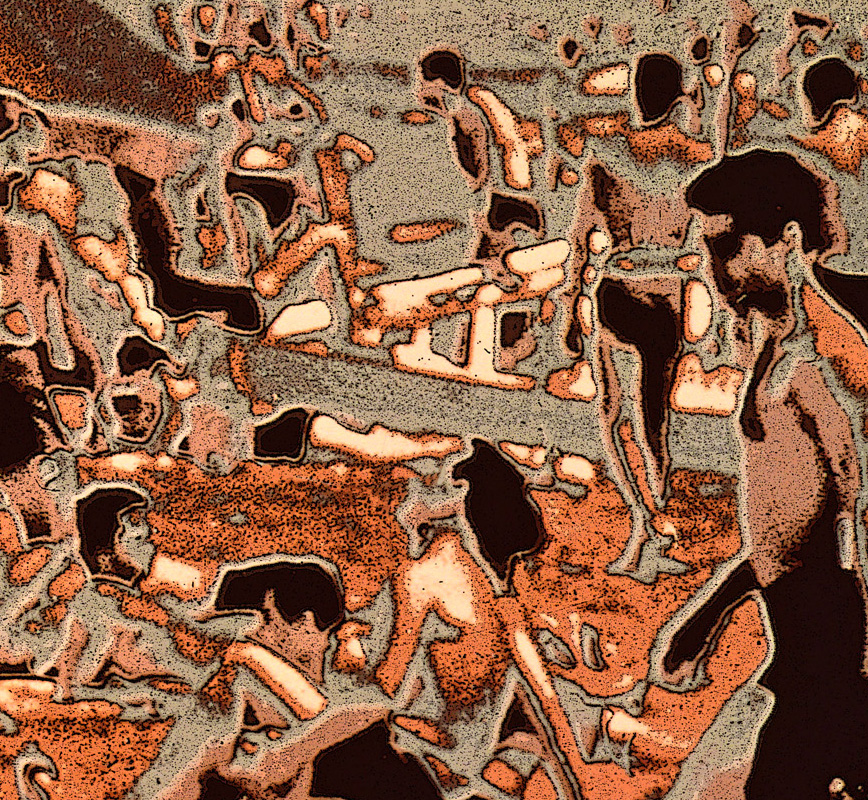
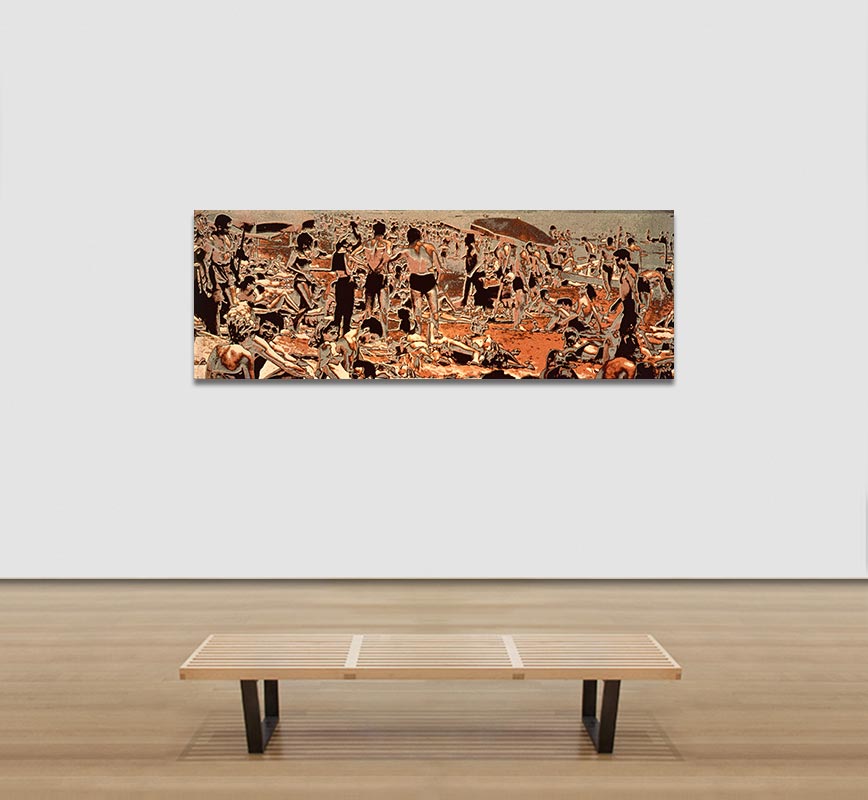
A sea of bodies stretches across a summer beach, and Enzo Ragazzini has done something to them: their forms flatten and glow, the tonal world reverses at its edges, and what was a documentary photograph becomes something closer to a field of drawn marks. The warmth of ochre, sandy earth, and deep shadow still reads as heat, as midday, as crowd, but the image has crossed a threshold. This is solarization, not as stylistic gesture but as perceptual shift, performed entirely in the darkroom without a single digital tool.
A sea of bodies stretches across a summer beach, and Enzo Ragazzini has done something to them: their forms flatten and glow, the tonal world reverses at its edges, and what was a documentary photograph becomes something closer to a field of drawn marks. The warmth of ochre, sandy earth, and deep shadow still reads as heat, as midday, as crowd, but the image has crossed a threshold. This is solarization, not as stylistic gesture but as perceptual shift, performed entirely in the darkroom without a single digital tool.
The technique has a precise genealogy. Before Ragazzini was a photographer he worked at a lithography company in Faenza, handling serigraphy, photomechanical materials, and high-contrast emulsion: the industrial graphic processes that taught him how light and chemistry behave at their limits. When he carried those instincts into the darkroom in the late 1950s, double solarization, exposing the developing print to controlled light in two successive passes to partially invert its tones and produce halo-like outlines at tonal boundaries, was a discovery made from inside the material rather than from knowledge of what anyone else was doing. Man Ray had prized the Sabatier effect because it produced something that no longer looked like photography: closer to drawing, closer to the hand the medium normally conceals. Ragazzini arrived at the same conclusion independently, and the beach crowd becomes an interlocking field of graphic forms that the eye reads as rhythm before it reads as bodies.
The photograph was commissioned for a large-scale mural in the Italian pavilion at the XIII Milan Triennial in 1963, dedicated to the theme of Leisure Time. The exhibition design won the International Grand Prix and was led by Gae Aulenti, the architect who would later transform the Gare d'Orsay in Paris into the Musée d'Orsay. It was the first major institutional recognition that Ragazzini's photomechanical invention had moved beyond the darkroom and into the public architecture of culture.