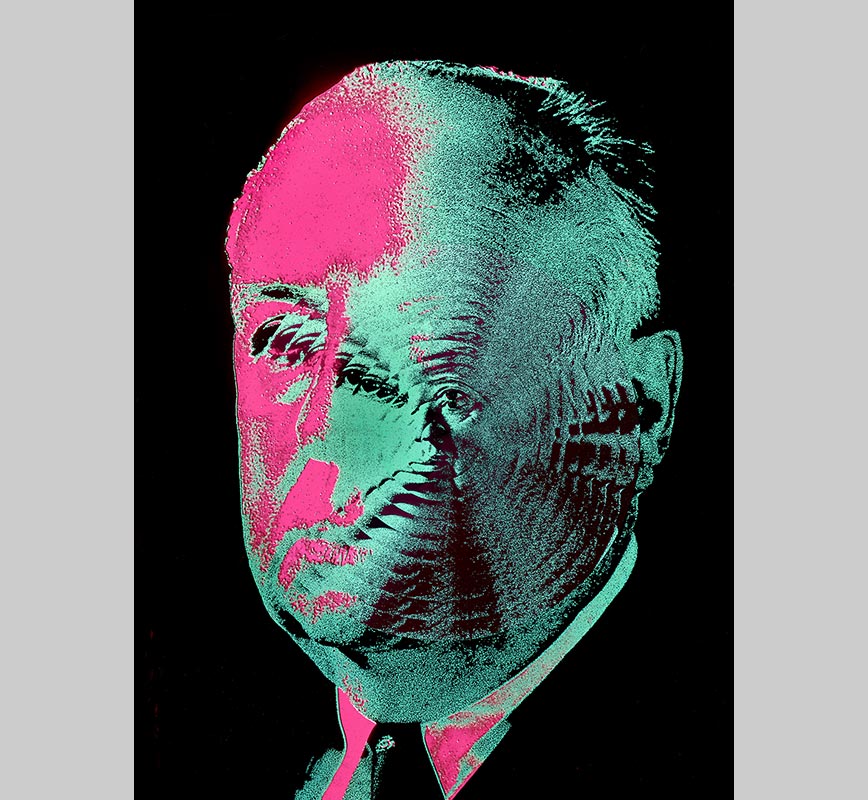
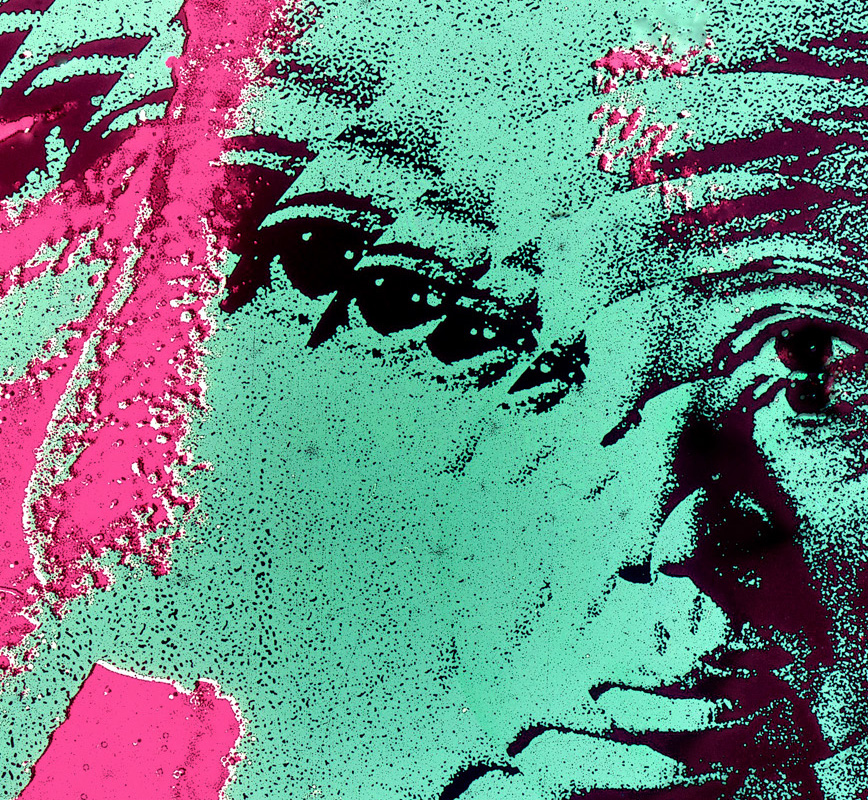
When I'm Sixty-Four - Perceptual Modulation IV, 1969
Archival Giclée Pigment Print on Archival Paper
Limited Edition of 5
42 x 42 in
107 x 107 cm
US $ 6,200
This is one of the four pages Ragazzini contributed to The Beatles Illustrated Lyrics in 1969, the largest single-artist allocation in the book and the only photographic contribution to a volume otherwise dominated by illustration and painting. Assigned to "When I'm Sixty-Four," the image uses anamorphic distortion and high-contrast optical layering to transform a portrait into a study of time: the face is present but multiplied, compressed, expanded at its edges, as though aging itself had been rendered as an optical phenomenon rather than a physical one.
This is one of the four pages Ragazzini contributed to The Beatles Illustrated Lyrics in 1969, the largest single-artist allocation in the book and the only photographic contribution to a volume otherwise dominated by illustration and painting. Assigned to "When I'm Sixty-Four," the image uses anamorphic distortion and high-contrast optical layering to transform a portrait into a study of time: the face is present but multiplied, compressed, expanded at its edges, as though aging itself had been rendered as an optical phenomenon rather than a physical one.
The song is the most contemplative in the collection: a McCartney reflection on aging, domesticity, and the quiet persistence of love. Alan Aldridge, who curated the volume at the height of his involvement with the Beatles and Apple Corps, chose Ragazzini's photomechanical approach specifically for this material, recognizing that a technique which multiplies and distorts a face across time was the appropriate instrument for a lyric about what time does to a face. The selection placed a Roman photographer working in Op-Art and darkroom experimentation inside the central visual document of British psychedelic culture, not as a documentary contributor but as an artist invited to interpret a canonical text through his own lens.
The technique, concentric mask sequences applied across multiple exposures with shifting scale and focus, produces a radial distortion that pulls the face outward from its center. Ragazzini had developed this approach independently, from a formation in industrial graphic arts that preceded any knowledge of the international Op-Art world. In January 1965, four years before this commission, he had held the first entirely photographic Op-Art exhibition in Rome, concurrent with but unaware of MoMA's landmark Responsive Eye survey. By the time Aldridge came to him, the practice was already fully formed. The Beatles commission was not the making of the technique; it was the technique finding its most culturally resonant subject.