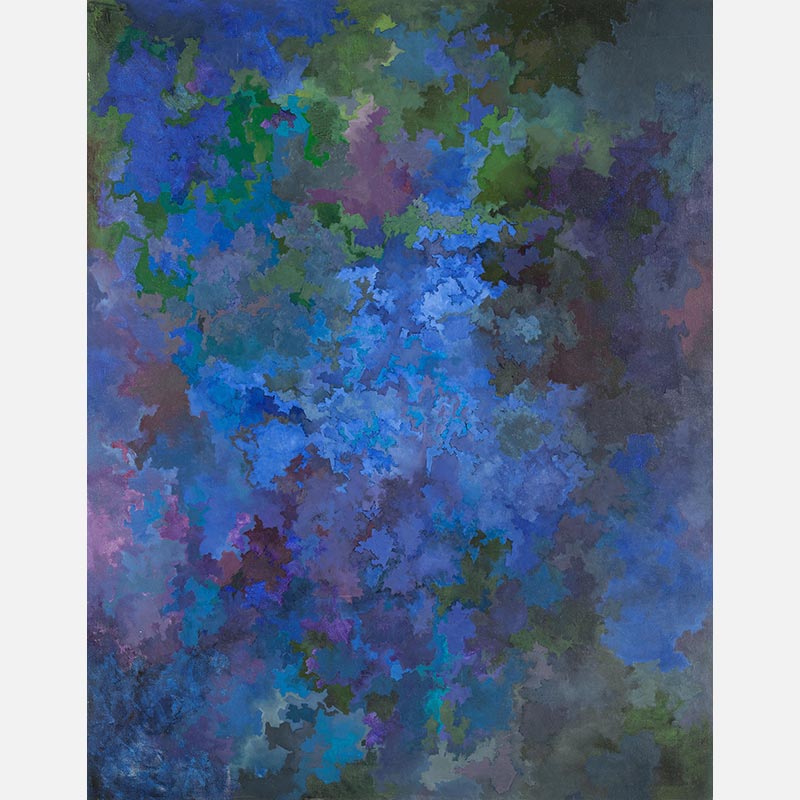
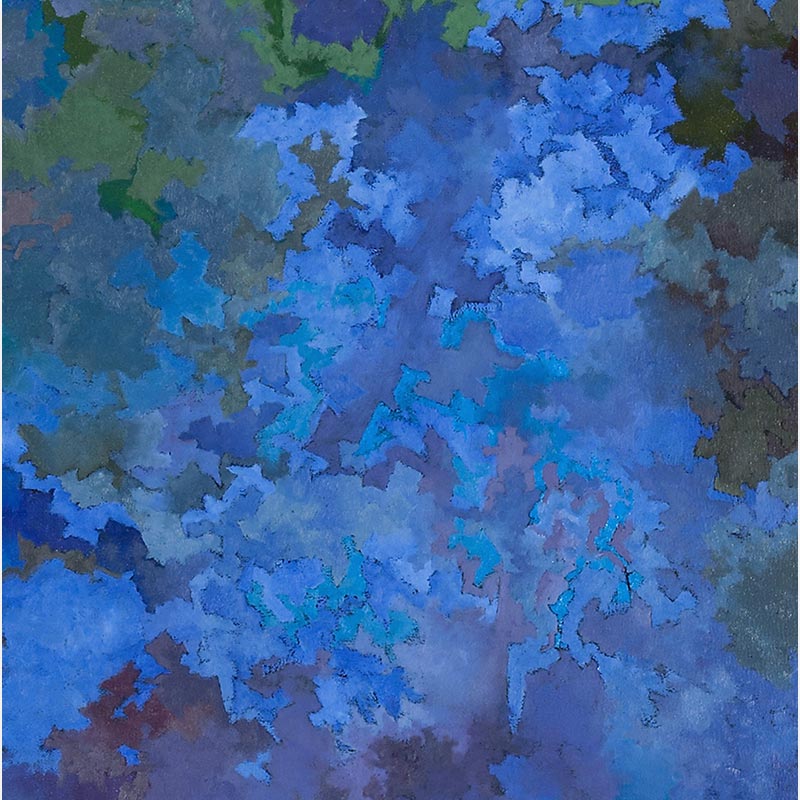
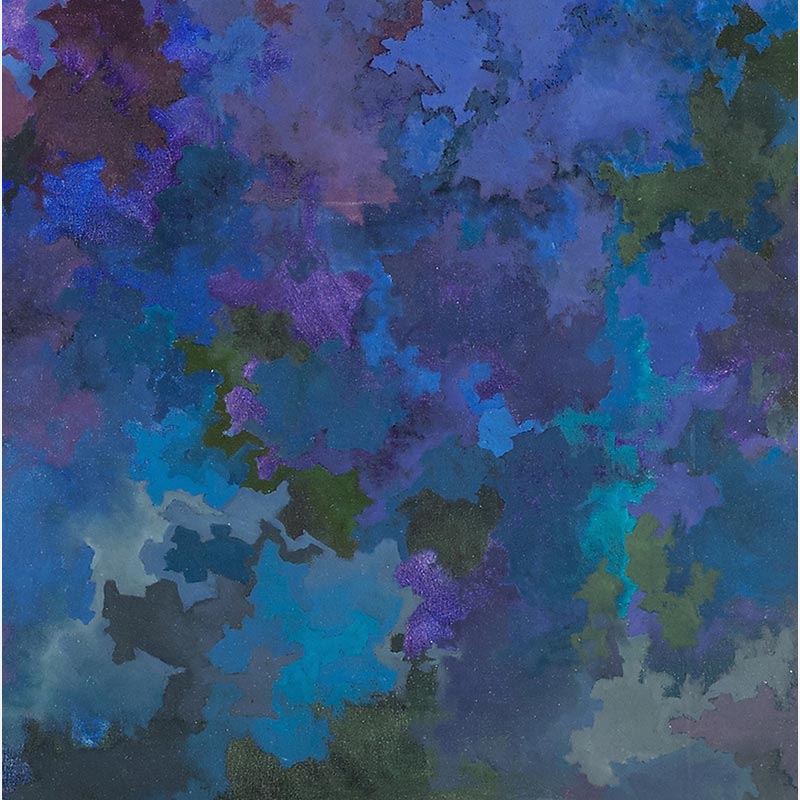
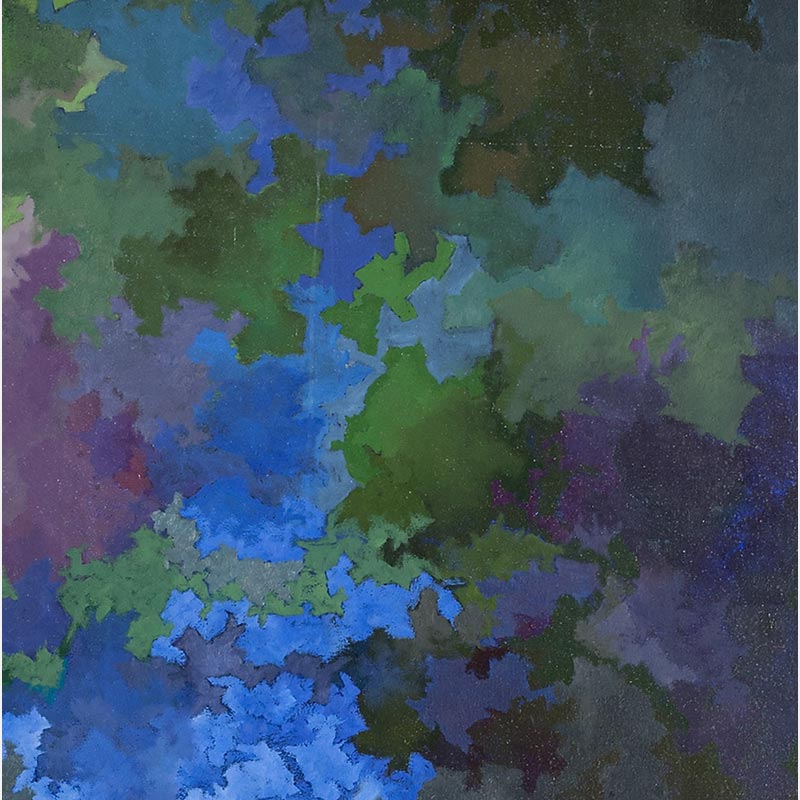
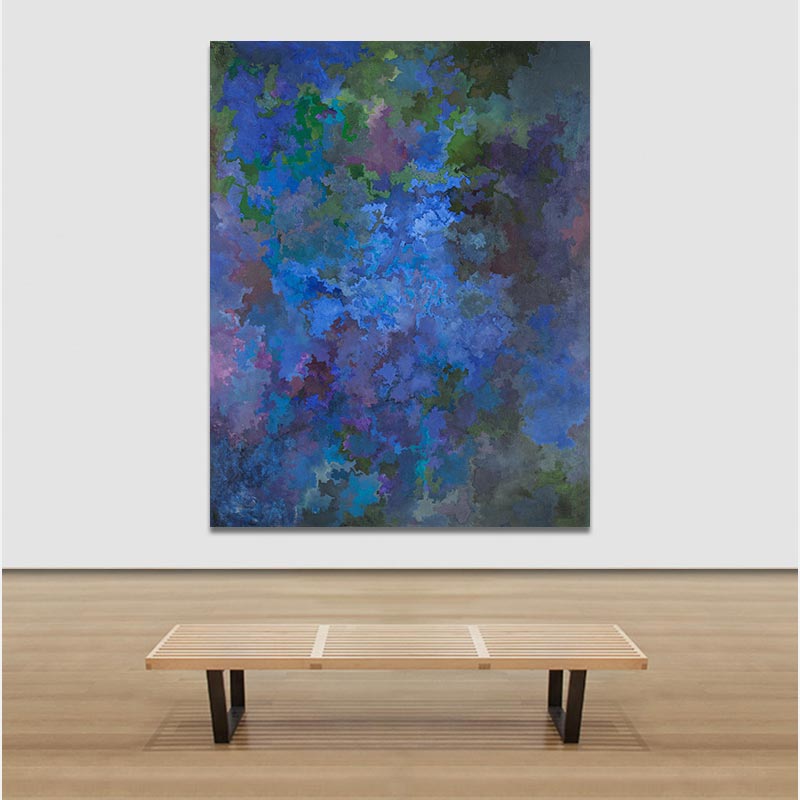
With In the Cold Light I we are fully immersed in a parallel world ruled by the blues, an underwater atmosphere surrounding rather than presenting itself. The body has no weight here, no orientation, no horizon. The eye acclimates, and we discover that those faint purples acquire the vibrancy of red corals, the muted greens the brilliance of vivid yellow algae, the whole field alive with chromatic presences no terrestrial surface could generate. A world complete in itself, sealed from above, with its own gravity and its own silence.
With In the Cold Light I we are fully immersed in a parallel world ruled by the blues, an underwater atmosphere surrounding rather than presenting itself. The body has no weight here, no orientation, no horizon. The eye acclimates, and we discover that those faint purples acquire the vibrancy of red corals, the muted greens the brilliance of vivid yellow algae, the whole field alive with chromatic presences no terrestrial surface could generate. A world complete in itself, sealed from above, with its own gravity and its own silence.
The cellular field logic as a compositional philosophy is tributary of the art of Luigi Boille, whose studio Ruggero was frequently visiting a decade before he painted this work. He absorbed the all-over organization of interlocking marks through direct proximity to the making rather than through any conscious decision. The adherence to that philosophy was not conscious in Ruggero at the time. On the contrary, when Gian Berto Vanni recognized the connection immediately in his son's work, the latter didn't see it. Forty years later, looking at this canvas, Ruggero recognized it himself. What Boille established as a compositional philosophy, a surface of mutual dependencies in which every element is defined by its neighbors, converged with what the Albers formation had already transmitted through a different channel: color as the outcome of relationships, not a property of individual pigments.
The palette is the argument. Blues, purples, and muted greens press against each other across a narrow chromatic range. Within that restriction the Albers logic operates at full intensity: surrounded by blue, purple becomes the warmest presence in the room. The cool register carries a longer consequence: this canvas is the first transposition of the red-fire atmosphere, like in the contemporaneous In the Warm Light IV acquired by the Yale University Eye Center, to a blue-ice that Ruggero would develop across the following decade. This painting is also a precursor of the non-directional paintings that would follow.