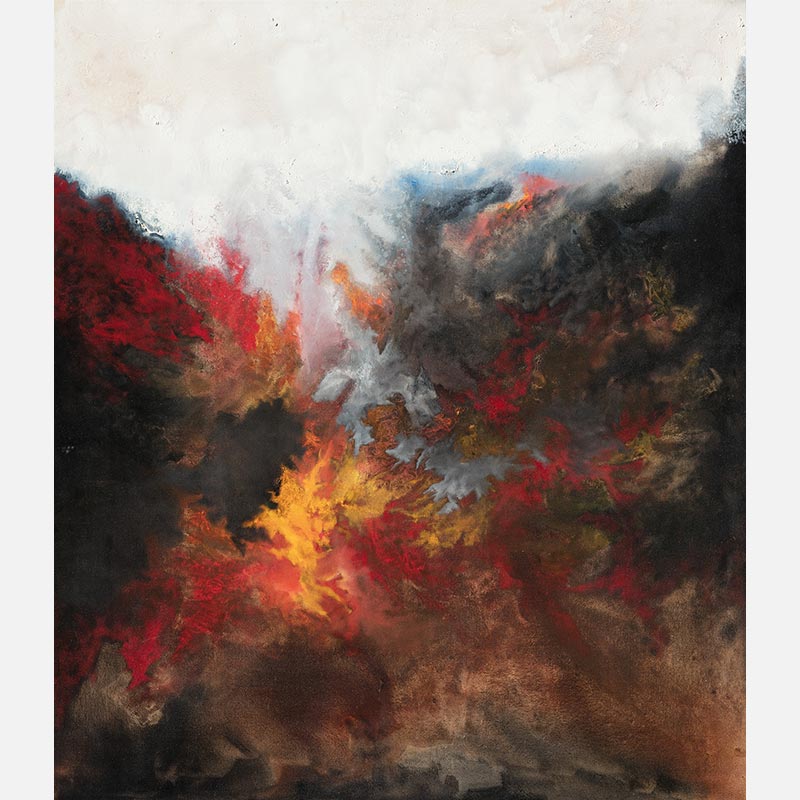
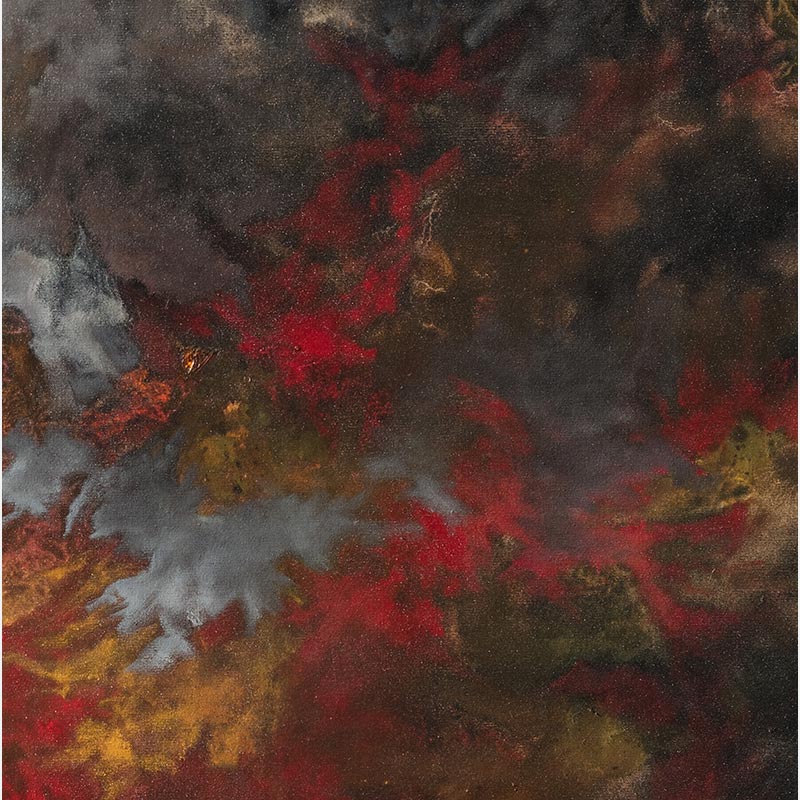
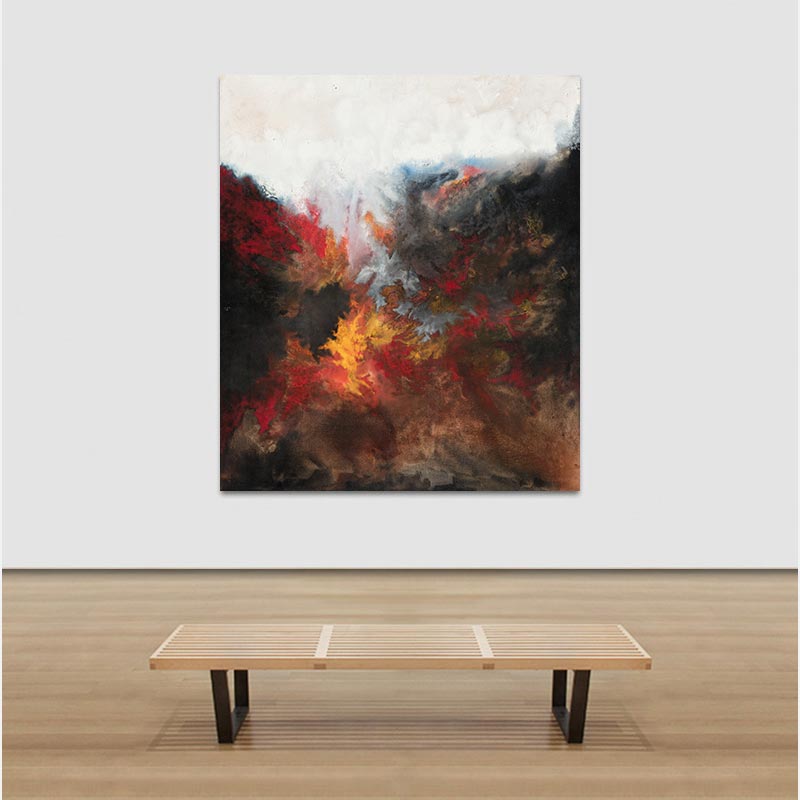
Combustion arrests its fire in the lower register and keeps its silence above: the base surges with volcanic force while the upper field opens into a dense white quiet that carries more emotional charge than the fire beneath it. The white is not resolution. It is suspension: the moment before the fire decides whether to consume what is above it or recede into the earth below. Neither has happened yet. The painting holds the decision open, and the longer you look, the more charged that undecided moment becomes.
Combustion arrests its fire in the lower register and keeps its silence above: the base surges with volcanic force while the upper field opens into a dense white quiet that carries more emotional charge than the fire beneath it. The white is not resolution. It is suspension: the moment before the fire decides whether to consume what is above it or recede into the earth below. Neither has happened yet. The painting holds the decision open, and the longer you look, the more charged that undecided moment becomes.
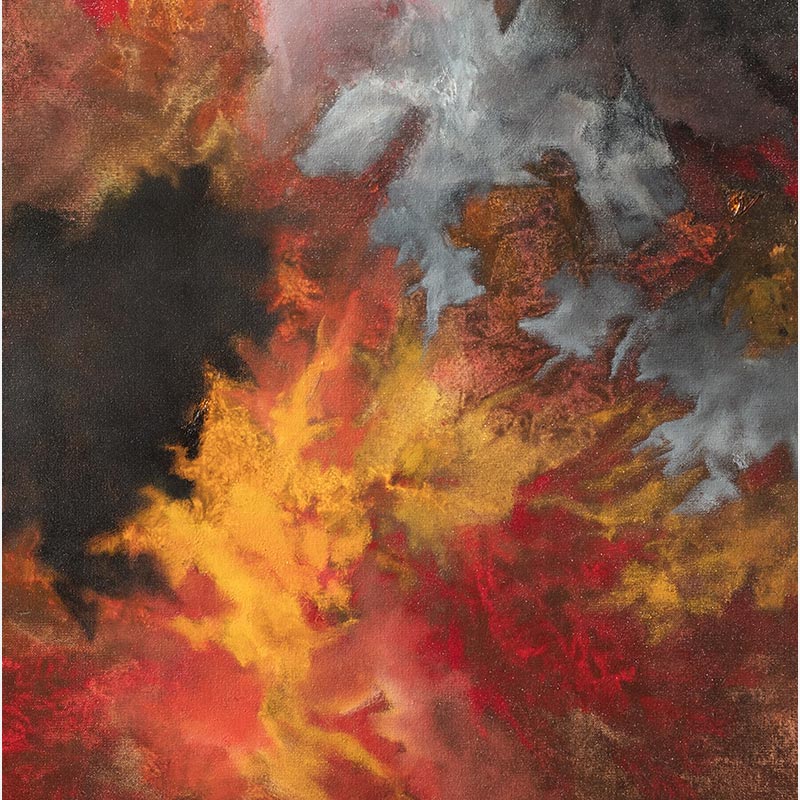
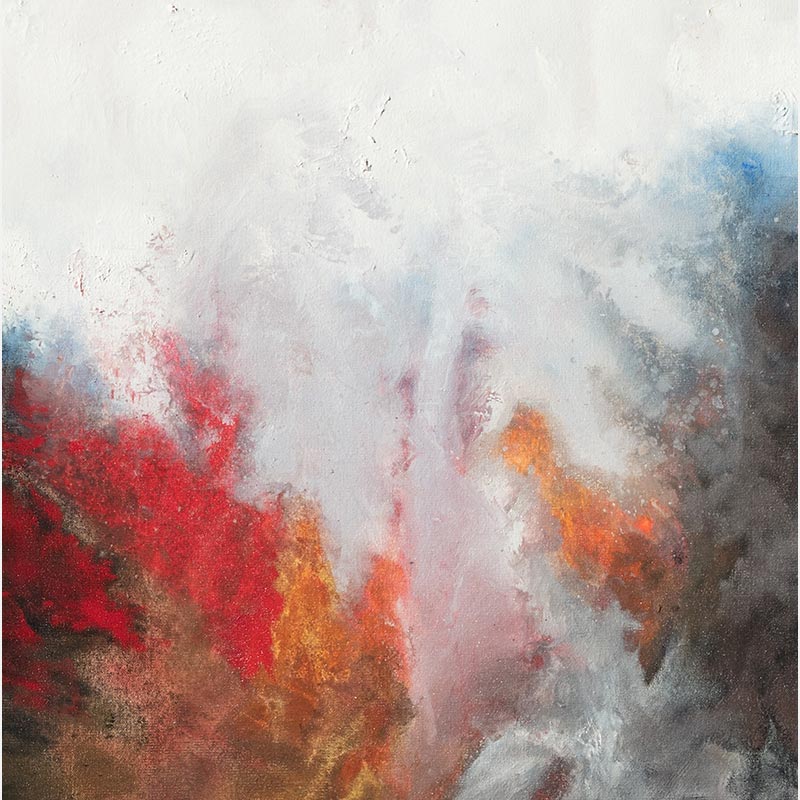
The white is not light: it is mass. Built at the same impasto density as the volcanic field below, distinguishable from it by temperature alone, it presses downward with the weighted authority of a Van Goyen sky, those leaden atmospheric masses that carry the full material presence of weather rather than its appearance. Below it, the fire operates in the register of Albrecht Altdorfer's cosmological infernos, most powerfully in the Battle of Alexander at Issus, where the world burns from below and the sky is consumed in the same event. Van Goyen above, Altdorfer below: two incompatible densities approaching each other, each carrying a charge the other cannot absorb.
Between them runs a sliver of electric blue. It is not a transition and not a blending: it is a discharge, the electricity generated by two charged masses approaching the moment of contact without reaching it. The filament of a man-of-war jellyfish has the same quality: a living, dangerous edge of energy running along the boundary between incompatible forces, belonging to neither, produced by both. The blue is also partly in the viewer's nervous system: a eye saturated by the warm lower register generates cold involuntarily when it reaches the boundary, so that the discharge is as much perceptual as painterly. The Albers principle made physical and electric.
The emotional proposition connects Combustion to Goya's black paintings: in the Saturn Devouring His Son and the Pilgrimage to San Isidro, darkness pressing from below generates an upper register of appalling stillness, the catastrophic force held at the moment before it resolves. In Combustion the white is simultaneously the stillness after catastrophe and the stillness before it, the silence that could belong to either end of the event. The fire is present. The resolution is absent. Nothing has the real upper hand.