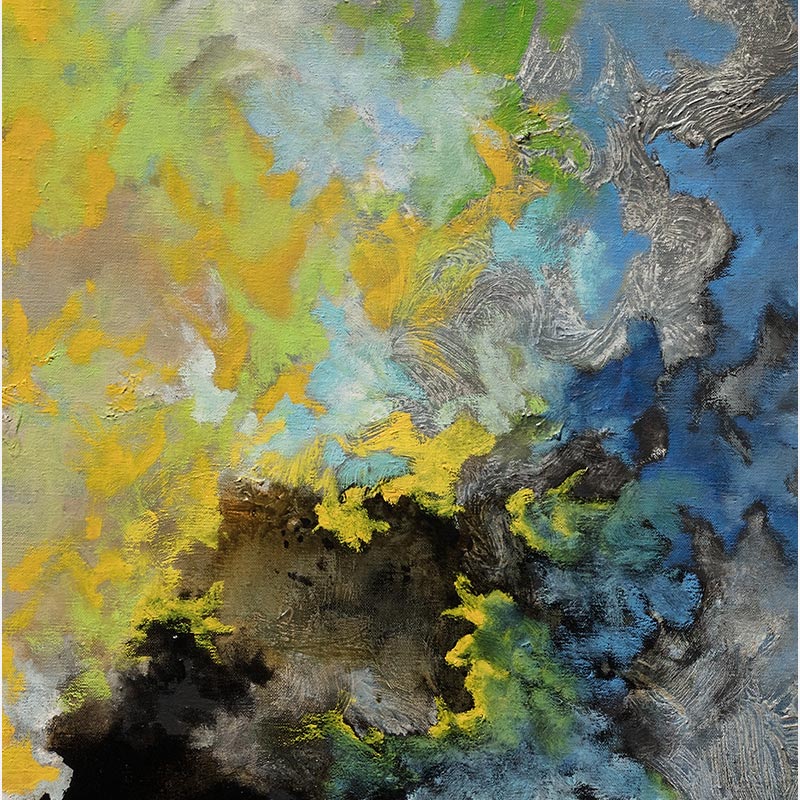
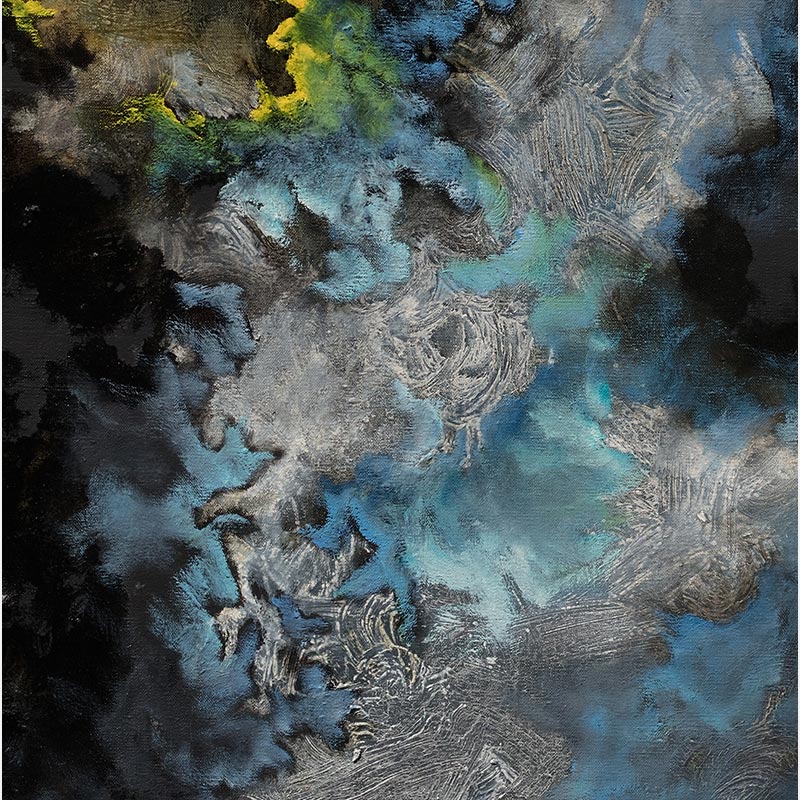
Glaciatus Ignis is a painting in which color has been turned against itself. The blues burn. The blacks are not dark: they are two different silences, one that conceals and one that cancels. The acid yellow is not luminous but viscous, globulous, a presence so assertive it makes the surrounding ochre look like an apology. The non-black field twists on itself like a tornado coiled before the strike. Something is wrong with this world: every color is doing what its opposite should do.
Glaciatus Ignis is a painting in which color has been turned against itself. The blues burn. The blacks are not dark: they are two different silences, one that conceals and one that cancels. The acid yellow is not luminous but viscous, globulous, a presence so assertive it makes the surrounding ochre look like an apology. The non-black field twists on itself like a tornado coiled before the strike. Something is wrong with this world: every color is doing what its opposite should do.
Only someone raised on the relativity of color could have done this. Josef Albers's conviction that color has no fixed attribute, that every chromatic quality is the product of relationship rather than pigment, here reaches its most perverse application: blues stripped of their soothing dormancy and forced into the burning register of reds, yellows made aggressive rather than luminous, blacks differentiated not by tone but by ontological function. Ice burns. The Albers formation is not the framework the painting illustrates: it is the instrument of violence the painting uses.
The two blacks deserve separate attention. The glossy, varnished black on the left has the depth of a Rembrandt shadow: it does not terminate vision but holds it, suggesting imagery in its depths, the possibility of something withheld rather than absent. The matte black on the right is a screen: it cancels, it forecloses, it places itself in front of whatever might be behind it and refuses any negotiation. Both blacks were ground by hand with linseed oil rather than taken from a tube, the same old master process that makes the acid yellow globulous and the matte black impenetrable. The grey textural passages surviving from the painting beneath, a green swamp painting Vanni was unhappy with and painted over in a single act of transformation, give the surface its specific topography: the black ridges left in the brushstrokes backlight the forms from within, as if the fire comes from behind the surface rather than from it.
The emotional source is the first Iraq War irrupting into Ruggero's peaceful world. He expressed it by inverting the world's colors: every chromatic given reversed, every comfort made lethal. The acrid smoke of the burning oil refineries is the specific imagery behind the nature of the blacks, that particular quality of industrial smoke that is simultaneously opaque and luminous, obscuring without burning out completely. Vanni wanted this painting to carry the sheer force of Albrecht Altdorfer's The Battle of Alexander at Issus, the cosmological tornado of that composition where the world itself twists before consuming. He thought again of Hans Magnus Enzensberger, whose epic poem The Sinking of the Titanic uses historical catastrophe as a metaphor for the collapse of political utopia. Glaciatus Ignis is one of the few works Vanni will not part with, and he sometimes regrets not following the path this painting had opened.