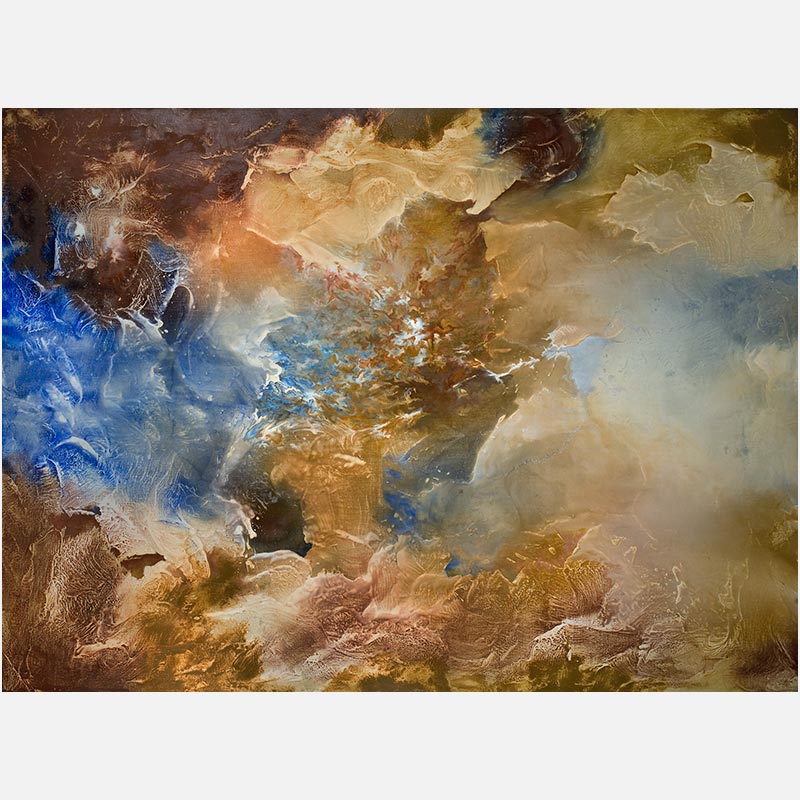
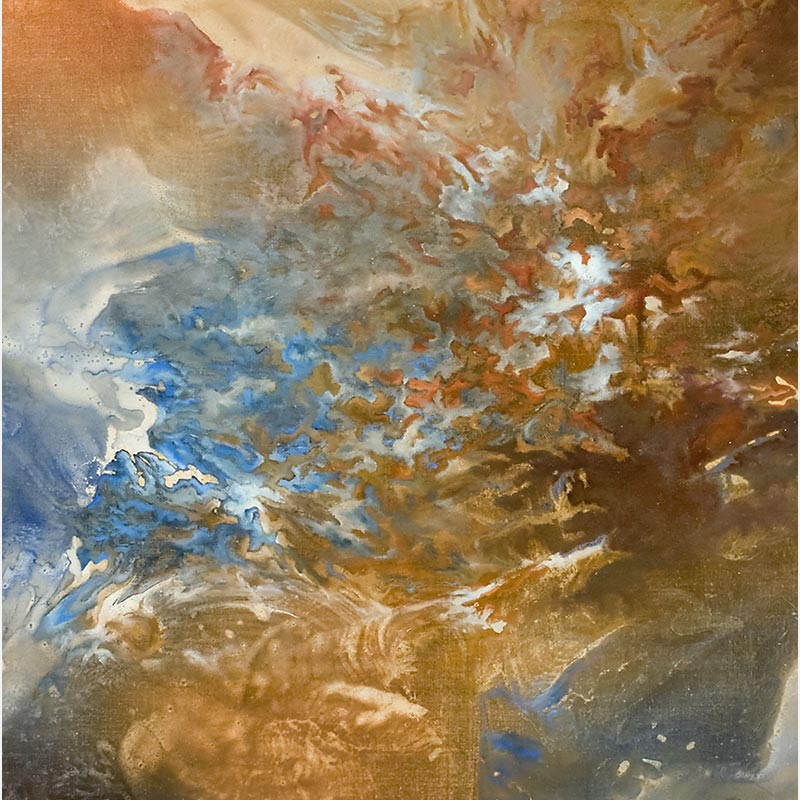
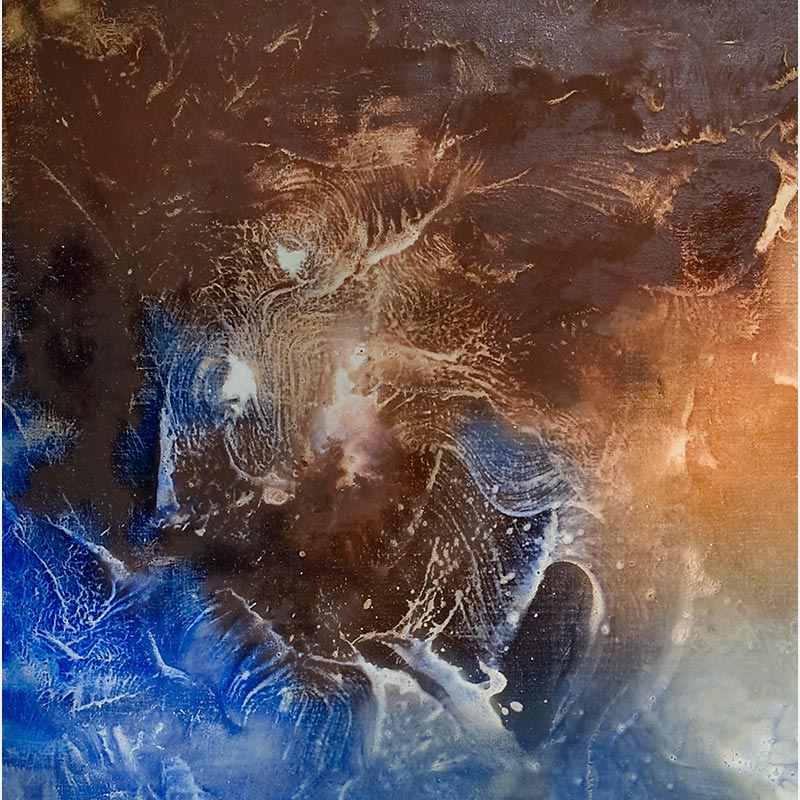
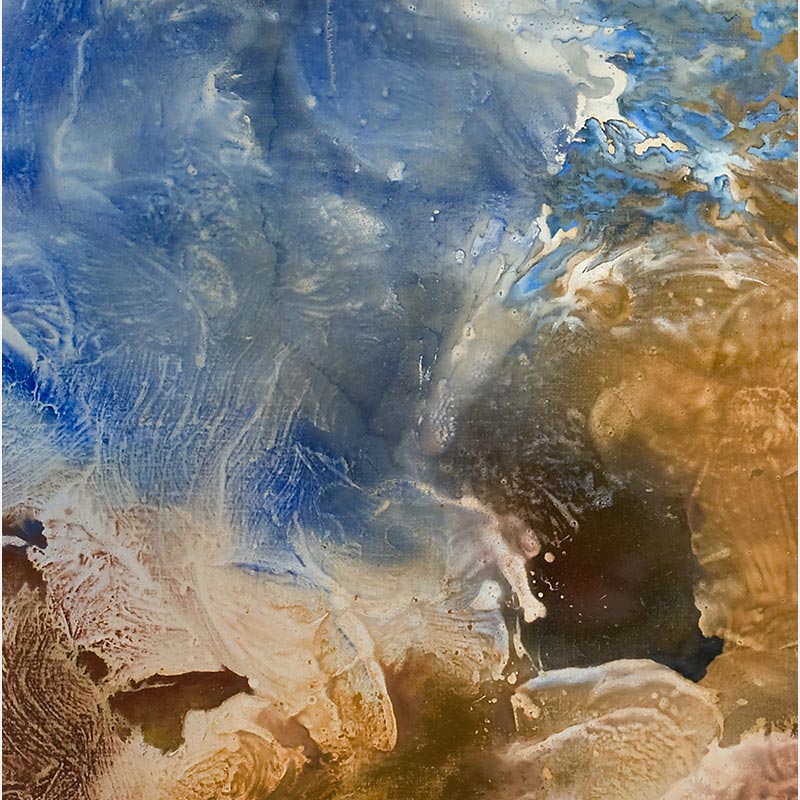
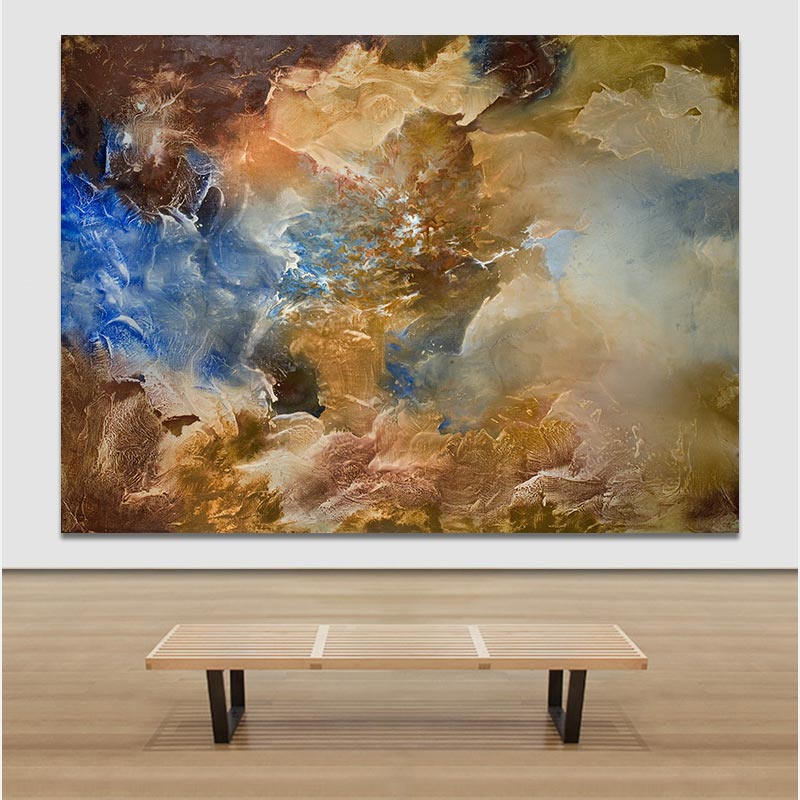
Aditus Caeli I is the most representational work in Vanni's practice, and it earns that quality entirely through paint. Warm rusty reds and pale blues build nebulous formations across a vast horizontal field: not landscape, not earth, but sky in every direction, atmospheric events developing simultaneously above, below, and around the eye. There is no ground here, no horizon, no position outside the composition. The gaze is not directed upward toward a painted sky: it is already inside one, the field developing around it rather than presenting itself before it.
Aditus Caeli I is the most representational work in Vanni's practice, and it earns that quality entirely through paint. Warm rusty reds and pale blues build nebulous formations across a vast horizontal field: not landscape, not earth, but sky in every direction, atmospheric events developing simultaneously above, below, and around the eye. There is no ground here, no horizon, no position outside the composition. The gaze is not directed upward toward a painted sky: it is already inside one, the field developing around it rather than presenting itself before it.
A single painterly decision generates the spatial illusion: the scale of the brushmarks changes across the surface, larger marks advancing and smaller ones receding, perspective generated through material size rather than linear geometry. In this painting Vanni is at his closest to Giovanni Battista Tiepolo, whose great ceiling works generate spatial depth through exactly this logic, the marks of the sky growing smaller as they rise, the eye convinced of actual distance through the differential of paint rather than through any drawn recession.
The spatial logic behind this painting is the formation of suspension underwater. At serious depth the body loses its gravitational orientation: it floats at the intersection of all directions simultaneously. This is not the experience of looking upward from below, which still implies a position, a floor, a direction. It is the experience of being suspended within a field that has no preferred axis, the body freed from gravity, the space organizing itself around the viewer rather than before them.
In 1997 Barbara Rose placed Aditus Caeli I on the central wall of the New York-New Generation exhibition at Palazzo della Penna, Perugia. In that setting the painting was in complete harmony with the sixteenth-century palace and its modernity exploded precisely because of that. The dialogue demonstrated something essential about Vanni's practice: its capacity to inhabit tradition while leaping simultaneously into the contemporary, each register intensifying the other rather than canceling it.
It is a painting Vanni will not part with, though not for the reasons that attach him to Glaciatus Ignis. Aditus Caeli I is unique in the practice for its representational quality, which leaves very little room for free association. It represents a direction he recognized and consciously chose not to follow. The representational pull was too strong for the practice he needed to build. What he kept from this canvas was the discovery of brushstroke scale as a generator of perspective: a technical finding he carried forward while setting aside the territory it had opened.