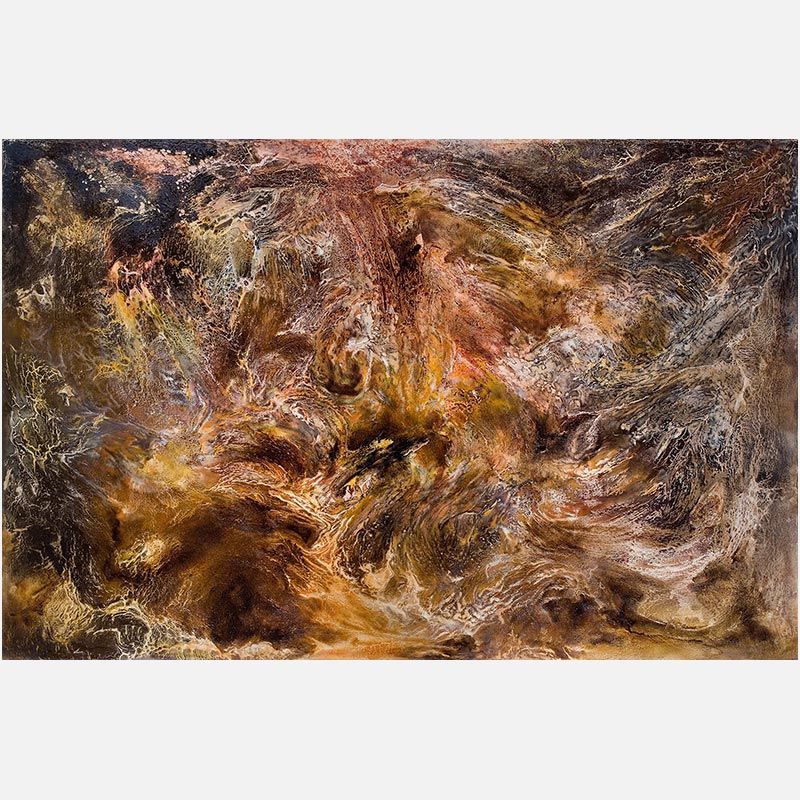
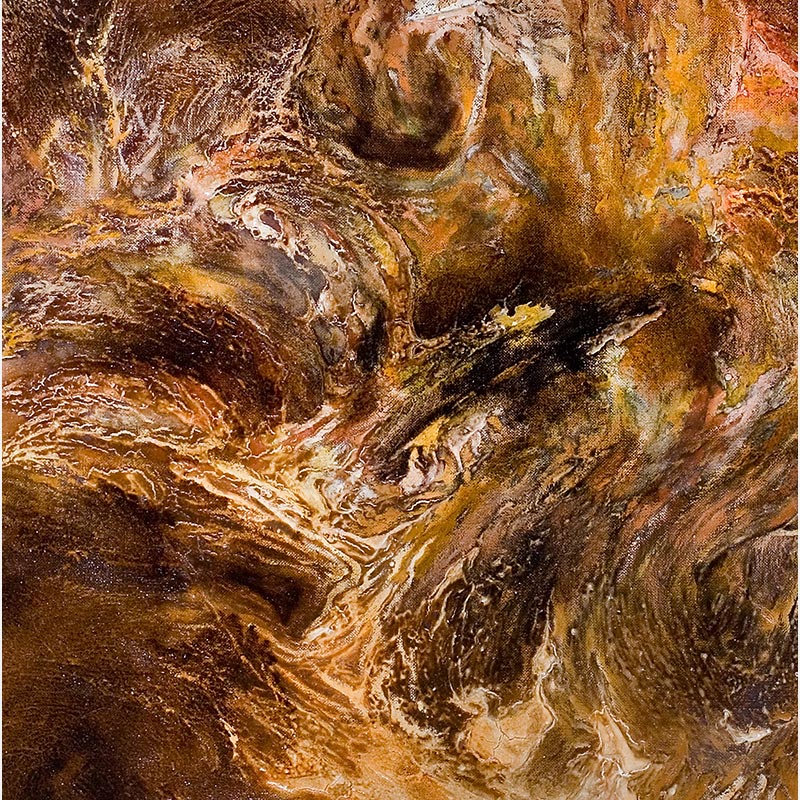
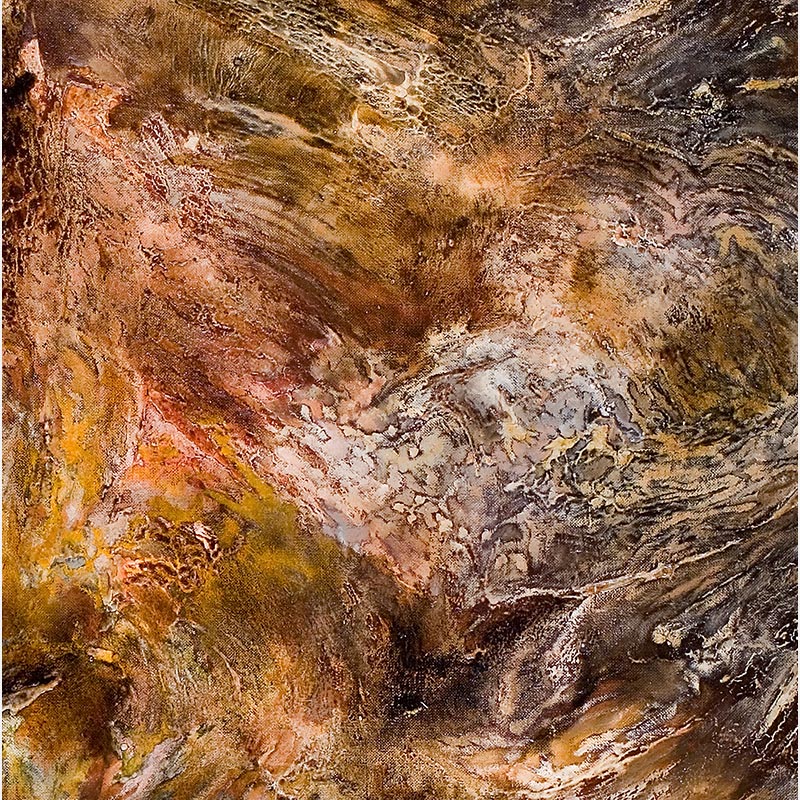
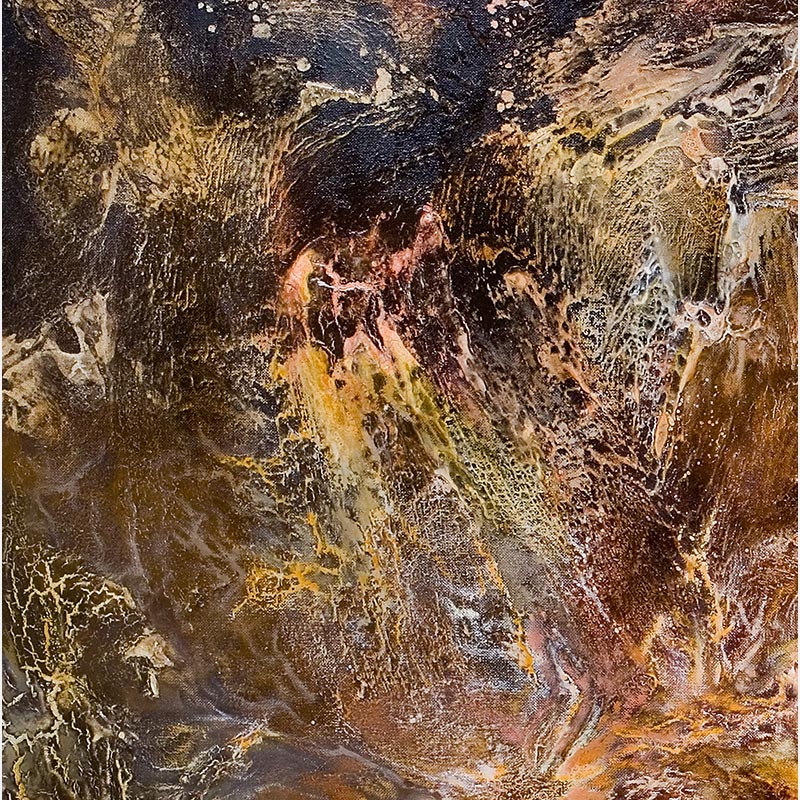
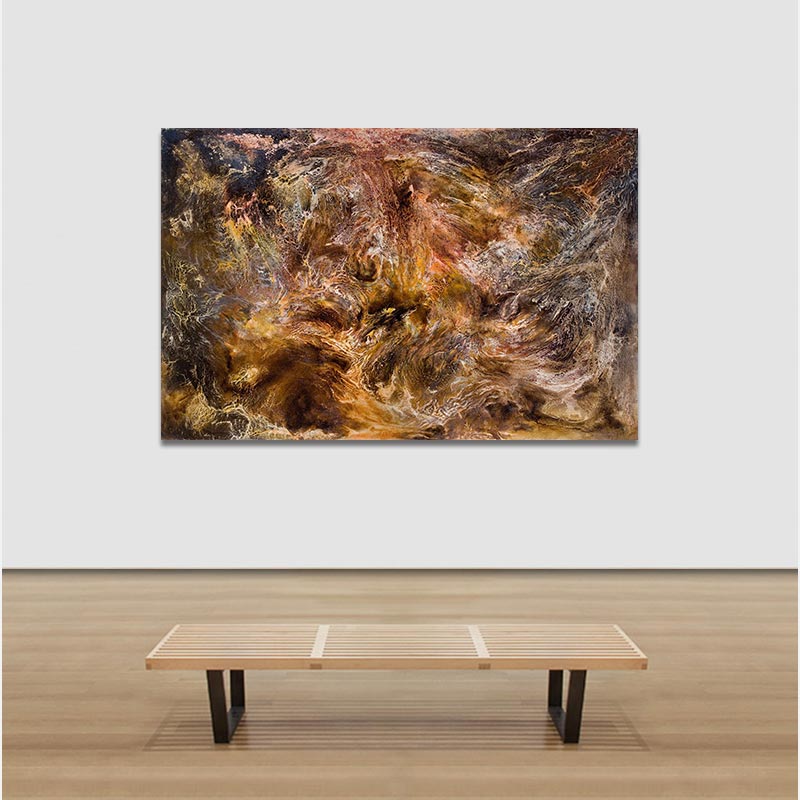
Radices Chaoi I pulls you in before you have found a foothold: rusted reds, oxidized golds, and deep browns twist and spiral across the entire surface in a churning lateral movement that swallows the eye the moment it attempts to settle. There is no center, no edge that holds, no direction the labyrinth does not redirect. The surface has the gnarled authority of something ancient under pressure, a fossilized olive tree, roots that have absorbed chaos into their own structure until chaos and root are the same thing.
Radices Chaoi I pulls you in before you have found a foothold: rusted reds, oxidized golds, and deep browns twist and spiral across the entire surface in a churning lateral movement that swallows the eye the moment it attempts to settle. There is no center, no edge that holds, no direction the labyrinth does not redirect. The surface has the gnarled authority of something ancient under pressure, a fossilized olive tree, roots that have absorbed chaos into their own structure until chaos and root are the same thing.
The dialogue between gesture and intellect that organizes this canvas is the central formal argument of the practice at full intensity. The gestural mark carries the evidence of its own making: direction, speed, pressure, the physical event of the brush. The structural logic that organizes those marks into a labyrinthine field is the Albers conviction operating at the level of composition rather than color: no element can be read in isolation, everything is defined by its neighbors, the whole is the argument rather than any of its parts. The tension between the freedom of the individual mark and the inexorability of the structure it feeds into generates the particular charge of this surface: the mark believes it is free; the structure knows it is not.
The palette is the Venetian formation absorbed through Tintoretto, Titian, and Rembrandt: oxidized golds, rusty reds, and deep earth browns, colors that carry the memory of glazing in their very chromatic identity. Vanni built this surface with extensive larch resin glazings, the same medium the Venetian masters used for its transparency and the depth it generates between layers, each stratum visible through the one above it. The labyrinthine surface is not flat gesture but laminated event, the spiral turning through depth as much as across the surface.
The labyrinthine field is a cove formation with waves hitting rocks, and the resulting reflux meeting the next incoming wave, in an event that appears chaotic but is fully deterministic. The horizontal format allows the eye to travel the full length of the turbulence without arriving at a resolution: the labyrinth develops across the canvas without a center, the spiral generating itself from its own momentum. In Radices Chaoi I the dialogue between gestural freedom and its taming by the intellect of the previous decade achieves its fullest integration; from this canvas the three-dimensional research of the Charta series will develop the same logic into physical space