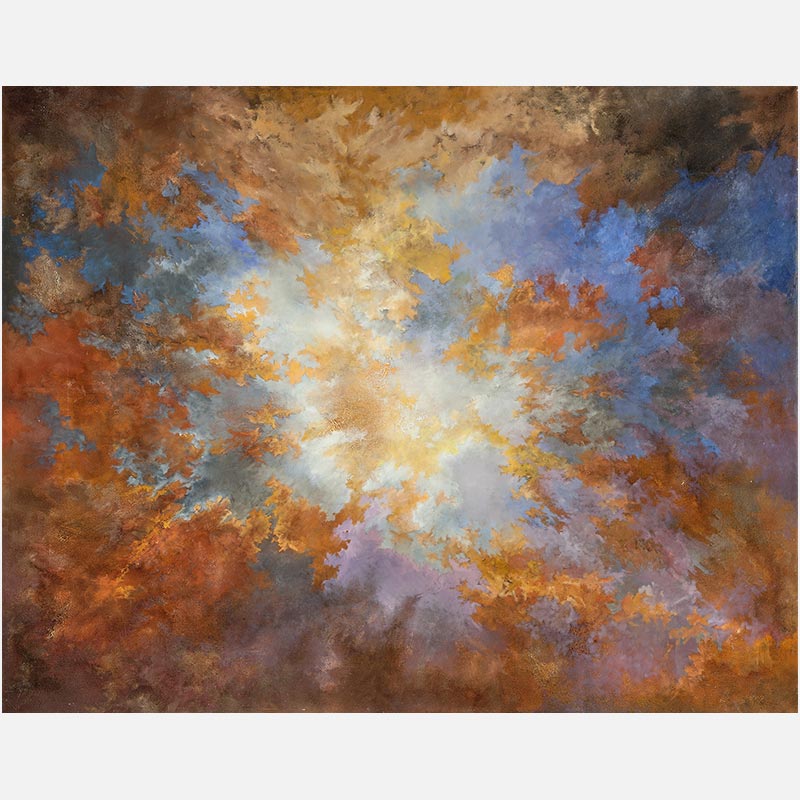
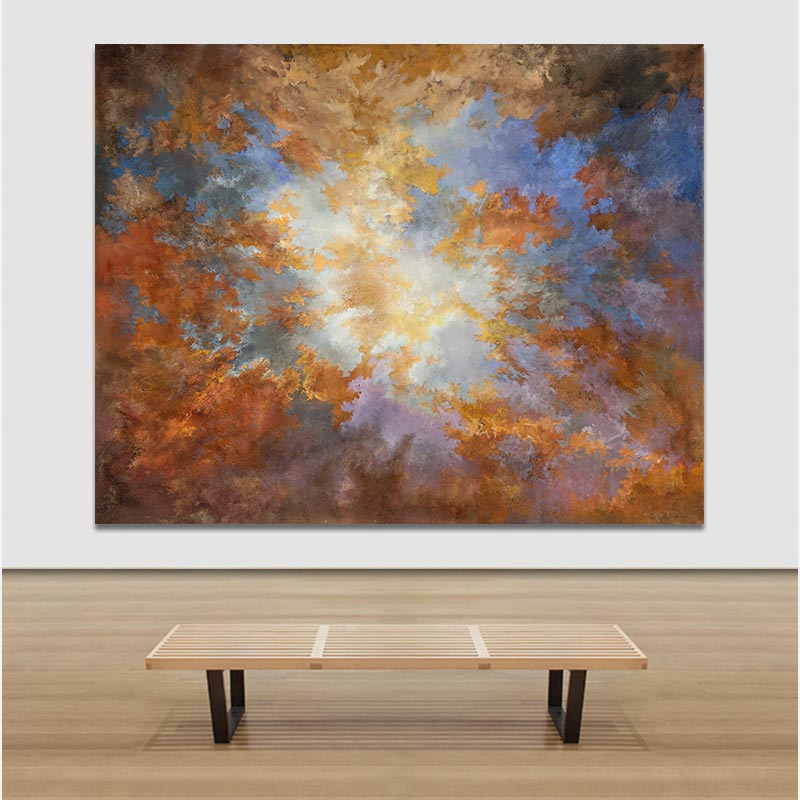
Into the Light IV opens above you. Warm earths and rusted oranges press in from the edges and where they release, a wide luminous field expands outward in every direction, carrying the full material density of the surrounding matter even as it brightens. The gaze is freed from the horizon, drawn upward into a field that has no ground beneath it, the sensation less of looking at a canvas than of being inside a sky that has no edge.
Into the Light IV opens above you. Warm earths and rusted oranges press in from the edges and where they release, a wide luminous field expands outward in every direction, carrying the full material density of the surrounding matter even as it brightens. The gaze is freed from the horizon, drawn upward into a field that has no ground beneath it, the sensation less of looking at a canvas than of being inside a sky that has no edge.
The compositional argument of Into the Light IV is not decorative: it is spatial. A painting organized around an upward gaze proposes a fundamentally different relationship between the viewer and the painted field. There is no implied position outside the composition, no horizon to anchor the eye, no ground to stand on. The field develops in every direction simultaneously and the viewer is inside it rather than before it.
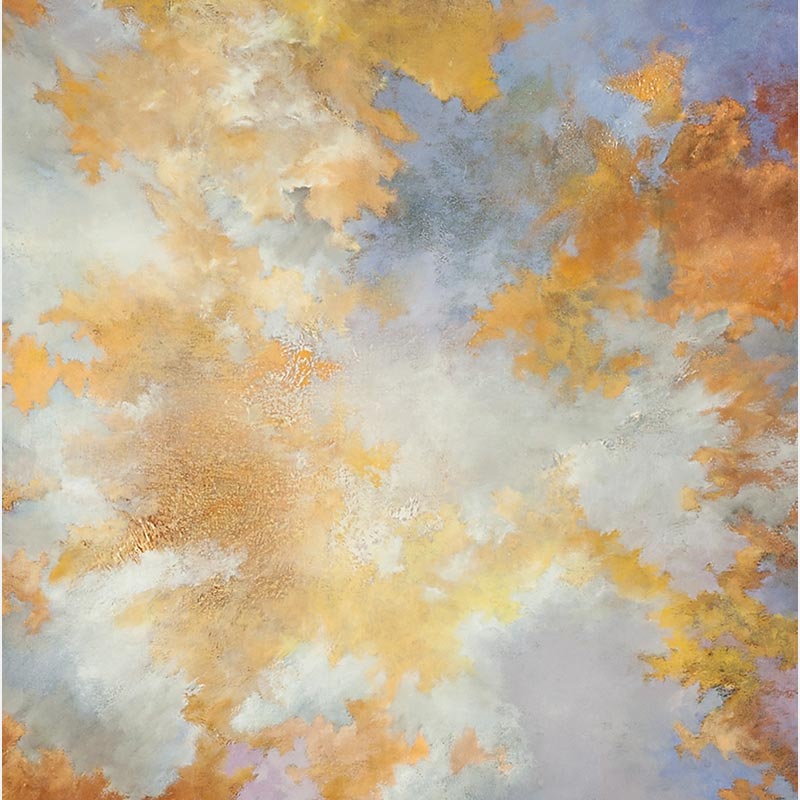
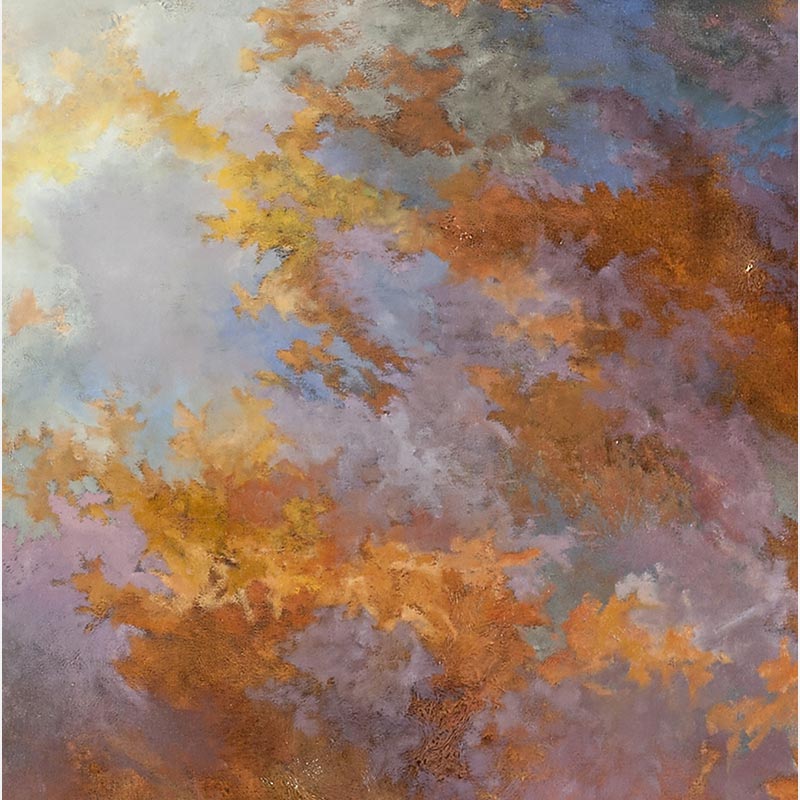
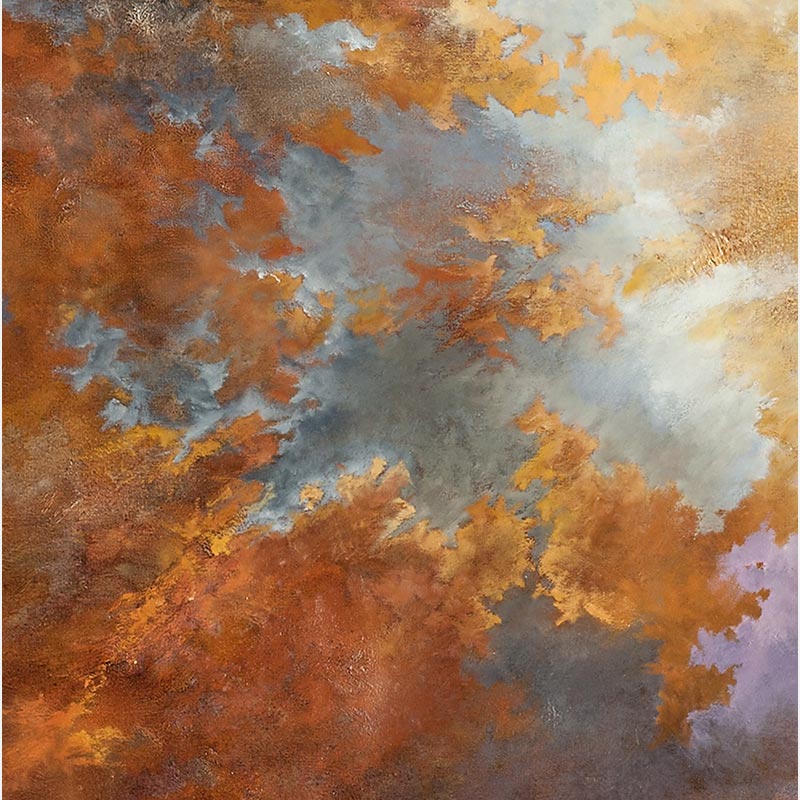
The luminous passages are governed by Giovan Battista Piazzetta's principle: the pale center is not created by thinning the paint but built at the same material density as the surrounding warm fields, light generated through chromatic relationship rather than by its removal. The warm earths and rusted oranges pressing in from the periphery carry the palette Ruggero had encountered upon his arrival in New York in 1979: looking up through the vividly red and yellow leaves of the Indian summer canopy, sky glimpsed in that specific blue and rusty-red accord that echoes the Renaissance. The canopy and the painted sky are structurally the same proposition.
The compositional organization of this painting also comes from a related professional assignment. Vanni was working at the architectural firm Davis Brody when, in 1985, Lewis Davis, then undertaking the restoration of the New York Public Library, commissioned the twenty-six-year-old to survey Venetian and Roman ceiling painting at first hand. What the investigation deepened was his understanding of the illusionistic ceiling tradition: Piazzetta's ceiling painting in Venice, Pietro da Cortona's vault at the Chiesa Nuova in Rome, the great painted openings that dissolve the ceiling plane into sky. The Into the Light series, of which this canvas is the fourth and fullest realization, began the following year.
Charles Scribner III, closing a lecture on Baroque ceiling painting at the Metropolitan Museum of Art in the mid-1980s, used images of this work and Gian Berto Vanni's work as the contemporary continuation of the tradition. The spatial proposition inaugurated here would deepen across the following decade into territory the ceiling paintings had not yet reached.