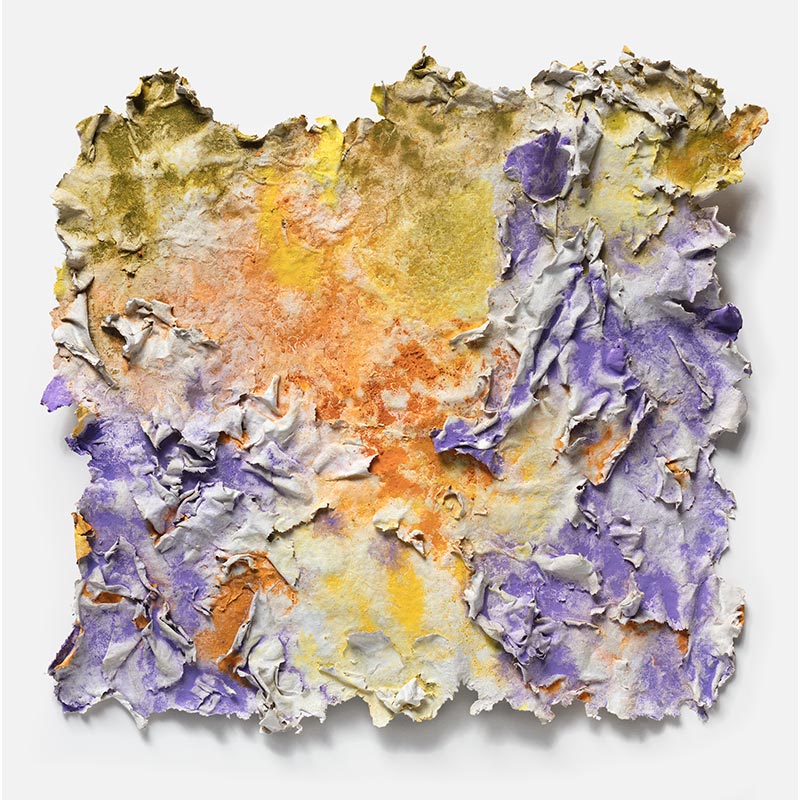
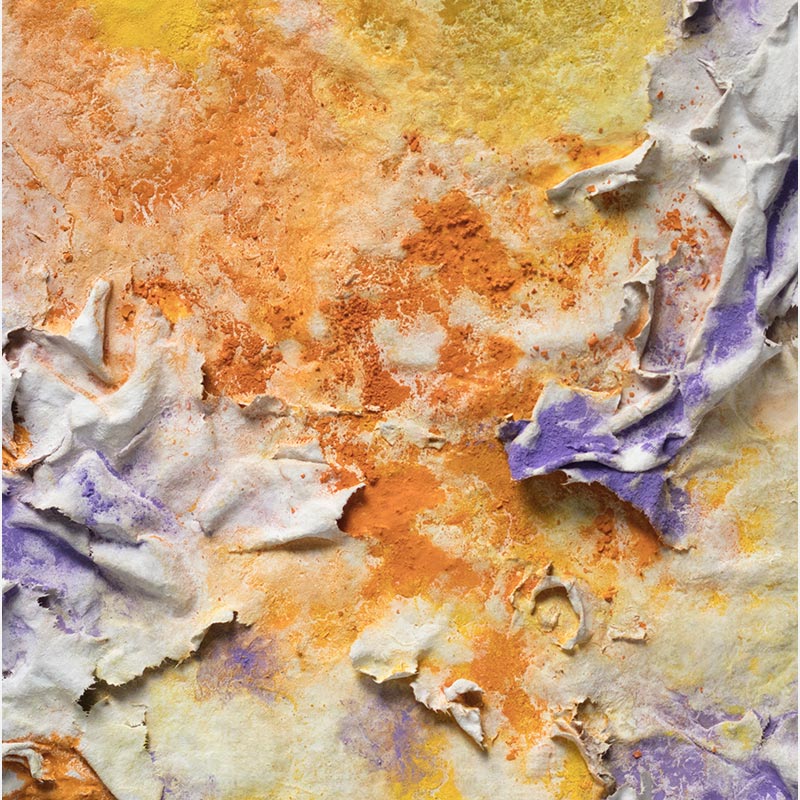
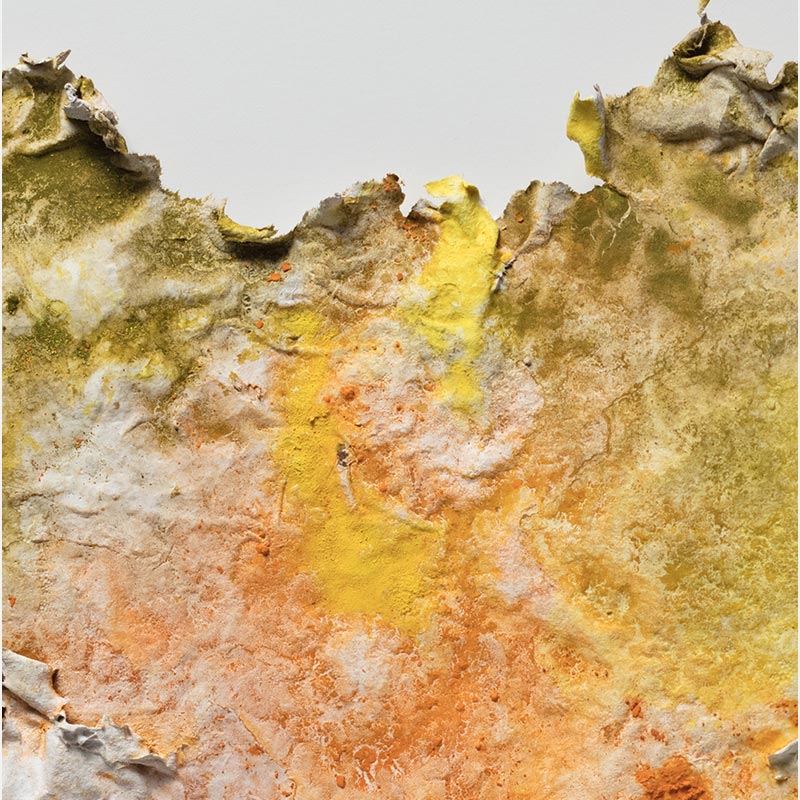
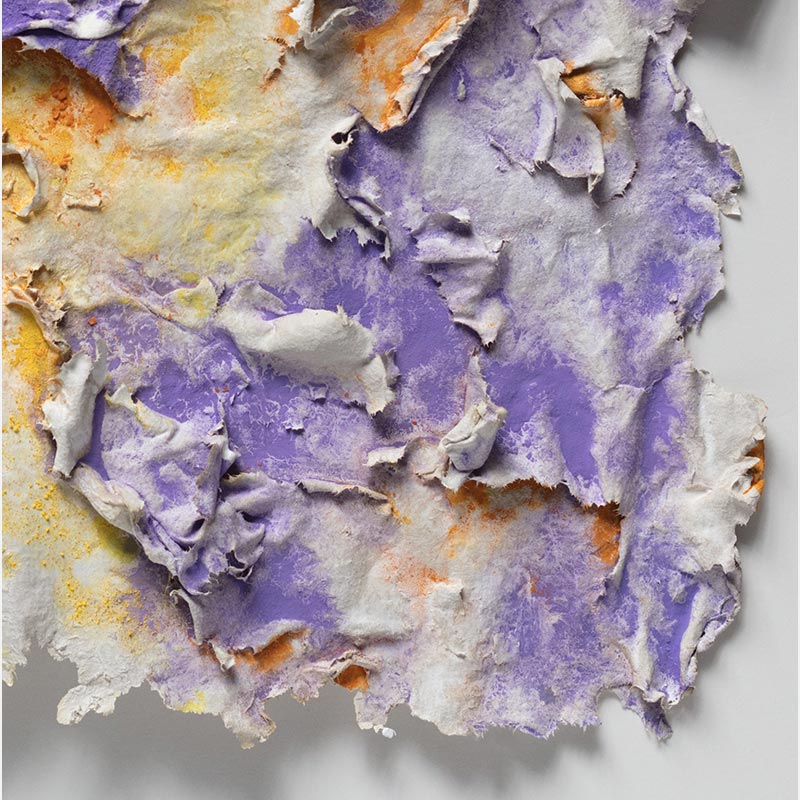
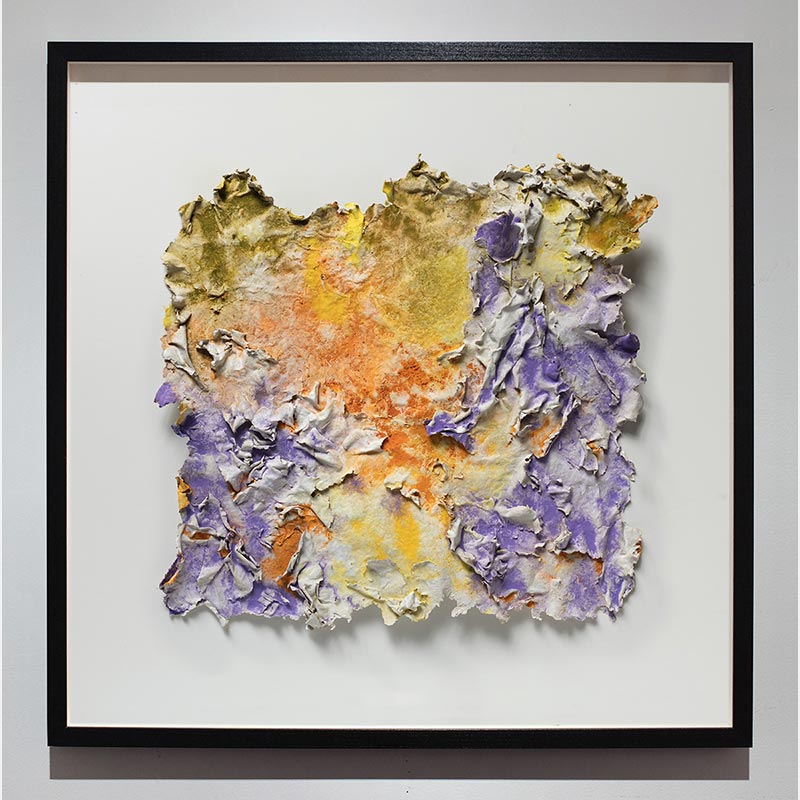
Solstitium I erupts in the chromatic register of high summer: warm yellows and oranges surge from the center while deep purples press in from the edges, each intensifying the other through proximity rather than contrast. The handmade paper buckles and tears at the periphery, the forming violence still present in the surface, while the center holds the colors at their most saturated point, the solstice as a chromatic fact rather than a calendrical one. This is summer not as temperature but as chromatic maximum.
Solstitium I erupts in the chromatic register of high summer: warm yellows and oranges surge from the center while deep purples press in from the edges, each intensifying the other through proximity rather than contrast. The handmade paper buckles and tears at the periphery, the forming violence still present in the surface, while the center holds the colors at their most saturated point, the solstice as a chromatic fact rather than a calendrical one. This is summer not as temperature but as chromatic maximum.
The warm-cool polarity is the governing chromatic argument: yellows and oranges generating luminosity through proximity to the purples rather than despite them, the purples in turn acquiring a warmth they could not generate alone. This is the Albers conviction that color is the outcome of relationships rather than a property of individual pigments, operating here at maximum solar intensity.
That productive contradiction at the periphery defines the Charta series: paper cast tumultuously as a counterpoint to its inherent frailness, the rupture of the material's natural smoothness the condition of its expressive possibility. Francesco Arcangeli's critical concept of ultimo naturalismo identified abstract painters whose surfaces enact the generative tensions of natural cycles rather than illustrating them: Solstitium I works in that register, the solstice present as structural argument before the title arrives to name it.
Solstitium I belongs to the Charta series, works on handmade paper begun in 2009 that form the generative core of Ruggero Vanni's three-dimensional research. In the Charta works, the paper is cast and sculpted before any pigment arrives: structure precedes color, and the topography of the surface is the composition.