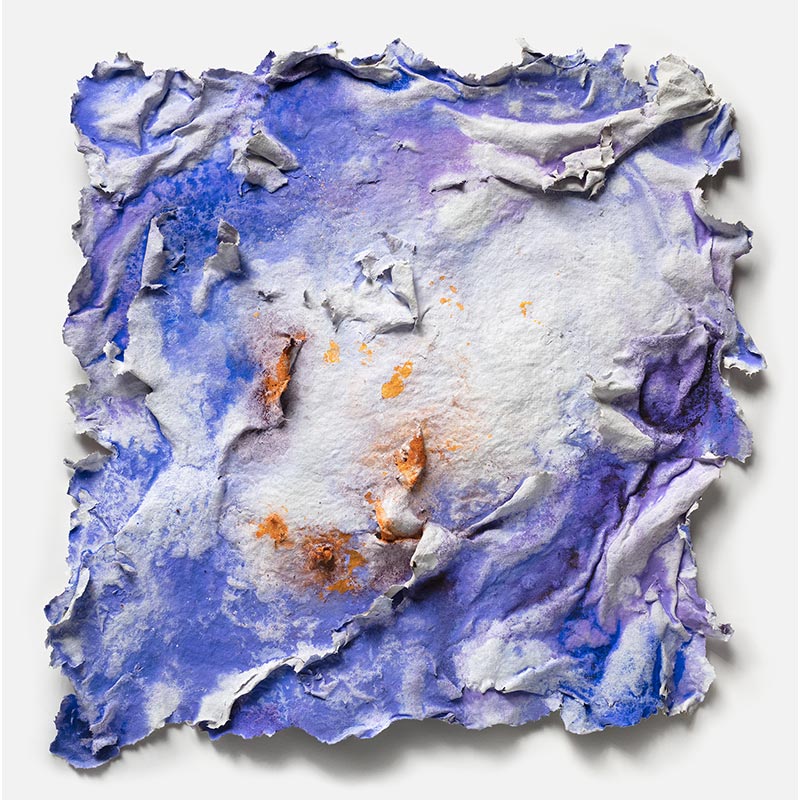
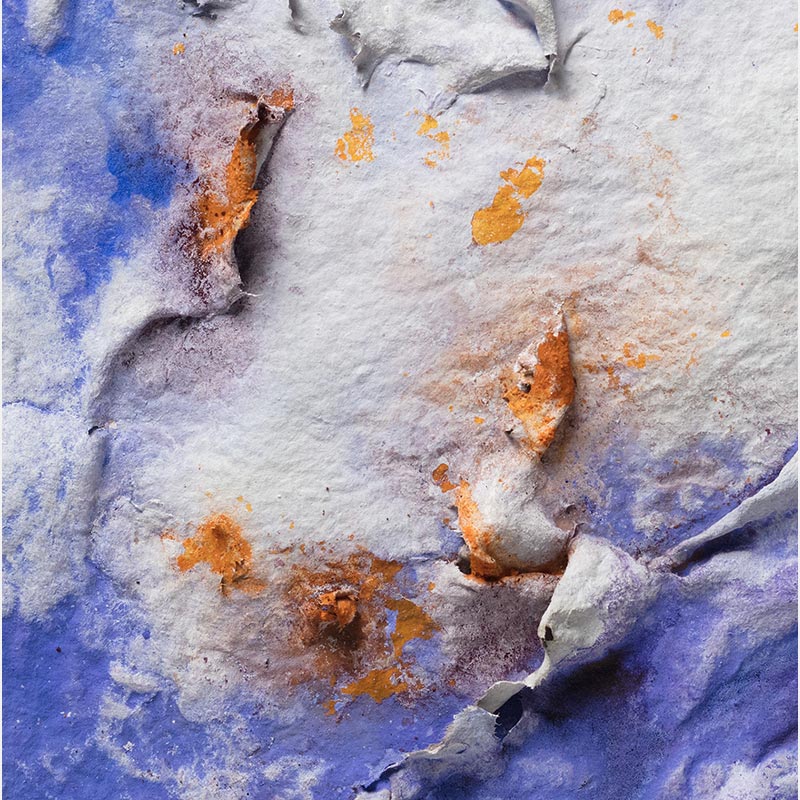
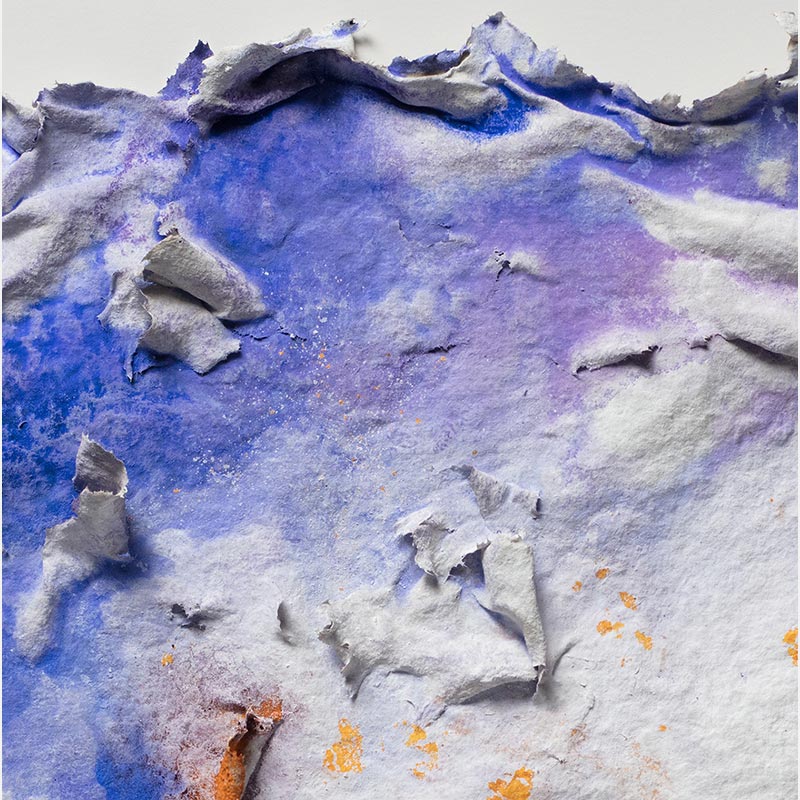
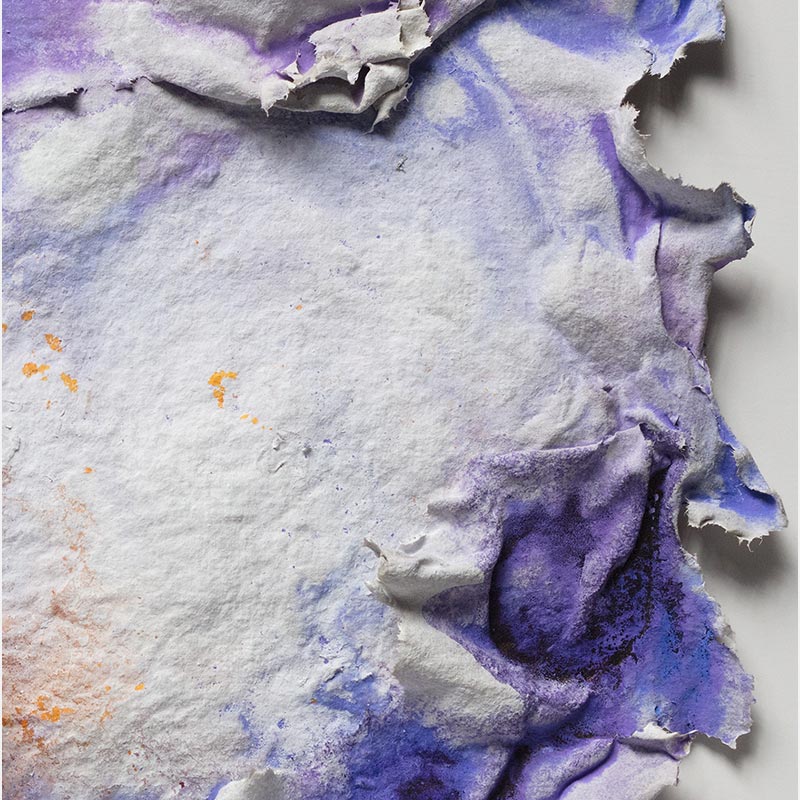
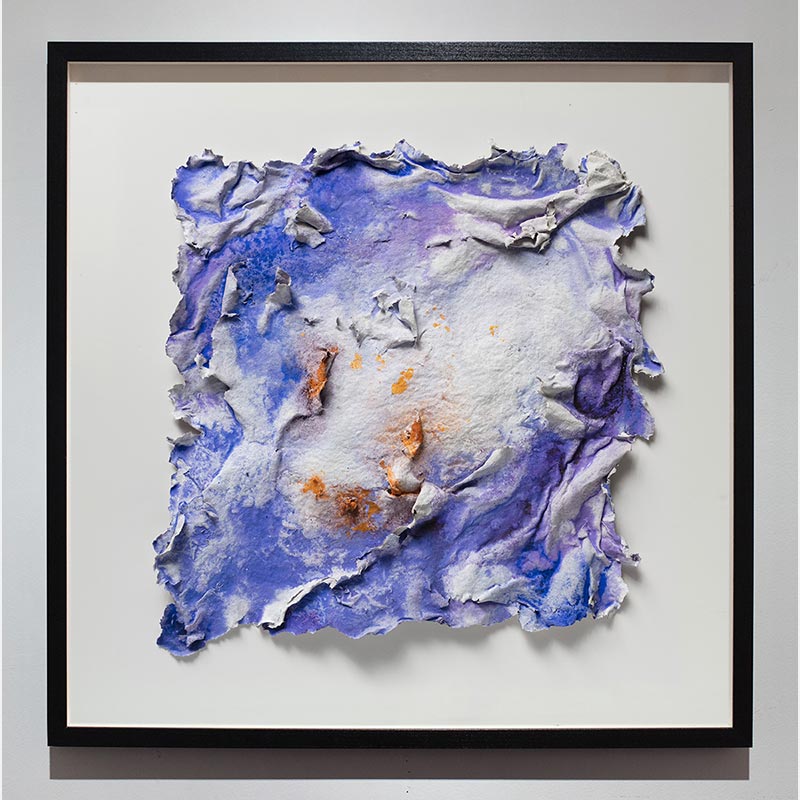
Lumina Brumalis carries the specific quality of winter light: pale and directional, arriving at a low angle, the shadows long and blue. The handmade paper surface buckles and folds in formations that catch that light differently at every angle, cool blues and soft grays holding the field while warm amber survives in the deepest folds, the last warmth of a sun that has already moved past its zenith. The season is not illustrated here: it is held in the paper's formed topography.
Lumina Brumalis carries the specific quality of winter light: pale and directional, arriving at a low angle, the shadows long and blue. The handmade paper surface buckles and folds in formations that catch that light differently at every angle, cool blues and soft grays holding the field while warm amber survives in the deepest folds, the last warmth of a sun that has already moved past its zenith. The season is not illustrated here: it is held in the paper's formed topography.
The white at the center is not a gap in the color but the most extreme chromatic event on the surface, built at the same material density as everything surrounding it: the Piazzetta principle that governs the practice, light generated through chromatic relationship rather than by removing paint. In this work the colors shift with the viewing angle, moving from blue to gray to pale lavender as the light changes across the buckled paper: Cennino Cennini called this cangianti, describing in his fourteenth-century handbook the way certain colors turn within themselves as fabric folds in the light. The cold register of winter allows the cangianti effect to operate across the narrowest possible chromatic range, generating maximum variation within minimum temperature span.
Francesco Arcangeli's critical concept of ultimo naturalismo, developed in Paragone in 1954 and 1957, identified abstract painters whose surfaces enact the generative tensions of natural cycles rather than illustrating them. Lumina Brumalis works in exactly that register: the winter season is structural before it is seasonal, the paper's formed topography making the light's behavior the composition.
Part of the Charta series, works on handmade paper begun in 2009 that form the generative core of Ruggero Vanni's three-dimensional research. In the Charta works, the paper is cast and sculpted before any pigment arrives: structure precedes color, and the topography of the surface is the composition.