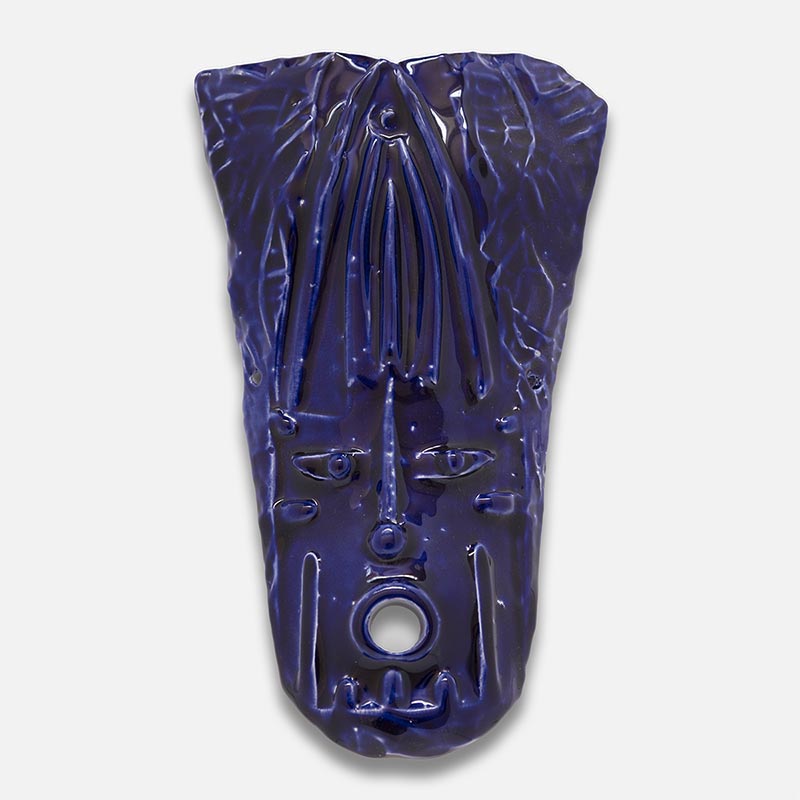
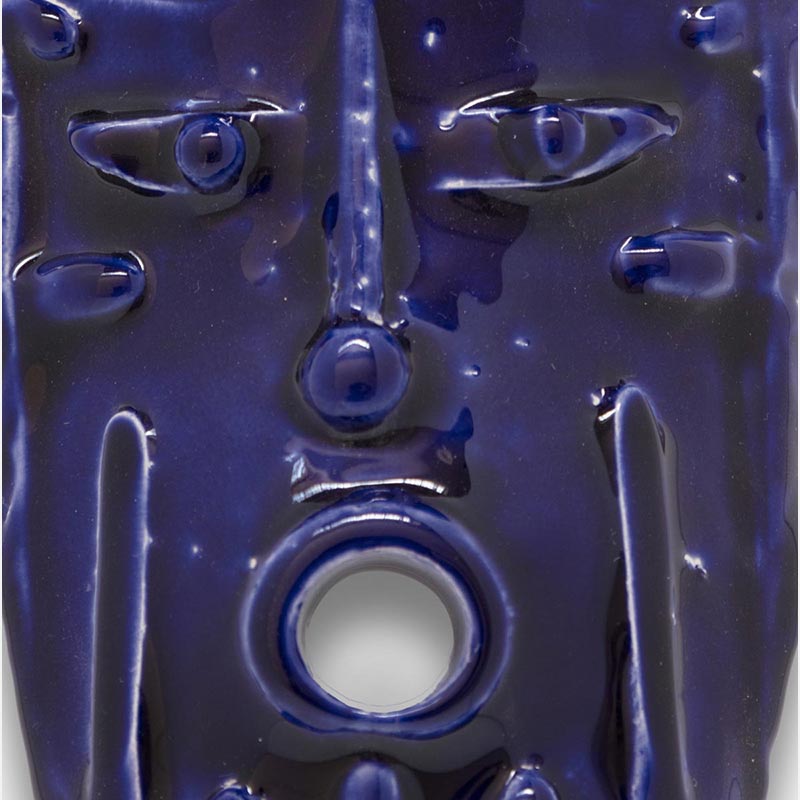
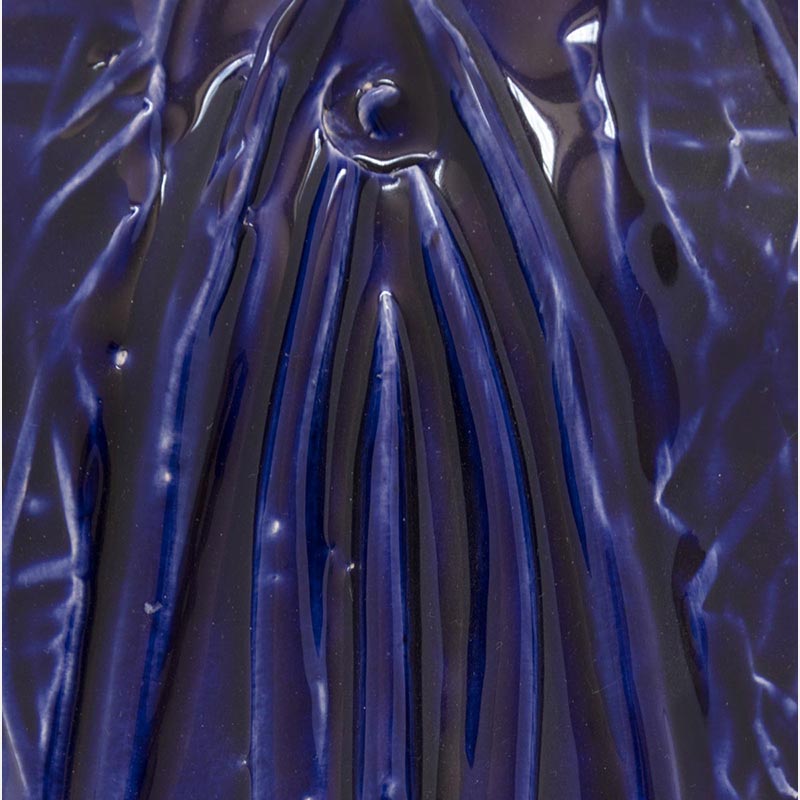
Maschera Blu II [Blue Mask II] submerges. The deep ultramarine blue saturates the surface, and across it a fine texture of vertical lines runs from top to chin like fabric draped over a form, or the surface of deep water holding its stillness. Within this field a face barely registers: two small almond eye apertures, a vertical nose ridge, a round mouth opening, the features almost dissolved into the surface that carries them. The blue gives nothing back: it absorbs, holds, and waits.
Maschera Blu II [Blue Mask II] submerges. The deep ultramarine blue saturates the surface, and across it a fine texture of vertical lines runs from top to chin like fabric draped over a form, or the surface of deep water holding its stillness. Within this field a face barely registers: two small almond eye apertures, a vertical nose ridge, a round mouth opening, the features almost dissolved into the surface that carries them. The blue gives nothing back: it absorbs, holds, and waits.
Part of the Masks series, the work carries blue not as color applied to a surface but as a condition the surface inhabits: the mask appearing submerged and recovered, depth held within the fired body. The draped texture reads as something veiled, the face present beneath rather than on it, features preserved in blue as in a medium that holds without releasing.
The Roman funerary tradition of the imago clipeata offers a precise parallel: the portrait shield, the face held in a material field not for display but for preservation, presence maintained through the object after the body dissolves. Crisafi’s cobalt mask operates in this register: the features barely distinguished from the surrounding field, the face at the minimum threshold of legibility, subsumed by blue that simultaneously conceals and preserves. The vertical lines do not animate the surface but quiet it. The mask does not perform. It endures.