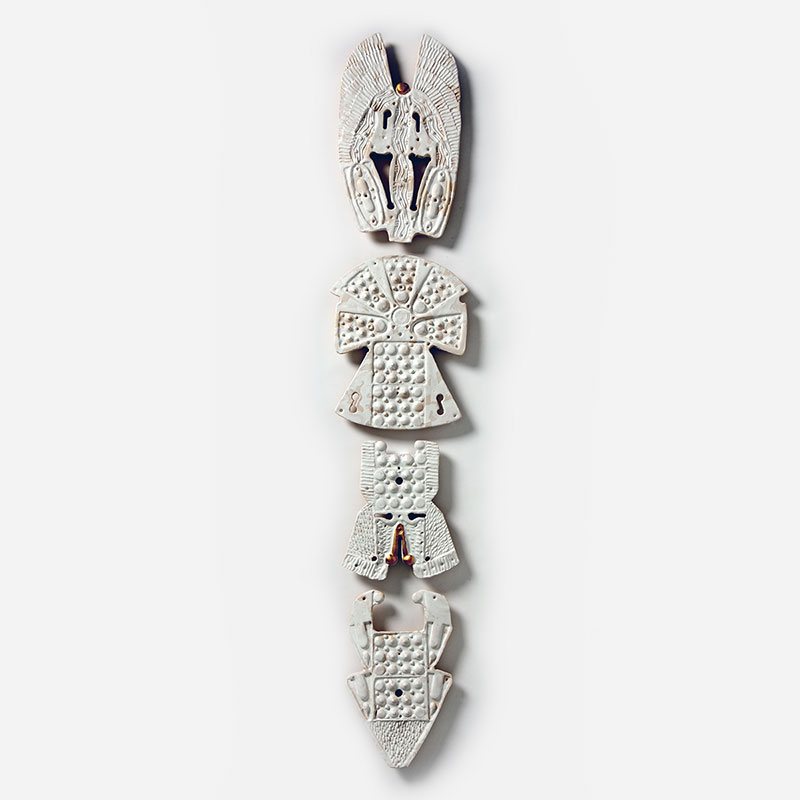
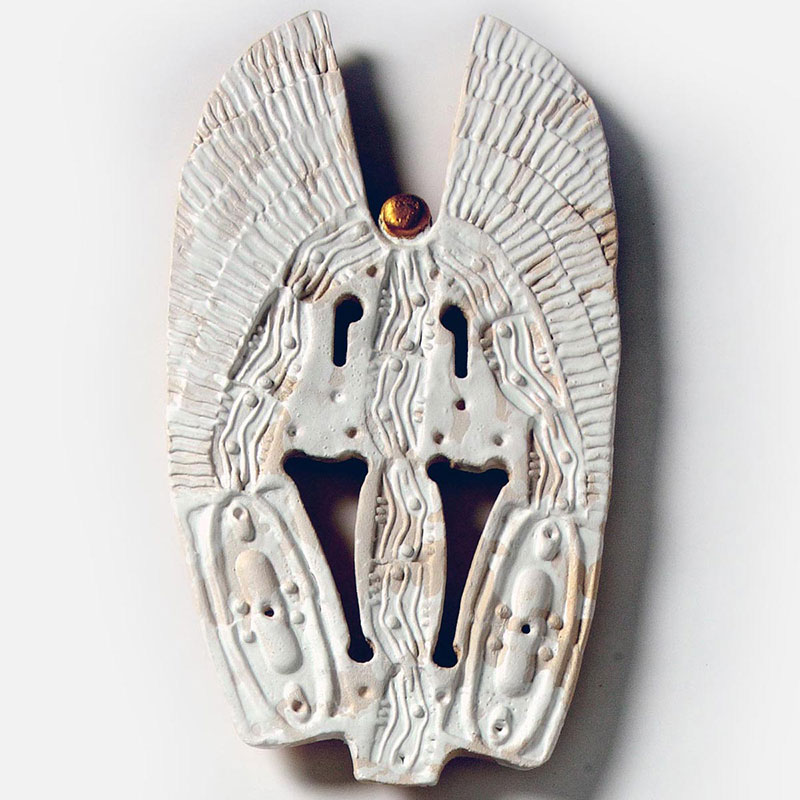
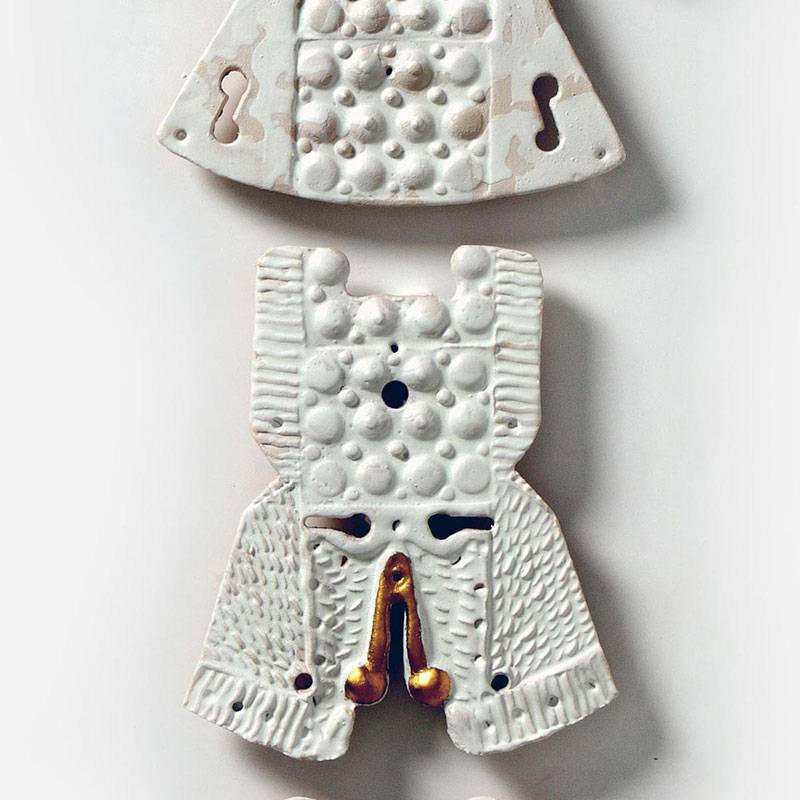
Legami XV [Bonds XV] arrives as a quieter proposition. The four ceramic elements are pale, almost chalky, their whiteness absorbing rather than reflecting light, and the surface is punctuated by perforations, cavities, and raised textures that create a figure defined as much by absence as by form. There is no chromatic force here, no declaration through color: the sculpture holds itself in suspension, its presence emerging through restraint, silence, and measured articulation. The work rewards attention rather than demanding it.
Legami XV [Bonds XV] arrives as a quieter proposition. The four ceramic elements are pale, almost chalky, their whiteness absorbing rather than reflecting light, and the surface is punctuated by perforations, cavities, and raised textures that create a figure defined as much by absence as by form. There is no chromatic force here, no declaration through color: the sculpture holds itself in suspension, its presence emerging through restraint, silence, and measured articulation. The work rewards attention rather than demanding it.
The Umbrian ceramic tradition carries a deep investment in surface, tactility, and symbolic abstraction, and Legami XV draws from this inheritance while opening it toward modern spatial thinking. The frontal stillness and stripped surface recall Etruscan votive figures from which narrative detail has been removed, leaving only the essential sign. The punctured surfaces and apertures engage Lucio Fontana’s understanding of the opening as threshold: not a deficiency of form but a spatial event, a place where the boundary between the object and what surrounds it becomes active.
Within the Legami [Bonds] series, this work explores connection through subtraction. Bonds and ligatures are implied through alignment and correspondence rather than material force: the figure holds together through intervals, pauses, and shared rhythm, as if sustained by an internal logic rather than external pressure. Crisafi presents a sculpture that privileges contemplation over impact, one in which unity is achieved through restraint and the quiet coherence of form rather than chromatic or structural assertion.