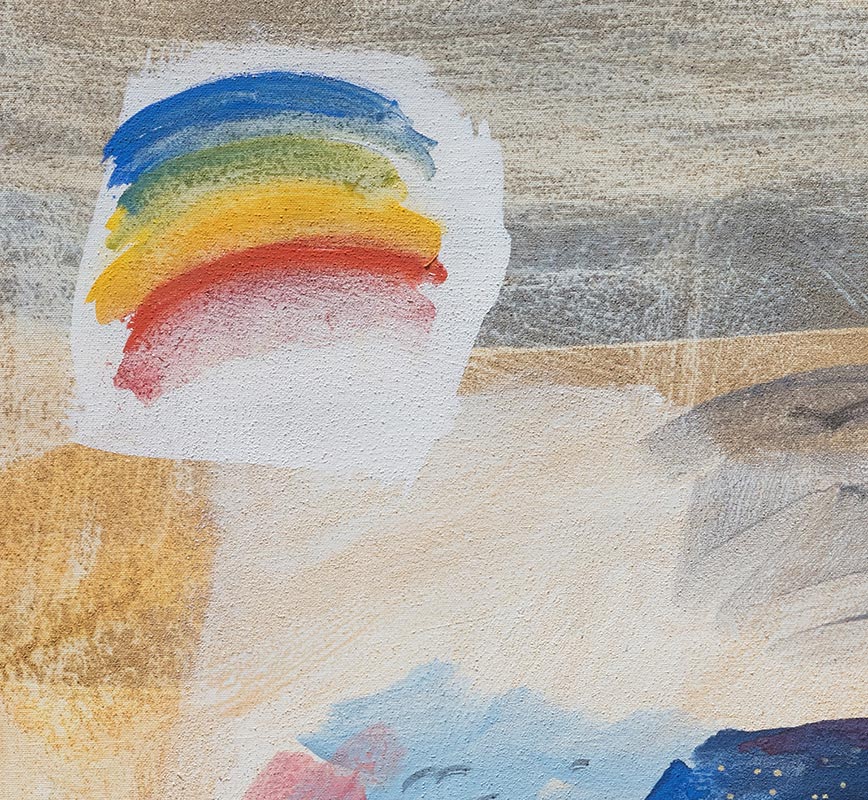
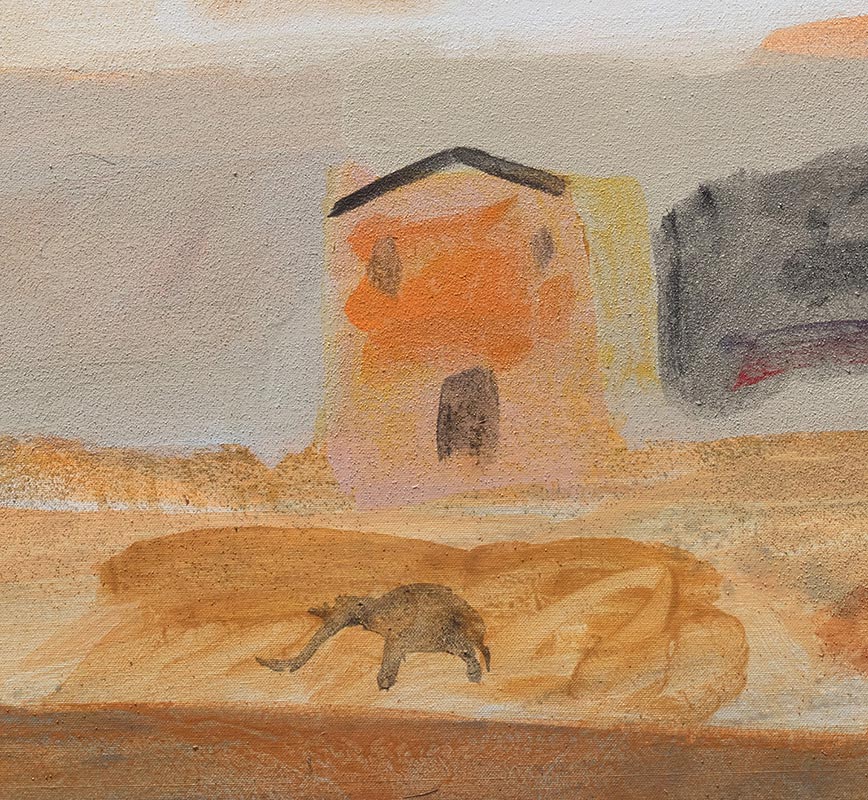
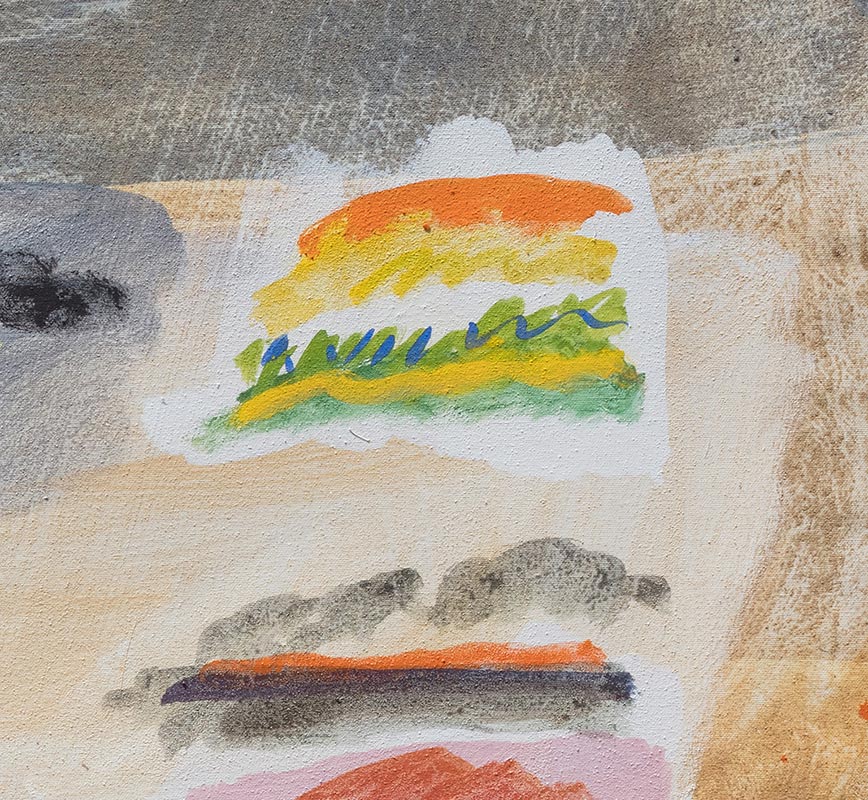
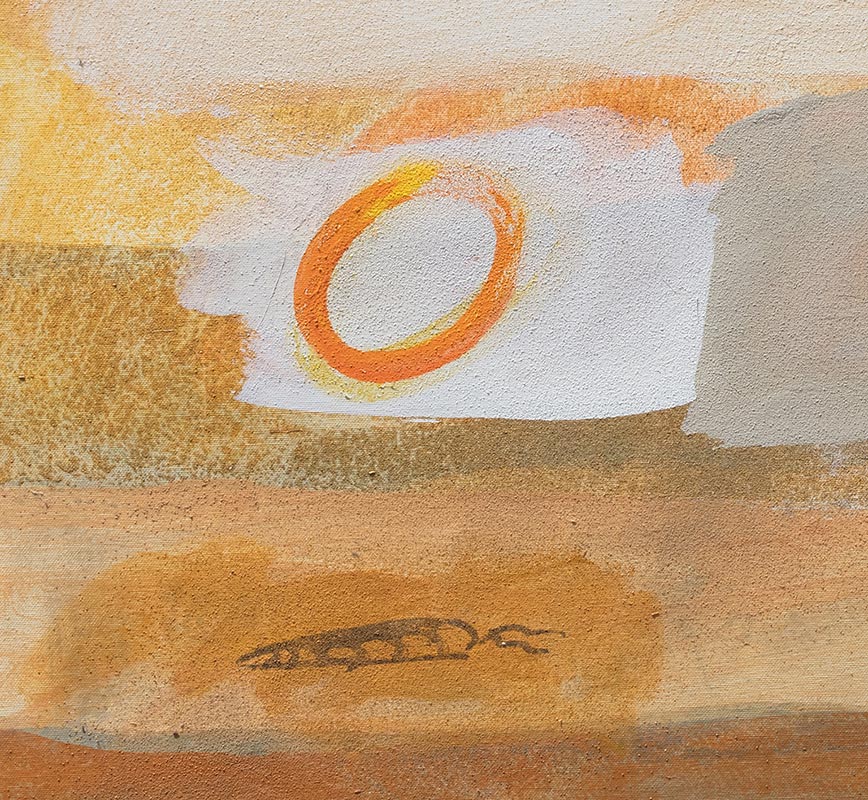
Il Muro di Sale II [The Wall of Salt II] is among the most austere paintings in Buggiani’s early practice: three large zones of raw canvas, white, and warm ochre divide the surface with the directness of a material fact rather than a compositional decision. The white vertical mass at the center, painted but dissolving at its edges, reads less like a form than like an accumulation, something deposited rather than made.
Il Muro di Sale II [The Wall of Salt II] is among the most austere paintings in Buggiani’s early practice: three large zones of raw canvas, white, and warm ochre divide the surface with the directness of a material fact rather than a compositional decision. The white vertical mass at the center, painted but dissolving at its edges, reads less like a form than like an accumulation, something deposited rather than made.
The title names the governing metaphor: salt is what remains after evaporation, the mineral residue of something once liquid. The exposed canvas ground, barely washed, reads as a bleached and porous surface; the white zone as encrustation; the small incidents at their junction, a grey wedge, fragments of orange and yellow, hairline red marks, as the chemistry of a surface acted on by time and element. This is not landscape in the conventional sense but material archaeology, a surface subjected to process rather than painted in the traditional sense.
Dated 1962, the year Buggiani left Rome for New York, it belongs to the same biographical threshold as other early works: the Informale formation fully absorbed, the encounter with New York still ahead. Di Genova documents a first Muro di sale from 1959, in the Schneider collection, as one of the definitive works of Buggiani’s Roman period; this second version revisits the same problem at the moment of departure. The connection to Burri’s investigations of the early 1950s, in which the painted surface is treated as a found or damaged thing rather than a field for expression, is direct: the Italian Informale’s insistence on material as primary pictorial fact, at its most austere.
![Paolo Buggiani, Il Muro di Sale II [The Wall of Salt II], 1962. Fresco on canvas, 35.5 × 47 in. Sparse composition of raw canvas, white vertical mass, and warm ochre zones with small orange and grey incidents.](images/artwork08a.jpg)