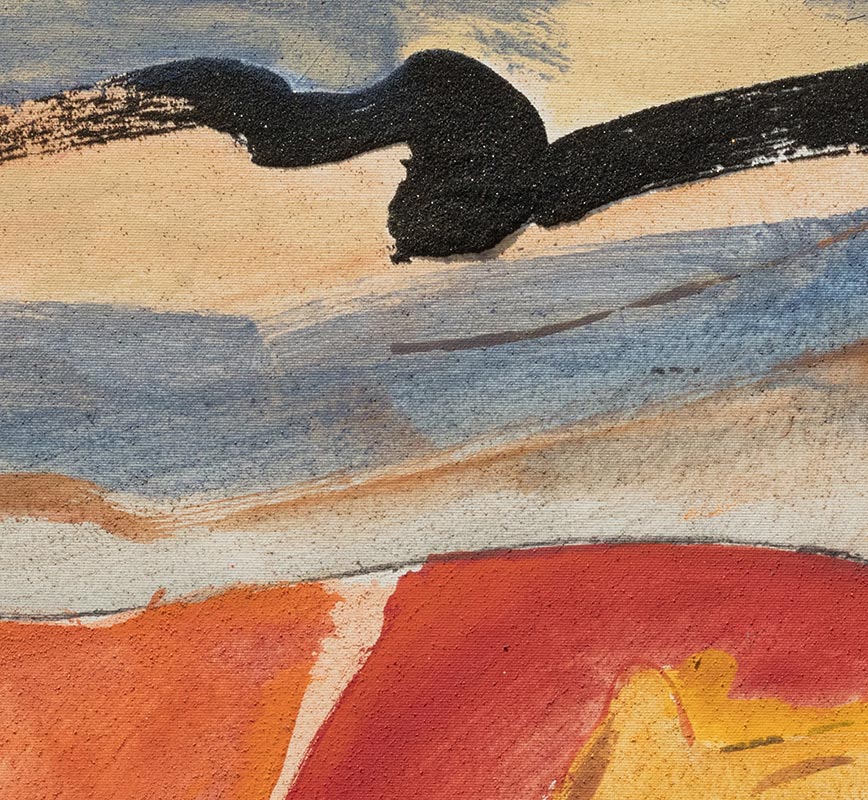
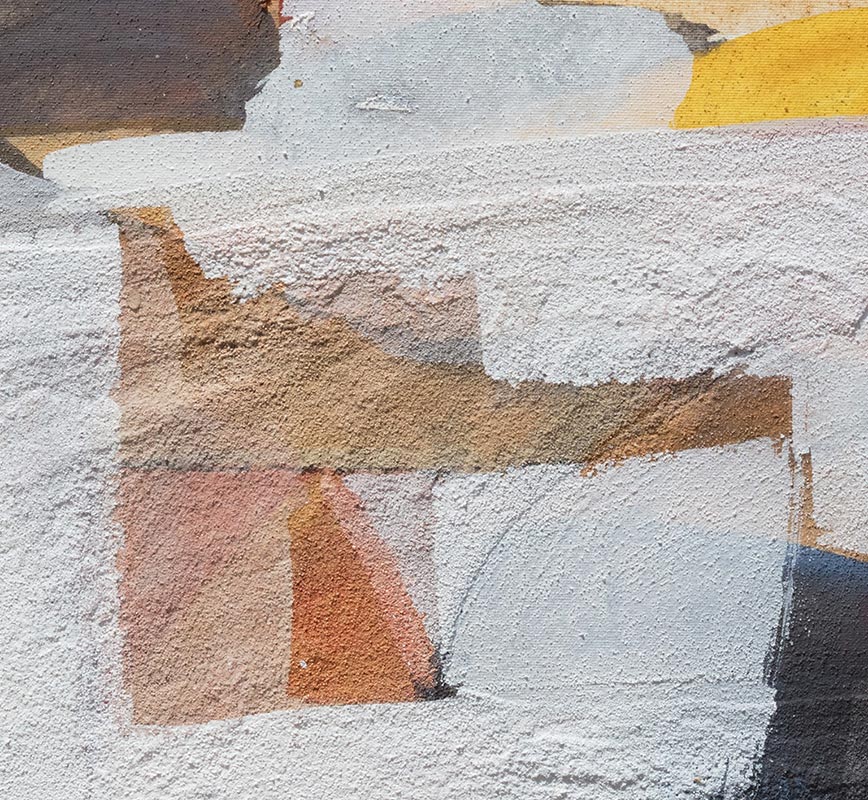
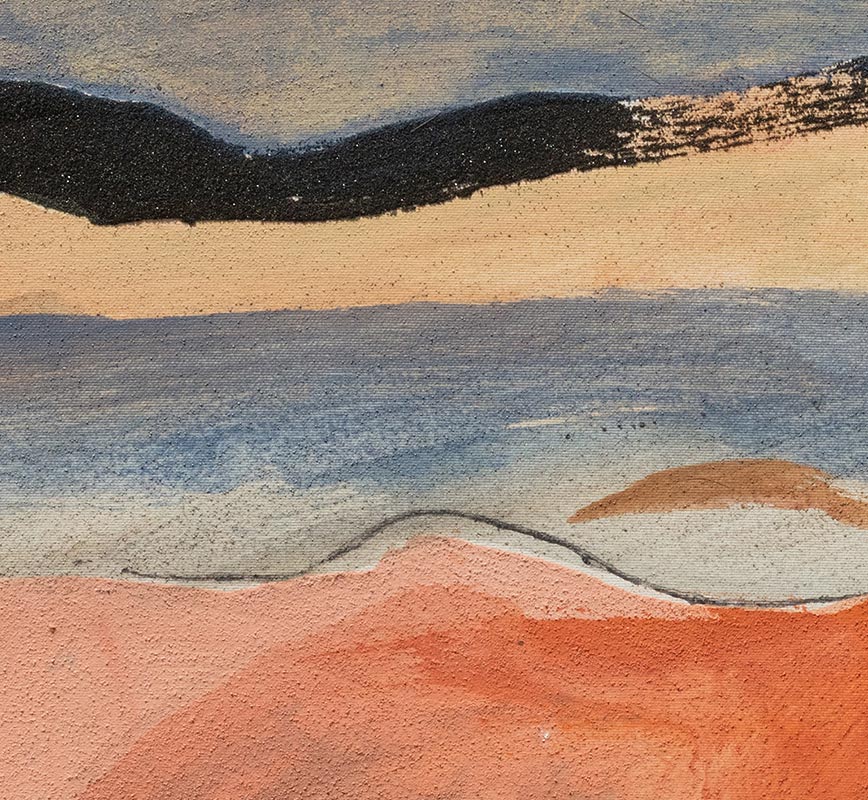
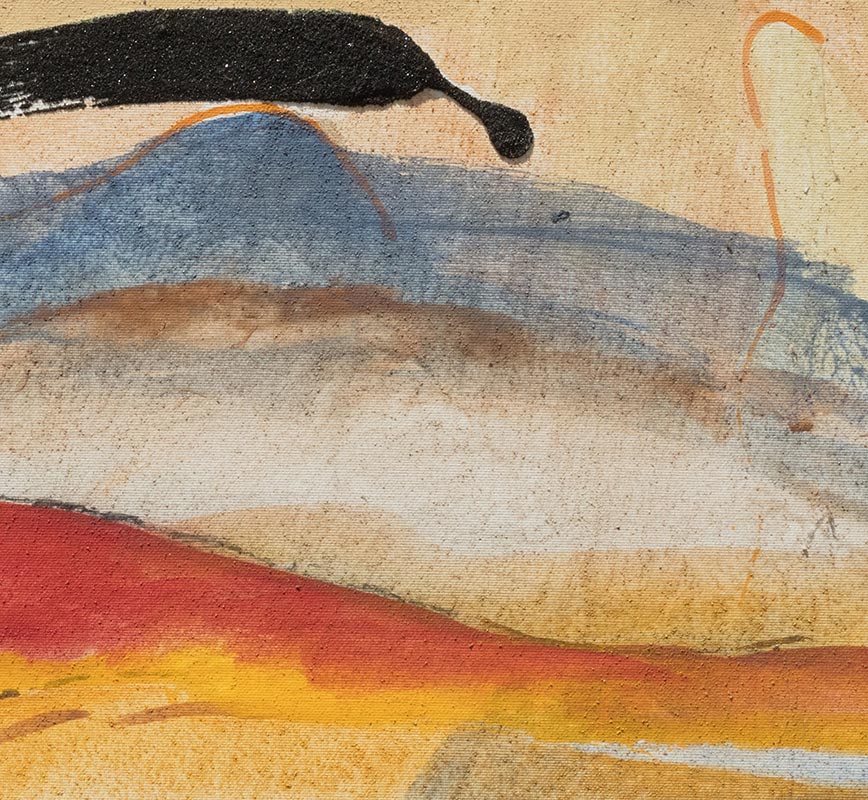
Viaggio nel Sud [Journey to the South] is among the most topographic of Buggiani’s fresco-on-canvas landscapes, the southern Italian terrain resolved into interlocking colored planes that rise from the picture’s base in a dense, upward-pressing mosaic. The palette is deliberately muted: dusty pinks, dull ochres, warm greys, and blue-toned earths with only occasional flashes of stronger color at the edges. A landscape seen from height and from memory simultaneously, stripped of incident and weather.
Viaggio nel Sud [Journey to the South] is among the most topographic of Buggiani’s fresco-on-canvas landscapes, the southern Italian terrain resolved into interlocking colored planes that rise from the picture’s base in a dense, upward-pressing mosaic. The palette is deliberately muted: dusty pinks, dull ochres, warm greys, and blue-toned earths with only occasional flashes of stronger color at the edges. A landscape seen from height and from memory simultaneously, stripped of incident and weather.
Each zone of color presses against its neighbor without overlap, producing a tight pictorial fabric in which the fresco surface plays a direct structural role: the matte granularity of sand and pigment gives each zone a visual weight independent of its hue. There is no atmospheric recession here, no softening of the distant hills: every plane holds its ground with equal conviction, and the landscape resolves into something closer to a map of feeling than a view.
Fabiola Naldi, writing in 2002, described the “interpretative starting grid” running beneath all phases of Buggiani’s practice as its consistent formal constant, tracing it back to his formation in the Roman circle around Cagli and the structural discipline of the Italian Informale. In Viaggio nel Sud, that grid is at its most exposed: the constructive spatial intelligence absorbed in Rome in the 1950s operating with the directness of someone who has been looking at the same hills for a lifetime and no longer needs to explain them.
![Paolo Buggiani, Viaggio nel Sud [Journey to the South], 2007. Fresco on canvas, 35.5 × 47 in. Dense mosaic of interlocking muted color planes in dusty pinks, ochres, and warm greys.](images/artwork02a.jpg)