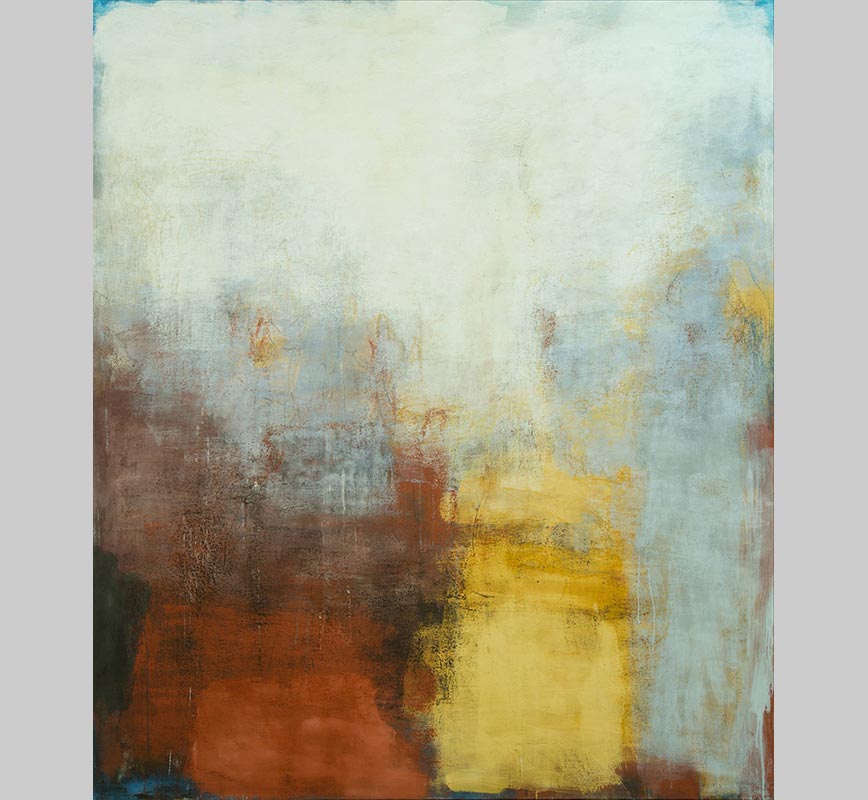
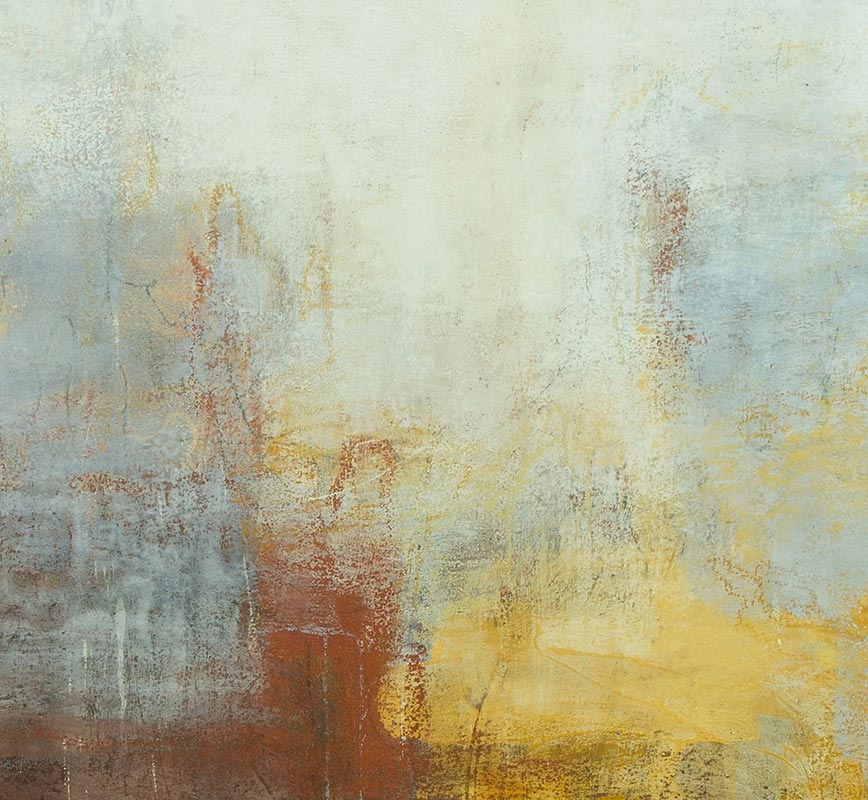
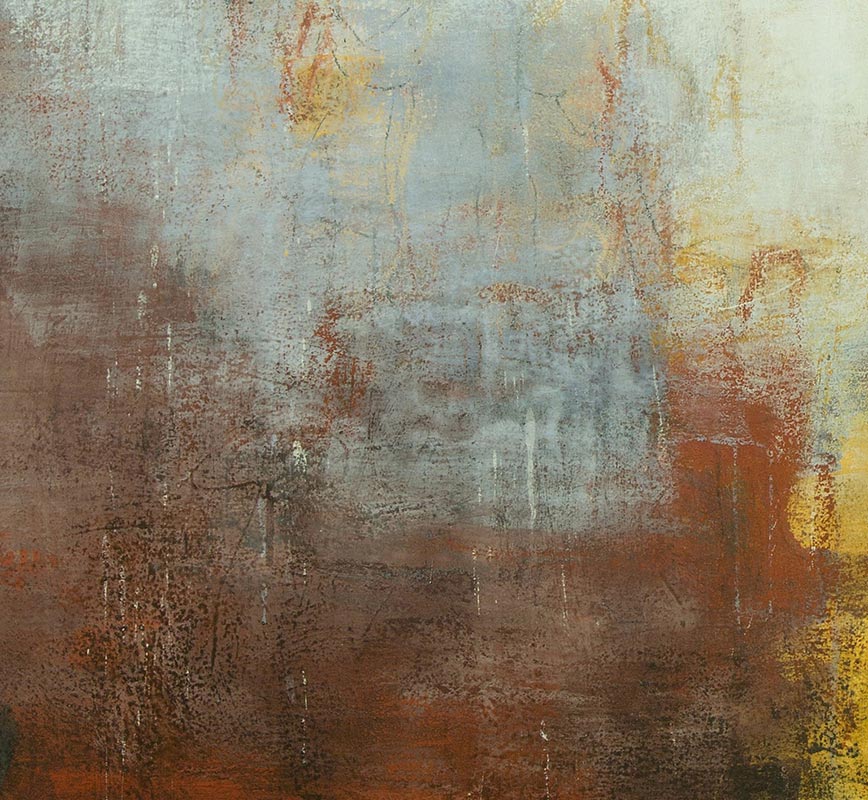
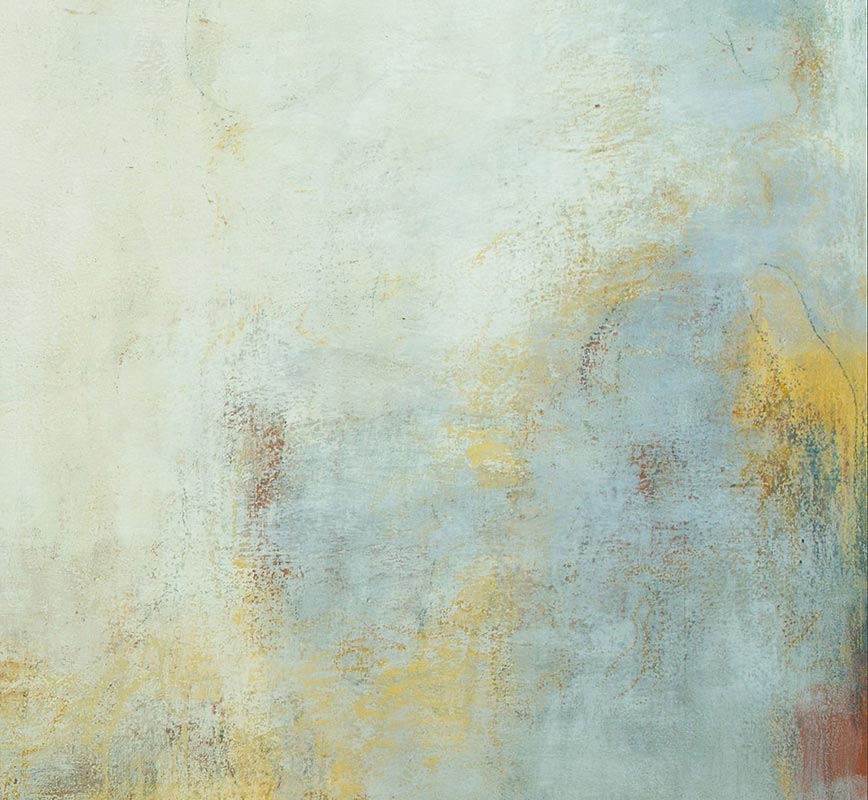
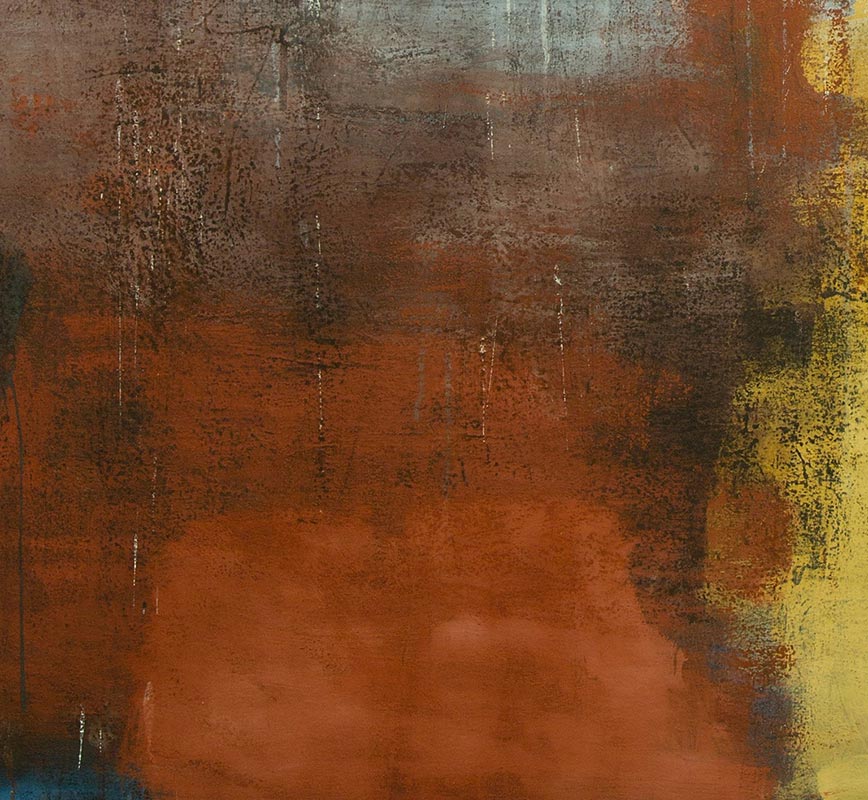
Fields of Quiet Light gives De Gennaro's horizontal landscape logic its fullest spatial extension: the composition moves through amber and burnt orange at the base, a broad turquoise band above, a zone of olive-gold at the center, a dark treeline at the upper third, and a lavender sky. The widest bands have a planarity and evenness that approaches color-field abstraction as primary register rather than landscape as primary subject; the wax surface holds each zone with a translucency that prevents the reading from becoming formal.
Fields of Quiet Light gives De Gennaro's horizontal landscape logic its fullest spatial extension: the composition moves through amber and burnt orange at the base, a broad turquoise band above, a zone of olive-gold at the center, a dark treeline at the upper third, and a lavender sky. The widest bands have a planarity and evenness that approaches color-field abstraction as primary register rather than landscape as primary subject; the wax surface holds each zone with a translucency that prevents the reading from becoming formal.
Fields of Quiet Light earns its title through restraint: the palette is cool and measured, the incident minimal, the treeline barely marking the boundary between earth and sky. The encaustic surface holds this quality without declaring itself, each color zone present at full intensity but contained within the horizontal logic of the composition.
Mark Rothko spent the central decades of his career asking what a field of color could hold: how much emotion, how much space, how much silence. De Gennaro's practice approaches the same question from the opposite formation, arriving at the horizontal field through landscape memory rather than through the American abstract tradition. The wax and glass-powder surface introduces a material specificity that Rothko's oil and egg-based grounds could not provide: the light is inside the paint layer, not merely on it, making the experience of standing before the work as much haptic as retinal.