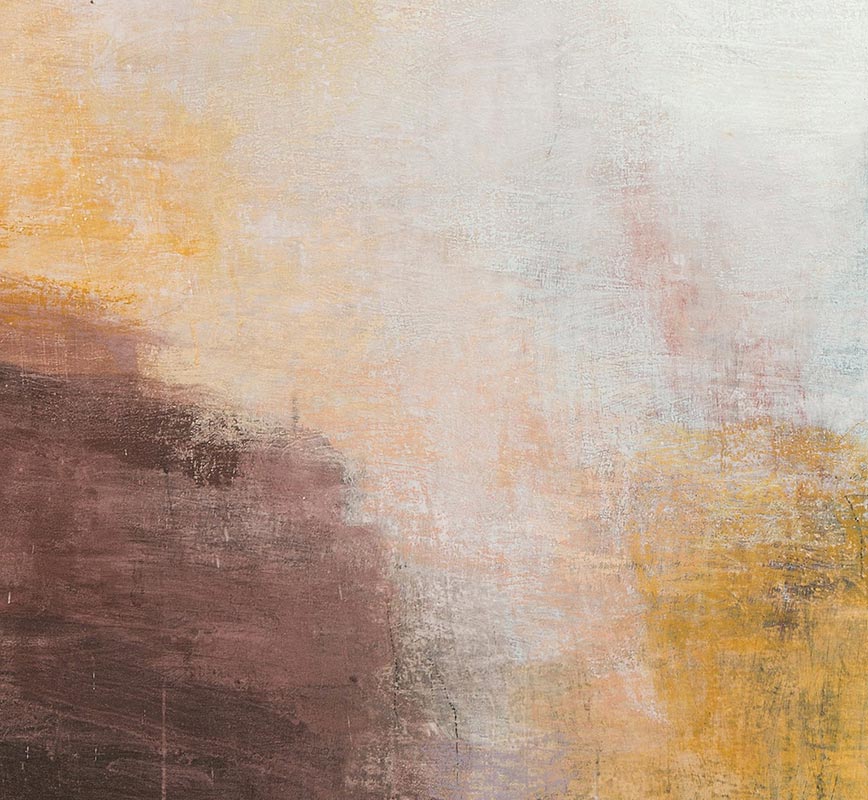
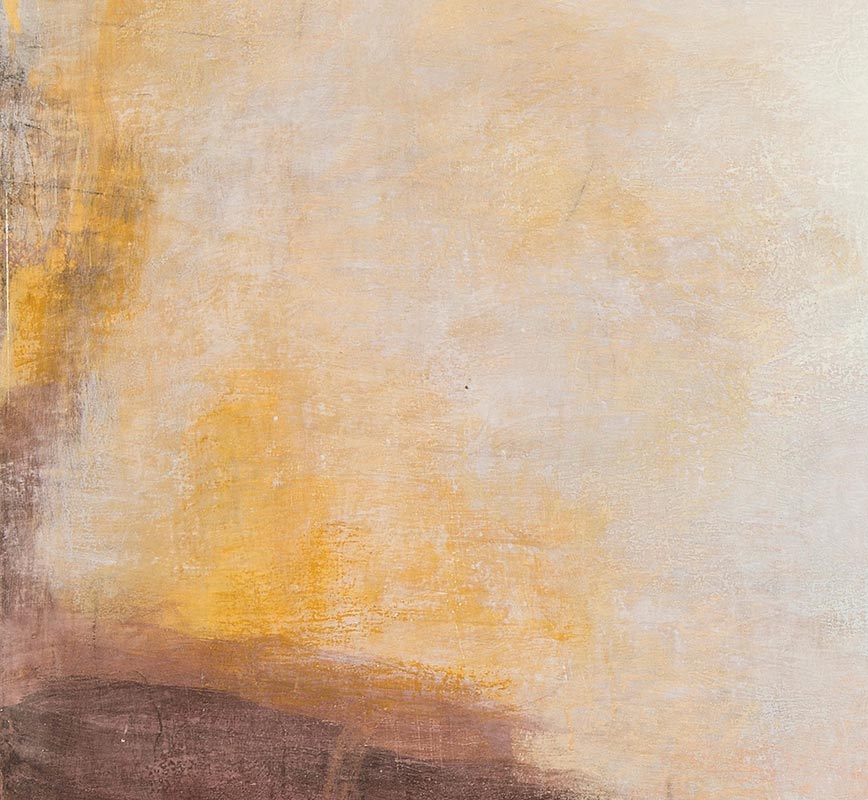
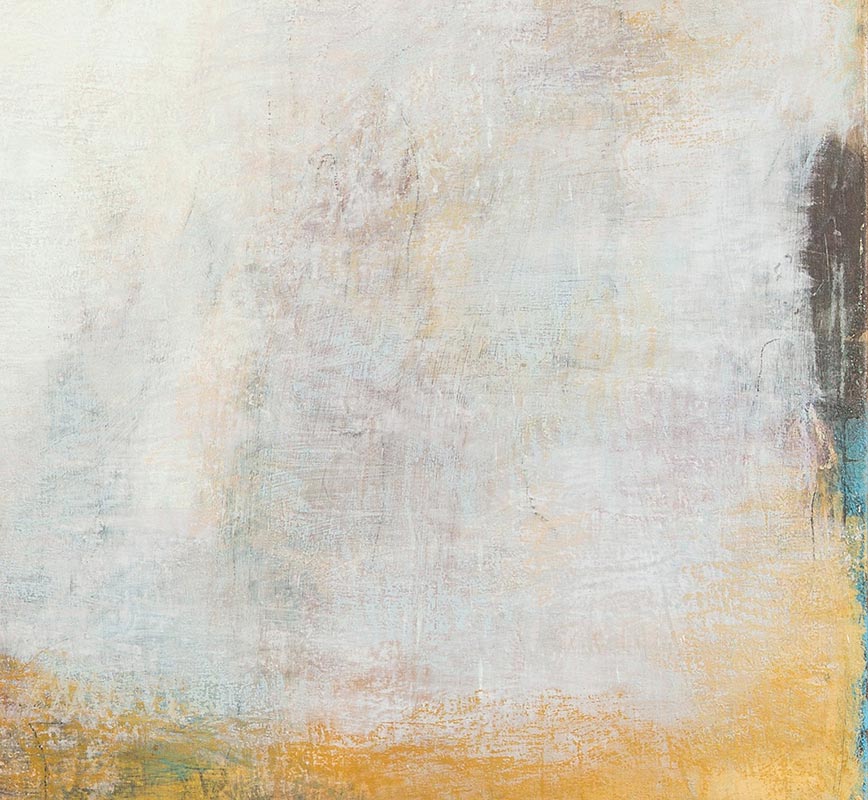
Campi Sospesi [Suspended Fields] condenses De Gennaro's atmospheric landscape language into a single dense chromatic event: cobalt and teal at the upper left, a diagonal sweep of muted gold, deep burgundy, and aquamarine converging toward a pale center that acts as a source of internal light. The small format does not diminish the work; it concentrates it. What in a larger panel would read as zone and stratum here reads as field and pulse, the landscape reduced to its essential chromatic argument.
Campi Sospesi [Suspended Fields] condenses De Gennaro's atmospheric landscape language into a single dense chromatic event: cobalt and teal at the upper left, a diagonal sweep of muted gold, deep burgundy, and aquamarine converging toward a pale center that acts as a source of internal light. The small format does not diminish the work; it concentrates it. What in a larger panel would read as zone and stratum here reads as field and pulse, the landscape reduced to its essential chromatic argument.
The title's word, sospesi, suspended, is precise. The fields in this painting are not at rest; they are held in a state of provisional equilibrium, the color zones meeting at boundaries that the encaustic medium refuses to resolve. The pale center is a vanishing point of a different kind: not depth receding into pictorial space, but light accumulating at the core of the material, a function of the wax and glass-powder matrix rather than of any depicted condition.
At ten inches square, Campi Sospesi asks the viewer to come close, and what it gives in return is a surface that only becomes fully legible in proximity: the glass-powder refraction in the wax matrix, imperceptible from a distance, reveals itself as the substance of the painting when the eye arrives at the right distance. The scale is not a limitation; it is a condition of the encounter. Paul Klee understood that small works do not merely compress large ones: they change the nature of attention, requiring the eye to enter an intimate register before the work yields what it holds. Campi Sospesi operates precisely in that register: the landscape is reduced to its essential chromatic argument, and the argument requires proximity to be heard.
![Abstract encaustic painting by Orazio De Gennaro. Dense chromatic event in cobalt, teal, muted gold, and aquamarine converging toward a pale internally lit center. Campi Sospesi [Suspended Fields], 2026.](images/artwork02a.jpg)