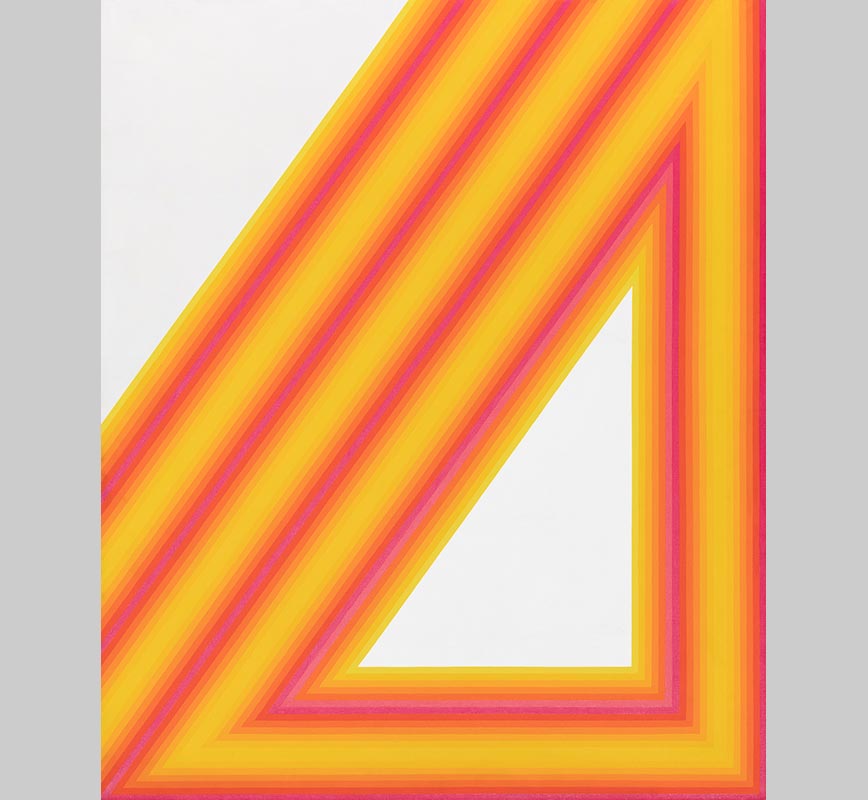
Three intersecting planes of black, gray, and white occupy a wide horizontal panel, their arrangement angular and architectural, the composition presenting itself as both painting and structural diagram. The surfaces have a matte, brushed quality that catches light differently across each plane, and the white triangle at upper right is not neutral but active: it generates a sense of light arriving from outside the painting’s own logic, from a source the composition does not disclose.
Three intersecting planes of black, gray, and white occupy a wide horizontal panel, their arrangement angular and architectural, the composition presenting itself as both painting and structural diagram. The surfaces have a matte, brushed quality that catches light differently across each plane, and the white triangle at upper right is not neutral but active: it generates a sense of light arriving from outside the painting’s own logic, from a source the composition does not disclose.
Canin is working in the territory that Kazimir Malevich mapped with his black and white Suprematist canvases, where those two values stood as the fundamental coordinates of painting freed from the world of objects. The intention here is different. The shaped panel is an object in the room; the gray plane, with its visible surface texture, keeps the work material and physical, resistant to the transcendence Malevich sought. The architectural quality connects instead to the Hard-Edge tradition: painting that treats the picture plane as a site of structural problem-solving.
Canin’s own statement, that Manet’s understanding of conciseness as both necessary and elegant still resonates after forty years of practice, is directly legible in this work. Every shape is load-bearing. The narrow white wedge could not be moved without altering the entire structure, and the dark mass that anchors the left side could not be lighter or heavier without destabilizing the precise equilibrium Canin has constructed. Luminosity, here, is not warmth; it is exactitude.