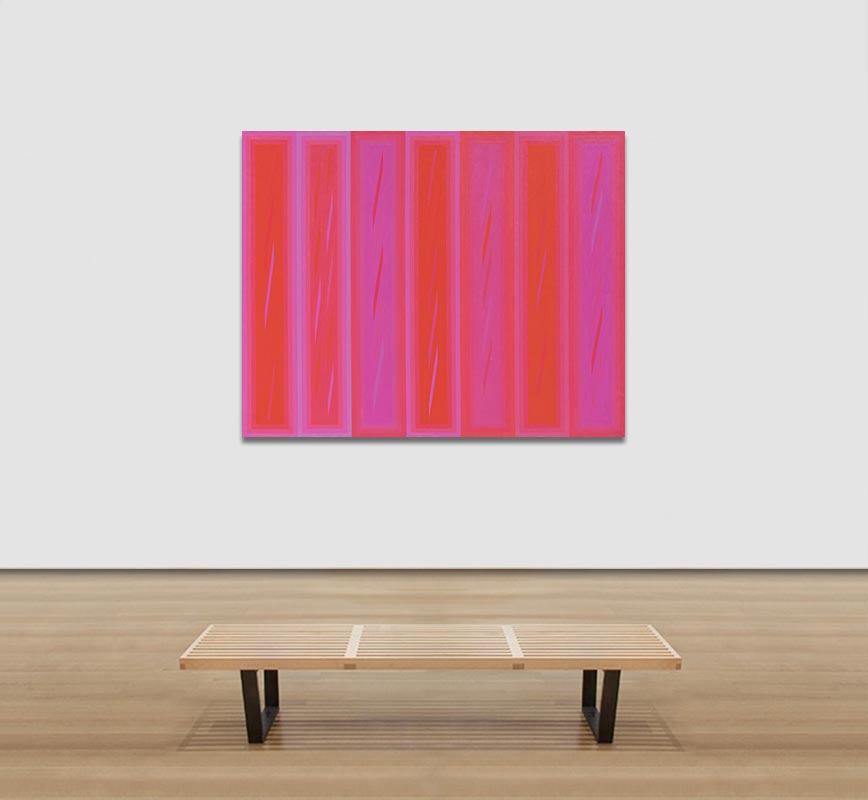
Victoria Blue is held almost entirely within a single blue, a deep, saturated field that occupies the canvas from edge to edge with the authority of a color that has decided it needs no support. Two vertical bands at the right edge shift the hue by barely perceptible degrees, introducing a quiet structural event that does not announce itself but cannot be ignored once seen. The matte surface keeps the blue from becoming spatial; it stays on the wall, present and self-contained.
Victoria Blue is held almost entirely within a single blue, a deep, saturated field that occupies the canvas from edge to edge with the authority of a color that has decided it needs no support. Two vertical bands at the right edge shift the hue by barely perceptible degrees, introducing a quiet structural event that does not announce itself but cannot be ignored once seen. The matte surface keeps the blue from becoming spatial; it stays on the wall, present and self-contained.
Canin embeds a decision within the monochromatic field: the two bands in Victoria Blue are a refusal of the absolute, a structural event however quiet that keeps color from dissolving into concept. This is the critical distance from Yves Klein’s International Klein Blue, developed in 1960, which pursued the field as pure chromatic presence freed from form and structural information. Canin’s blue stays a painting.
Barnett Newman’s zip paintings introduced a vertical line that divided and activated the fields on either side, creating scale and spatial drama. The bands in Victoria Blue work differently: they introduce differentiation without drama, a slight shift in hue rather than a structural rupture. Martica Sawin, writing about Canin’s shaped canvases in 1978, described his work as addressing the mind rather than seducing the eye; this painting is the quietest demonstration of that disposition in the set.