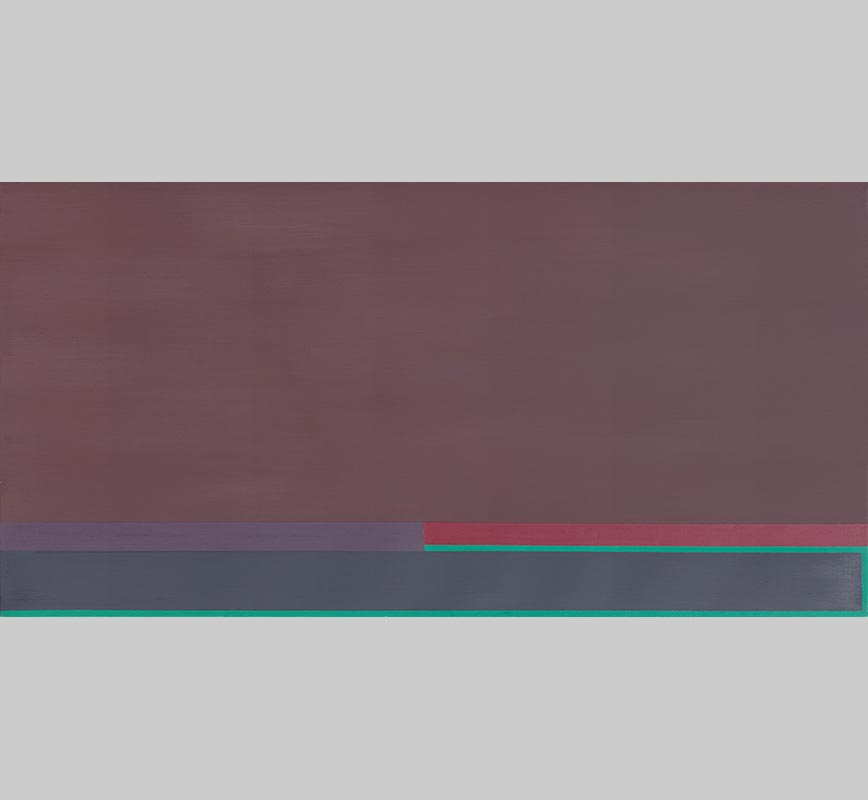
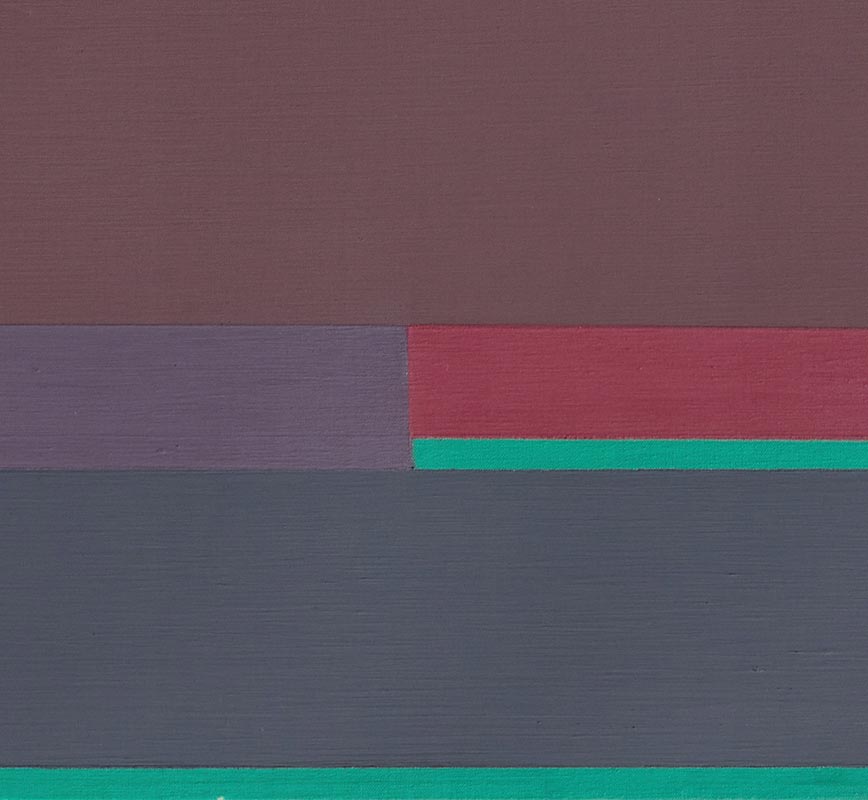
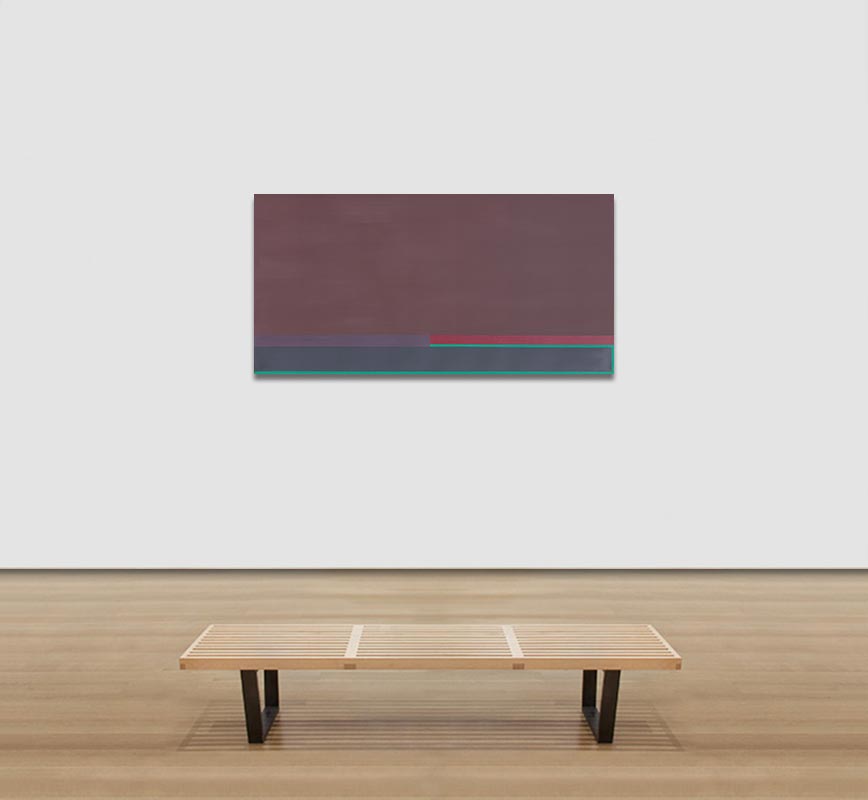
This shaped canvas from around 1990 takes the form of an irregular pentagon, its top edge angled sharply and its bottom cut to a point on the left, so that the painting reads in the room as a tilted, weightless plane rather than a rectangle held in place. Lavender dominates the central field, with a pink wedge at the upper right and an orange band along the bottom, a thin turquoise line marking the boundary between the two upper zones.
This shaped canvas from around 1990 takes the form of an irregular pentagon, its top edge angled sharply and its bottom cut to a point on the left, so that the painting reads in the room as a tilted, weightless plane rather than a rectangle held in place. Lavender dominates the central field, with a pink wedge at the upper right and an orange band along the bottom, a thin turquoise line marking the boundary between the two upper zones.
Canin places color independently within the shaped support, the zones coexisting with the perimeter rather than generated by it. This is the critical distinction from Frank Stella, whose shaped canvases derived their painted images directly from the eccentric support: the composition issued from the edges, form and content structurally inseparable. Canin’s support provides the physical context; the painted decisions are independent. The result is a more meditative relationship between paint and support than Stella sought.
The lavender field carries the same contemplative register as Canin’s band paintings from the previous decade; the shaped support has not changed the fundamental quality of the color, only the terms of its experience. The pastel palette, lavender against pink against orange with turquoise as structural accent, belongs to the lighter chromatic register that distinguishes Canin’s work from the saturated contrasts of Hard-Edge abstraction.