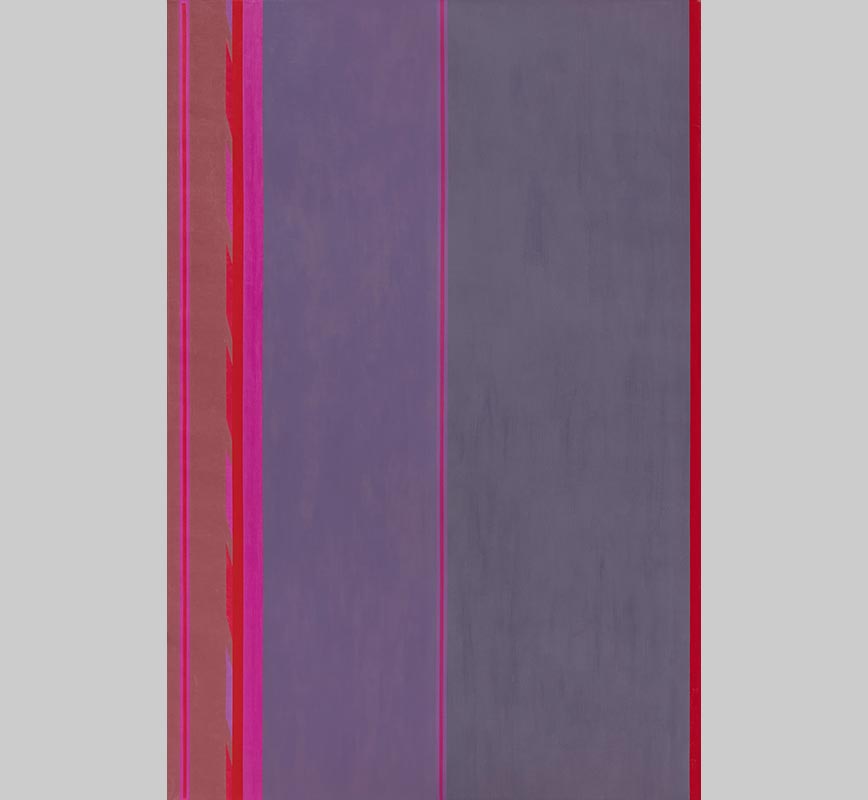
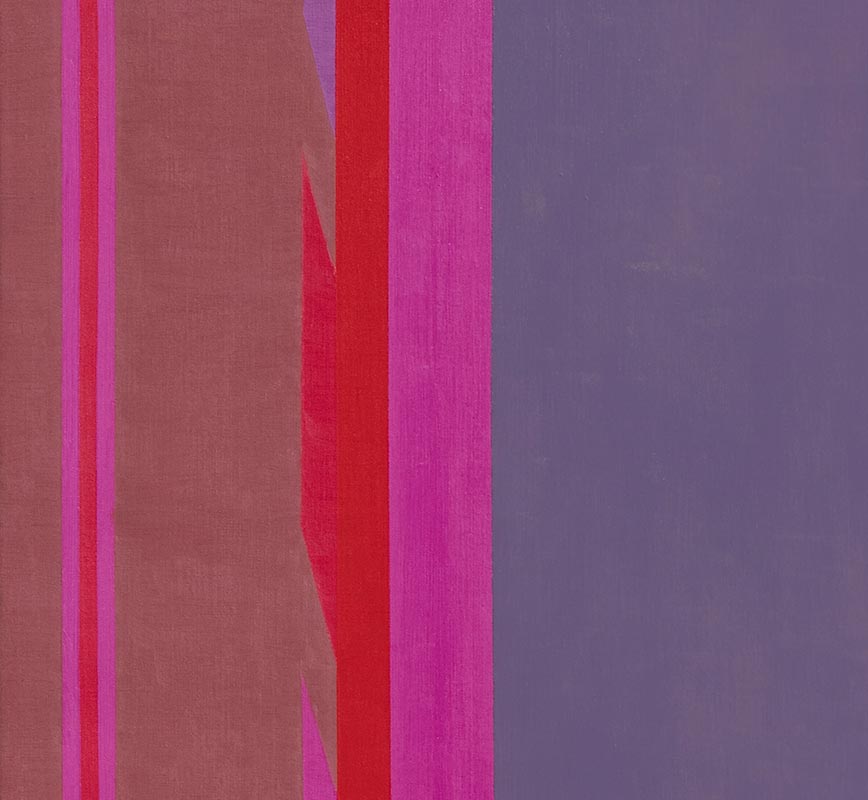
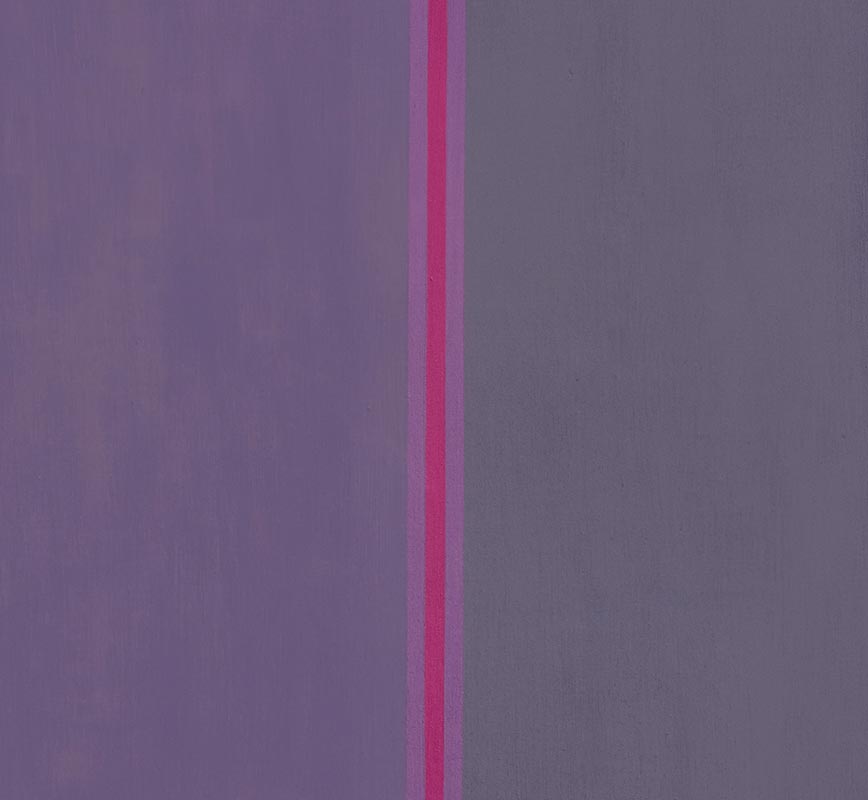
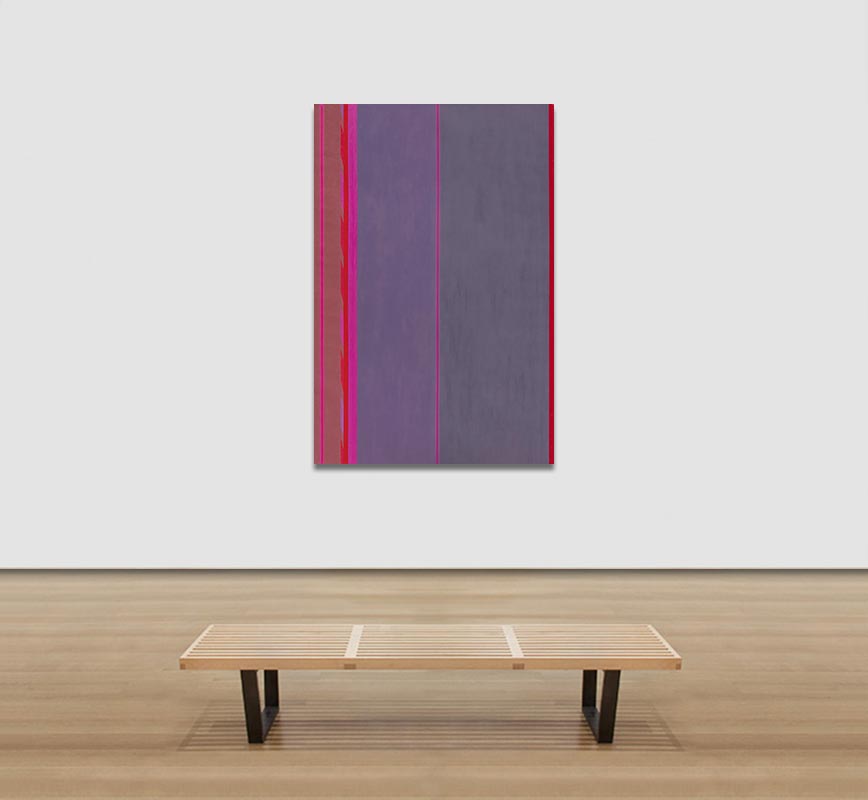
Three geometric planes in muted red, olive green, and deep purple overlap and interlock across a shaped canvas whose angled sides press against the composition’s sense of forms under lateral pressure. The palette has withdrawn from the vivid chromatic energy of the earlier band paintings into a more restrained architectural register, and the partially overlapping planes build a layered spatial depth that the band works deliberately refused.
Three geometric planes in muted red, olive green, and deep purple overlap and interlock across a shaped canvas whose angled sides press against the composition’s sense of forms under lateral pressure. The palette has withdrawn from the vivid chromatic energy of the earlier band paintings into a more restrained architectural register, and the partially overlapping planes build a layered spatial depth that the band works deliberately refused.
Canin’s overlapping planes work in dialogue with the tradition of Piet Mondrian’s Neo-Plasticism without submitting to it. Mondrian reduced painting to horizontal and vertical elements in primary colors, every relationship defined and balanced, the logic one of absolute formal resolution. The muted tones and diagonal overlaps here are less resolved than Neo-Plasticism demanded: the composition holds an irresolution Mondrian would have corrected.
The shaped canvas here differs from the T-form of Mars Violet or the wedge of Chad. Those supports carried architectural and cultural references; this support is more irregular, its angled sides offering no stable orientation. The interlocking planes must negotiate a pressured spatial context, and the muted palette amplifies rather than resolves the tension.