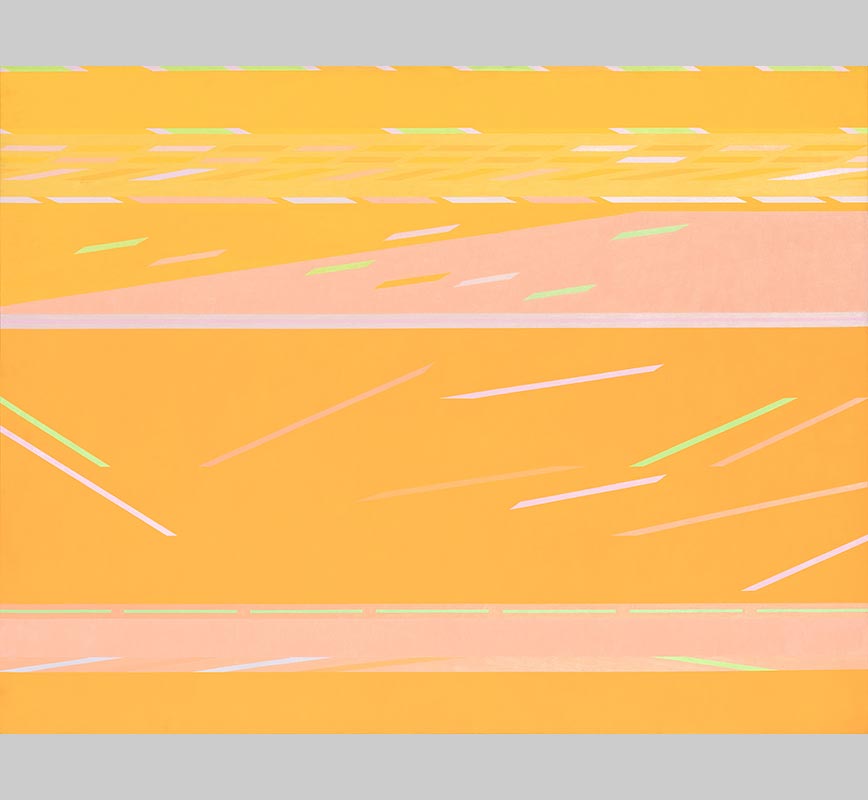
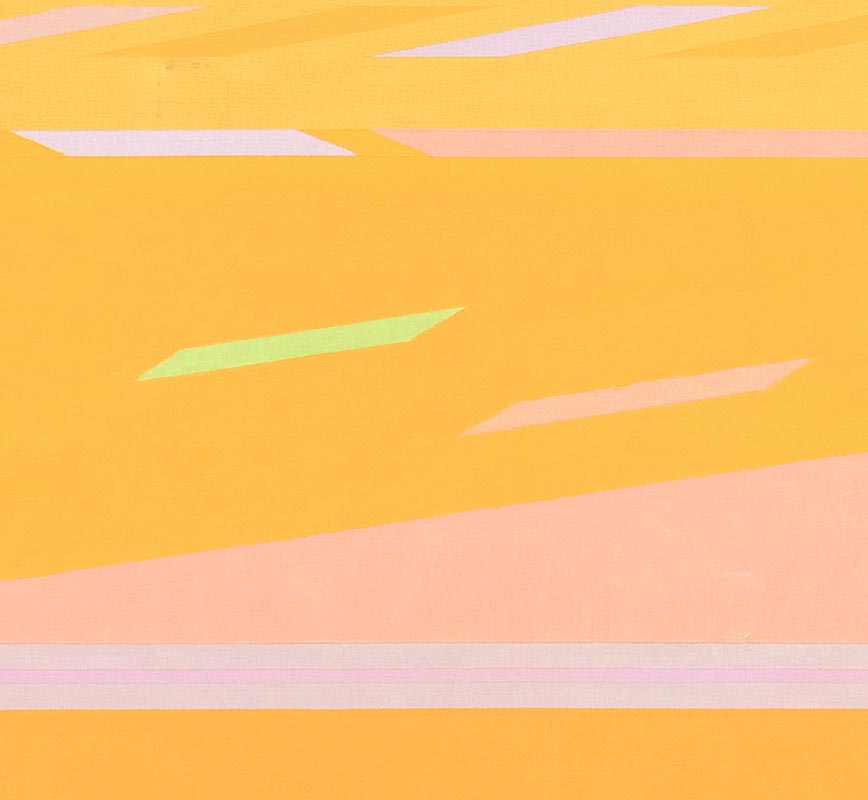
A field of deep red occupies Pont Marie almost in its entirety, and the painting’s restraint is its argument: the red is not a background to something else but the event itself, dense and sustained, interrupted on the left by three narrow vertical bands in violet and pink that introduce just enough complexity to make the field’s own silence audible. The matte surface amplifies this quality, refusing the reflective warmth that glossy oil might produce and keeping the color within itself.
A field of deep red occupies Pont Marie almost in its entirety, and the painting’s restraint is its argument: the red is not a background to something else but the event itself, dense and sustained, interrupted on the left by three narrow vertical bands in violet and pink that introduce just enough complexity to make the field’s own silence audible. The matte surface amplifies this quality, refusing the reflective warmth that glossy oil might produce and keeping the color within itself.
Canin’s edges are decided: the violet and pink bands at the left of Pont Marie are placed, not drifted, their narrow precision in structural tension with the atmospheric reach of the red field behind them. This is the crucial temperamental and technical distance from Mark Rothko, who pursued a related logic in his mature works but let color fields breathe at their margins, dissolving at the edges into uncertainty. The tension Rothko dissolved, Canin holds.
The artist himself identified with Manet’s conviction that conciseness in art is both necessary and elegant. In Pont Marie the restraint is radical: the entire pictorial event is contained in three narrow bands against a field that occupies nearly the full canvas. Nothing is added that the composition does not require, and the luminosity Canin always sought arrives not from color complexity but from the clarity of the proposition itself.