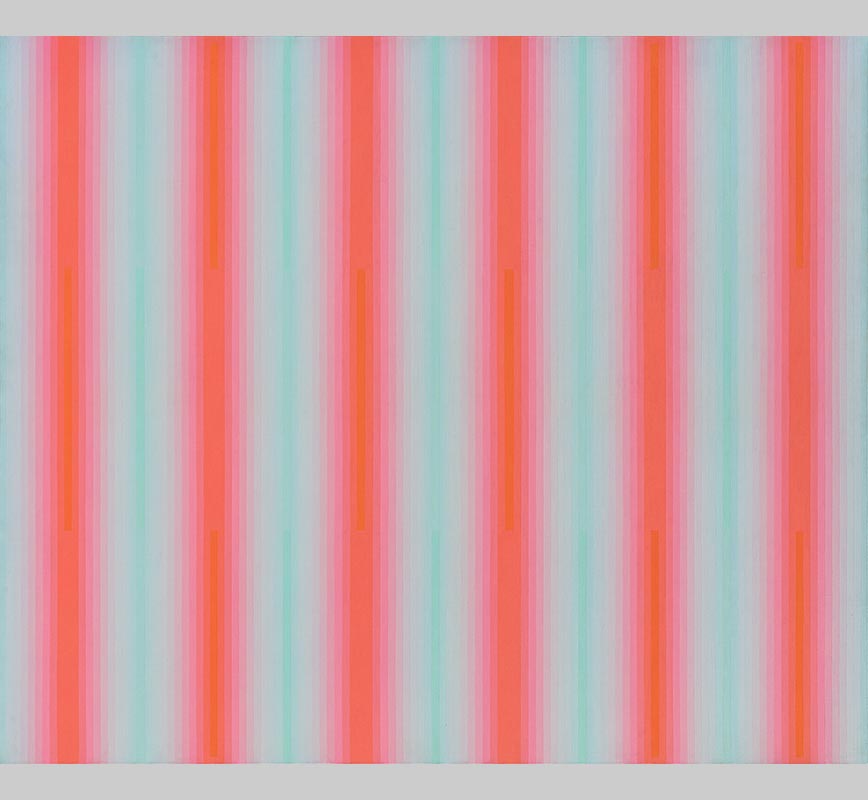
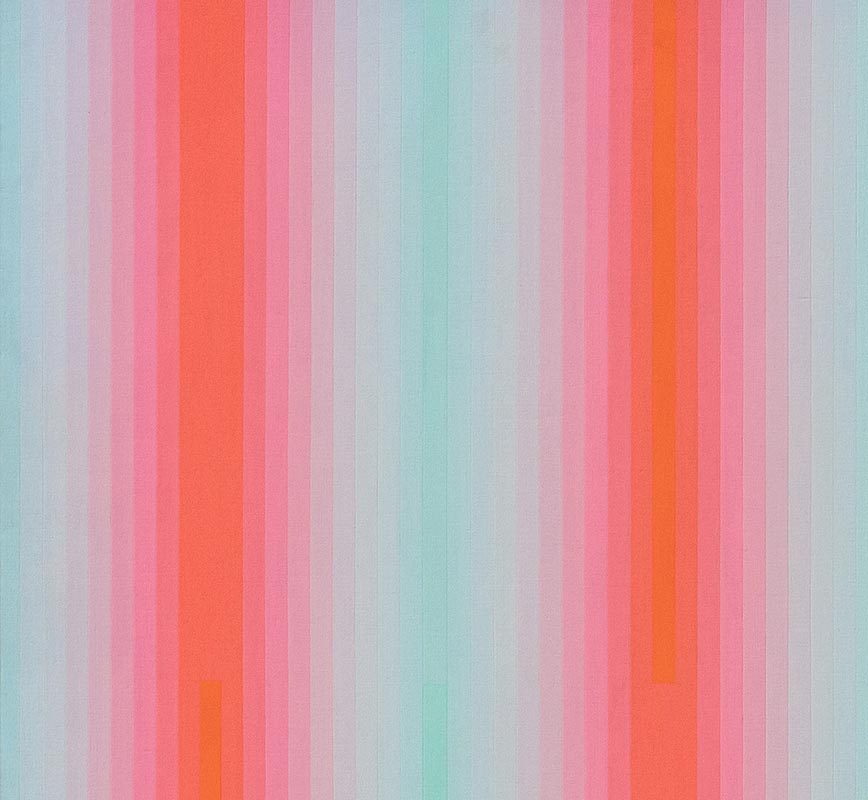
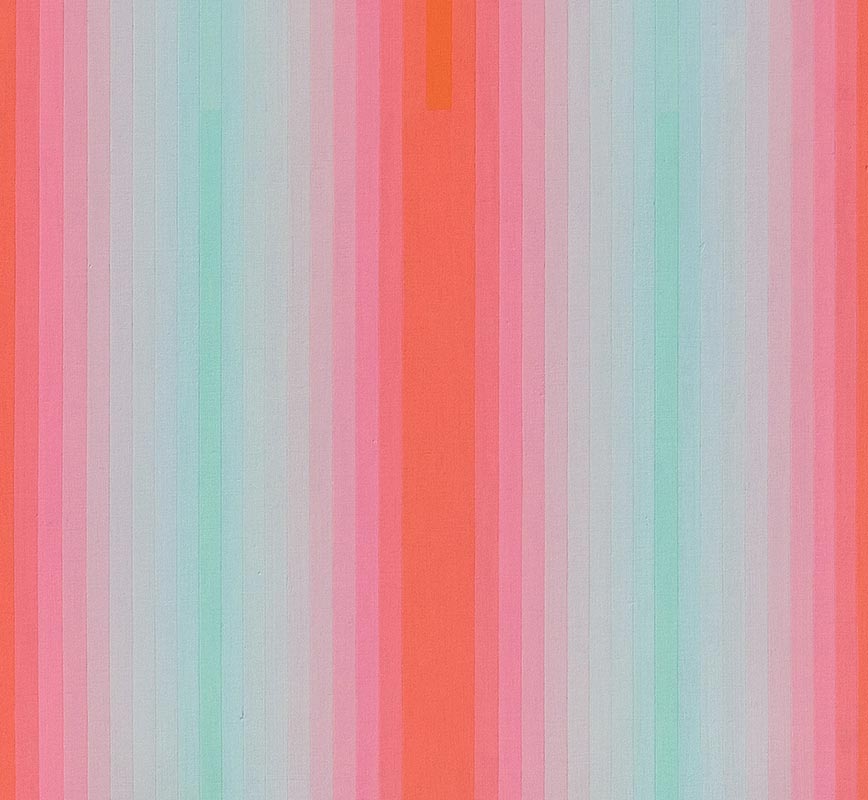
The eye settles into that vast, quiet mauve field and stays there longer than expected, long enough to register that it is doing something: holding. Then the bottom of the canvas opens into a different kind of logic, a sequence of horizontal bands in slate, lavender, crimson, and teal that are not quite symmetrical, not quite resolved. The left and right halves do not agree. Something is withheld, and that withholding is the painting's subject.
The eye settles into that vast, quiet mauve field and stays there longer than expected, long enough to register that it is doing something: holding. Then the bottom of the canvas opens into a different kind of logic, a sequence of horizontal bands in slate, lavender, crimson, and teal that are not quite symmetrical, not quite resolved. The left and right halves do not agree. Something is withheld, and that withholding is the painting's subject.
Canin's band paintings of the late 1970s were not operating within the Color Field orthodoxy they superficially resemble. Where Helen Frankenthaler or Morris Louis dissolved color into atmosphere, Canin kept it declarative: edges taped, surfaces workmanlike, the process legible. What interested him was not color's ability to seduce but its resistance to easy identification. The teal strip at the bottom registers as both complement and intrusion, too precise to be atmospheric, too narrow to be structural. It sits there asking a question the mauve field above cannot answer.
Martica Sawin, writing in Arts Magazine in 1978, described Canin's shaped work as presenting a subtle visual conundrum, a logic of structure at variance with what the painted surface actually shows. The observation applies here without the eccentric support: the asymmetric break in the bands creates exactly that variance, proposing order and then quietly refusing to deliver it. Richard Bellamy, whose eye shaped the Michener Collection's extraordinary archive of late-1960s experimental abstraction, placed Canin among painters who wanted their work experienced over time. This painting makes that demand.