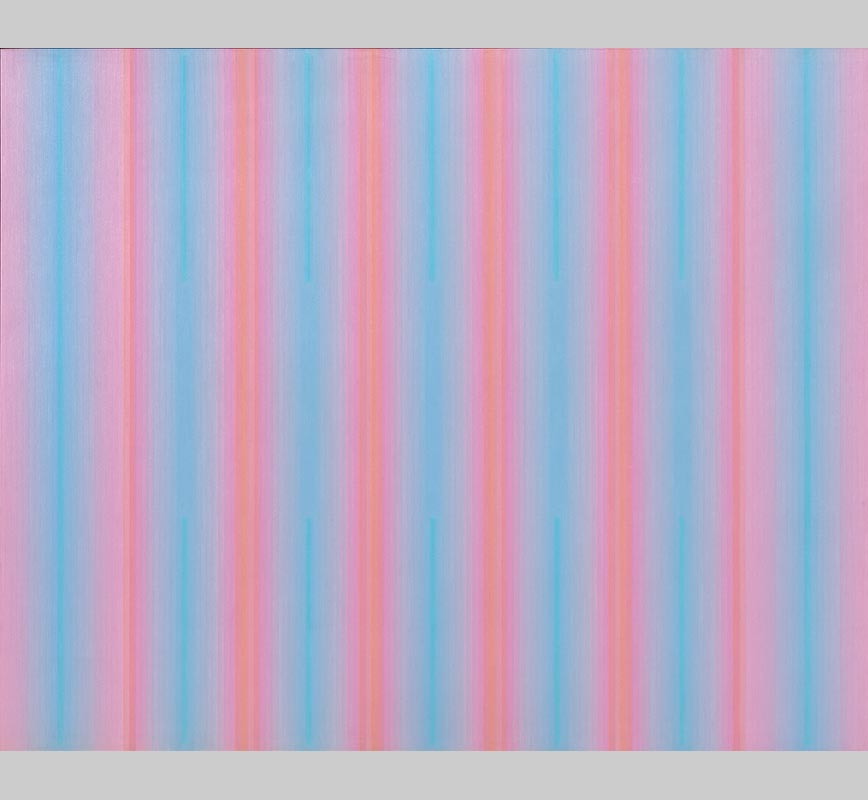
A mauve field occupies most of Untitled #51, holding the canvas in a sustained, contemplative register before the eye reaches the horizontal bands at top and bottom. Three bands, green, gray, and a narrow rectangle of red near the upper edge, create a structure that is spare almost to the point of severity. The red is the painting’s most concentrated event: a small, bright presence in a field of quiet that announces itself precisely because of how little company it has.
A mauve field occupies most of Untitled #51, holding the canvas in a sustained, contemplative register before the eye reaches the horizontal bands at top and bottom. Three bands, green, gray, and a narrow rectangle of red near the upper edge, create a structure that is spare almost to the point of severity. The red is the painting’s most concentrated event: a small, bright presence in a field of quiet that announces itself precisely because of how little company it has.
The green and gray bands at the edges of this painting are in exactly the relationship that Josef Albers spent his career at the Bauhaus and then at Yale demonstrating: color is never perceived in isolation, every hue transformed by its neighbors, its identity contingent on context. The small red rectangle placed asymmetrically at the upper edge creates a quiet structural tension that Albers would have recognized as a color argument rather than a compositional decision.
Unlike painters who use the full rectangle as an undifferentiated field, Canin distributes his color events across distinct spatial zones, the broad mauve center functioning as the painting’s ground zero, the bands at the perimeter providing the structural information the center withholds. The intimacy of this arrangement is not accidental: it scales the color relationships to the viewer’s close attention rather than to the room.