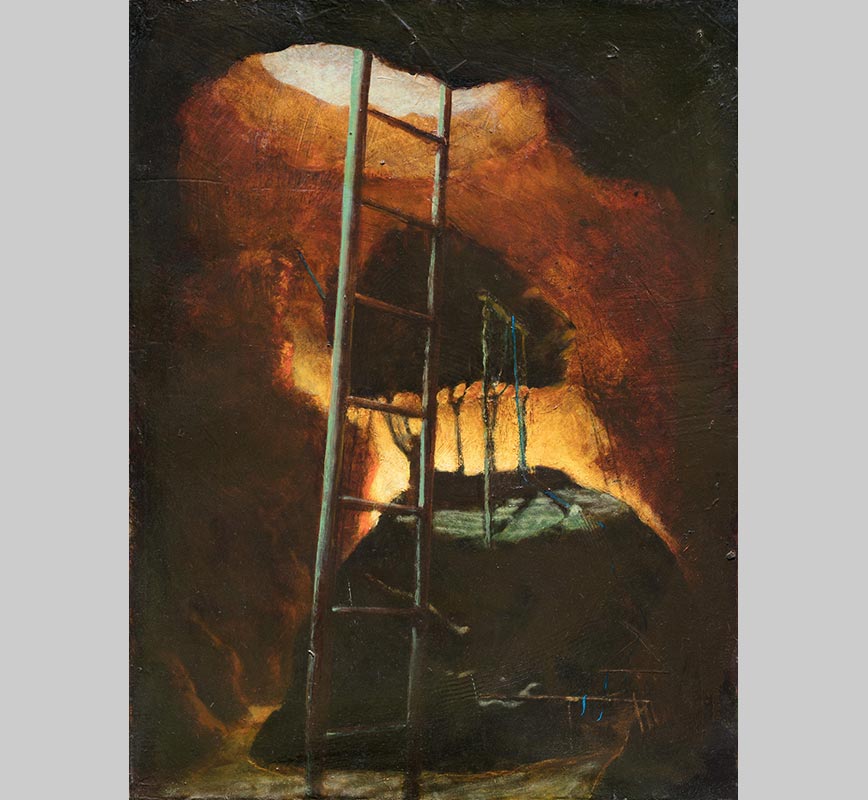
Landscape sets bright colored geometrical forms against a heavily worked ground of browns and ochres, the composition driven by a surge of competing energies that refuses any single point of rest. The foreground holds scroll-like structures that have unfurled and lie partially flattened, resembling ancient maps or rolled documents. Nothing in the scene is recognizably a landscape in the conventional sense; it is an investigation of what the word could mean once representation yields to surface, architecture, and mark.
Landscape sets bright colored geometrical forms against a heavily worked ground of browns and ochres, the composition driven by a surge of competing energies that refuses any single point of rest. The foreground holds scroll-like structures that have unfurled and lie partially flattened, resembling ancient maps or rolled documents. Nothing in the scene is recognizably a landscape in the conventional sense; it is an investigation of what the word could mean once representation yields to surface, architecture, and mark.
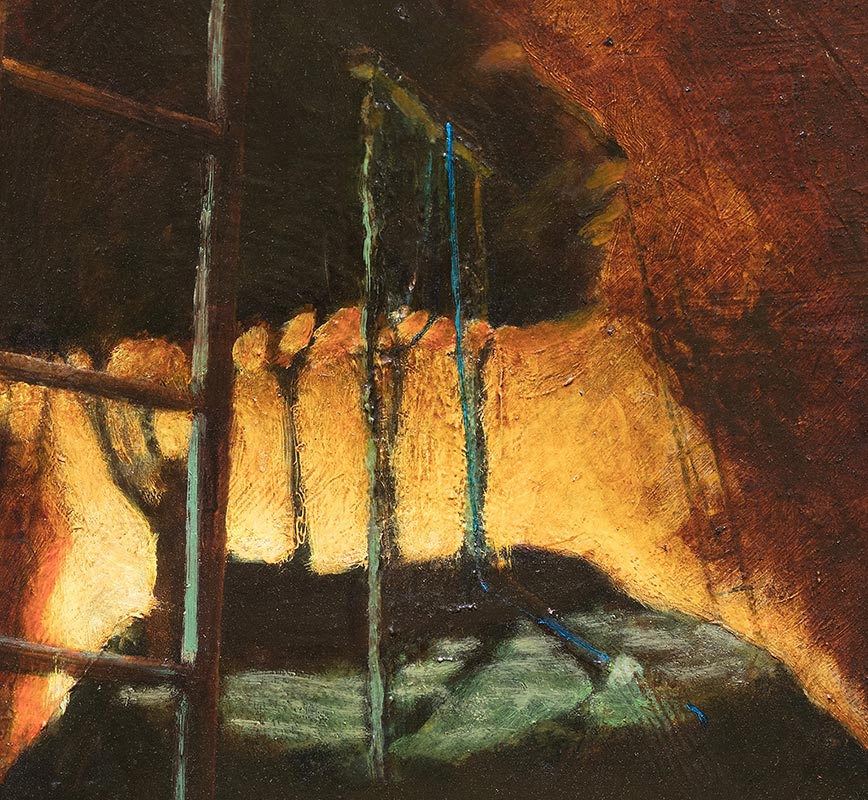
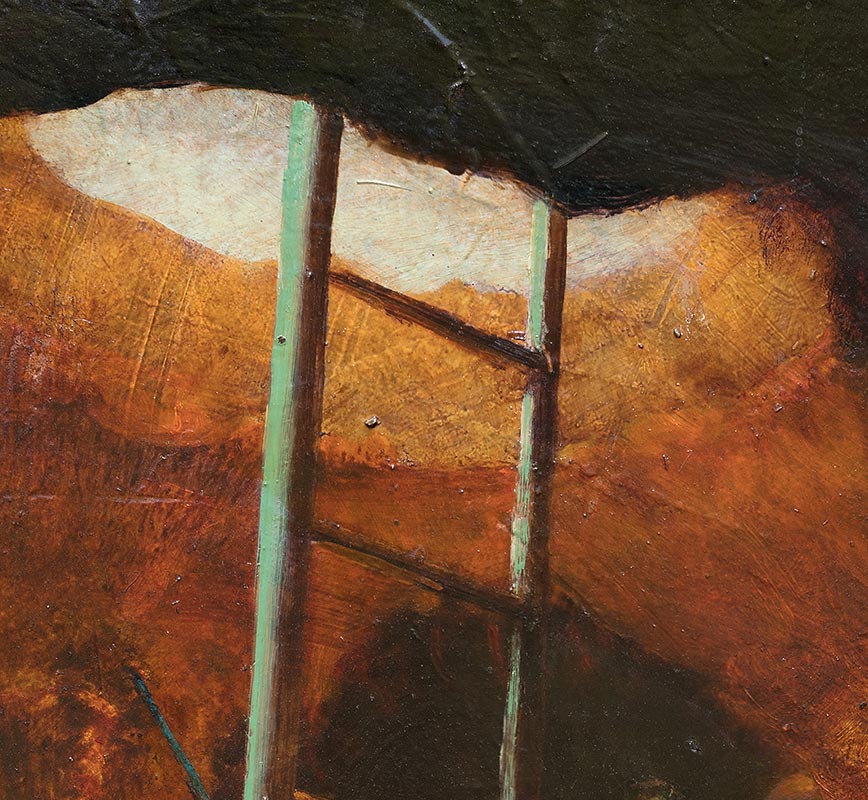
The scrolls in the foreground are the key: they suggest written or visual records, documents of something that has been seen, navigated, or accumulated. Their unfurling introduces a temporal dimension: these forms were once rolled, their content concealed, and something has caused them to open. Kitterle’s fresco-like surface handling, even in this oil on panel, produces the same effect of excavated matter: the paint is layered, abraded, and marked by the history of its own application.
The scrolls are the key: they suggest written or visual records, documents of something seen, navigated, or accumulated, and their partial unfurling introduces a temporal dimension. These forms were once rolled, their content concealed; something has caused them to open. Kitterle's surface enforces this reading: even in this oil on panel, the fresco-like handling produces the effect of excavated matter. The paint is layered, abraded, and marked by the history of its own application, each reworking still legible beneath the uppermost surface. Arshile Gorky's late paintings occupy related formal territory: biomorphic and semi-abstract forms in an ambiguous spatial field between landscape and interior, meaning held in perpetual suspension. Franz Kline's bold verticals, particularly in works of the early 1950s, establish the same compositional logic as the blue form at the center of Landscape: a single strong vertical that serves as an axis for everything around it, the surrounding field held in relation to rather than independent of that spine. The title operates as deliberate provocation: by naming the most legible genre, it foregrounds everything that resists that name.