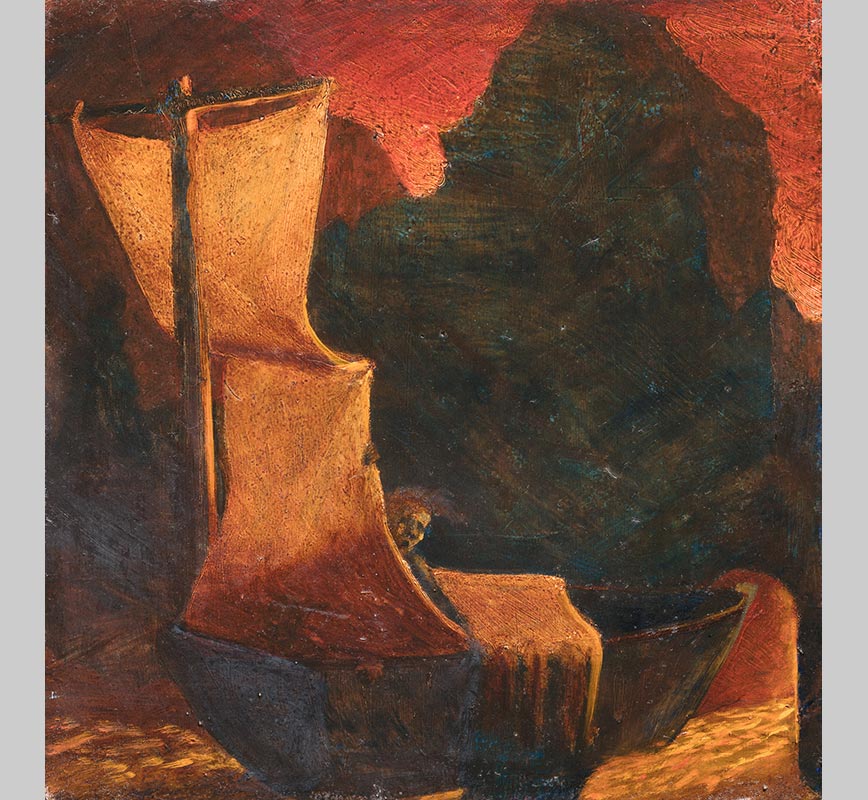
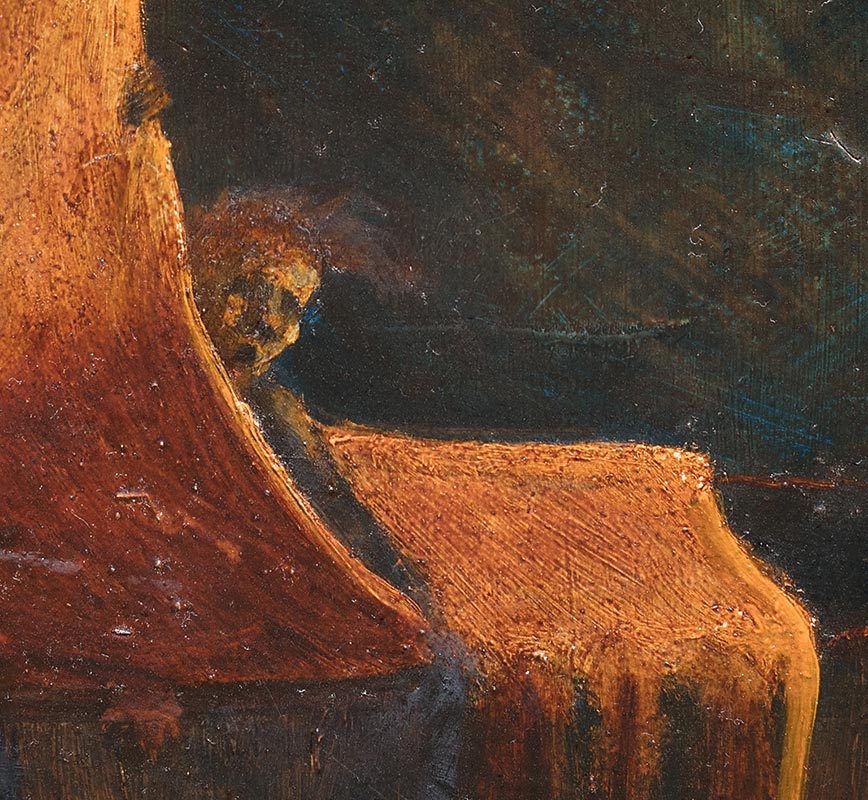
Upon Leaving the Body is organized around two registers: above, a reclining figure in heavy shadow, accompanied by glass vessels, books, and a golden headpiece that rises above the surrounding darkness; below, a foreground of concentric water rings expanding outward, as though something has just passed through the surface. The fresco medium carries this double reading: its worn, mineral surface has the quality of matter that has been through something, a record rather than a backdrop.
Upon Leaving the Body is organized around two registers: above, a reclining figure in heavy shadow, accompanied by glass vessels, books, and a golden headpiece that rises above the surrounding darkness; below, a foreground of concentric water rings expanding outward, as though something has just passed through the surface. The fresco medium carries this double reading: its worn, mineral surface has the quality of matter that has been through something, a record rather than a backdrop.
The water rings introduce a temporal dimension that the upper register cannot supply alone. They suggest an event completed: a body passing through, an energy dispersed, a presence dissolved into liquid geometry. The objects that surround the figure, the glass, the books, the gold, read as what is left behind, relics organized not for use but for witnessing. Kitterle’s fresco surface reinforces this: the pigment absorbed into plaster cannot be removed; what enters the wall stays there. The mark and the material are the same thing.
Mark Rothko’s late chapel paintings treat a structurally analogous threshold: surfaces in which tonal fields simultaneously material and metaphysical produce an experience at the limit of what representation can address. The golden headpiece, the vessels, the books belong to an alchemical logic: not mourning but transformation, the same substance continuing in a different state. George McNeil, in the Hofmann tradition that shaped both him and Kitterle, articulated the painter’s task as translating “energies seen in nature” into “pictorial equivalents”: Upon Leaving the Body applies that principle to the most profound natural energy of all.