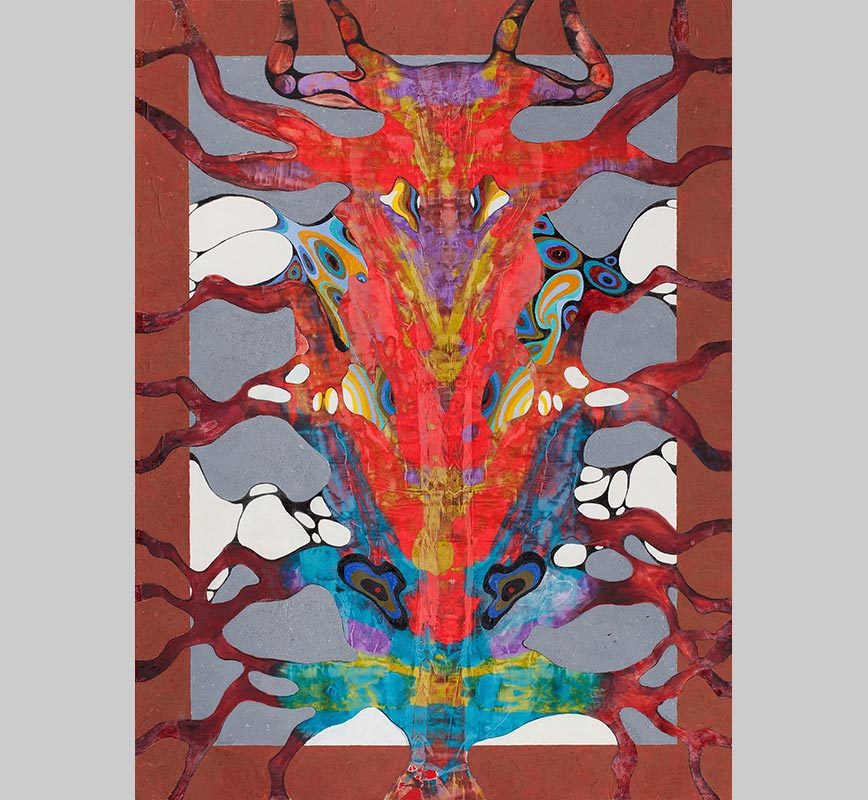
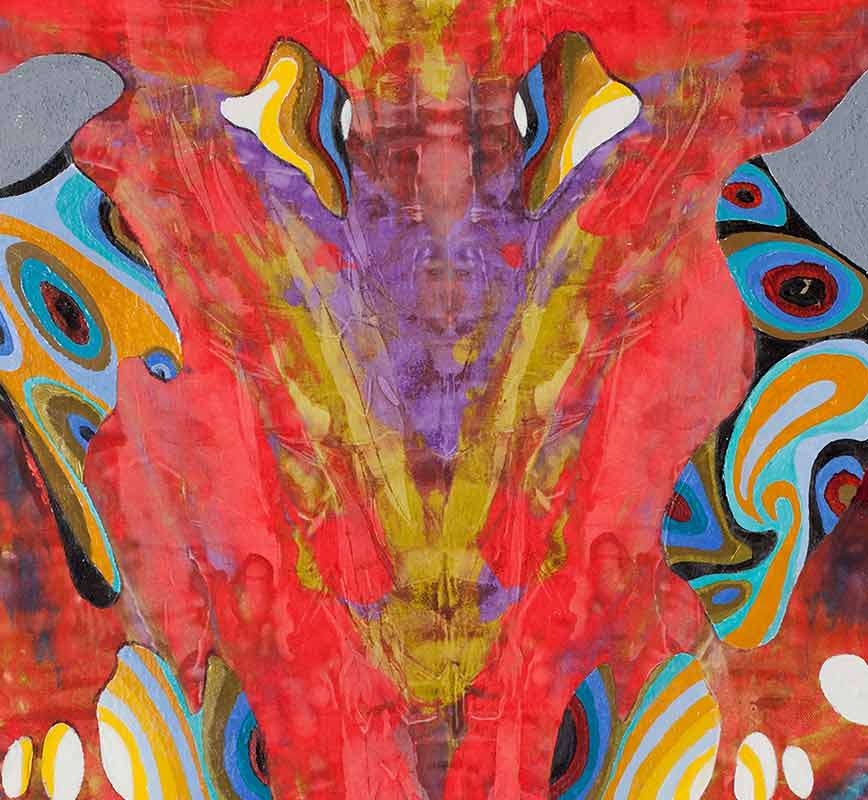
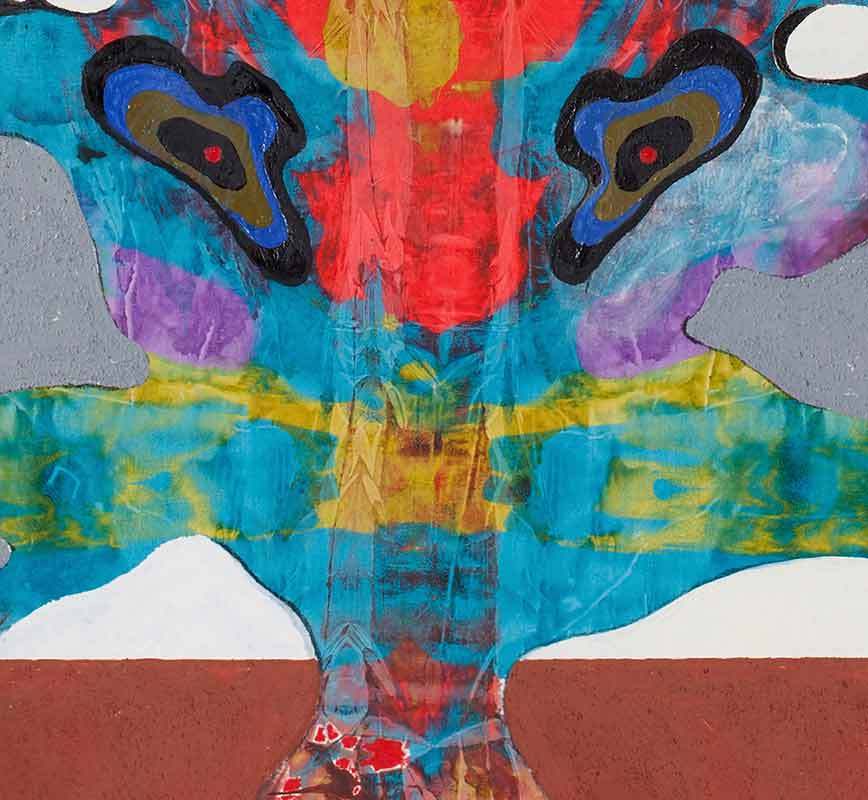
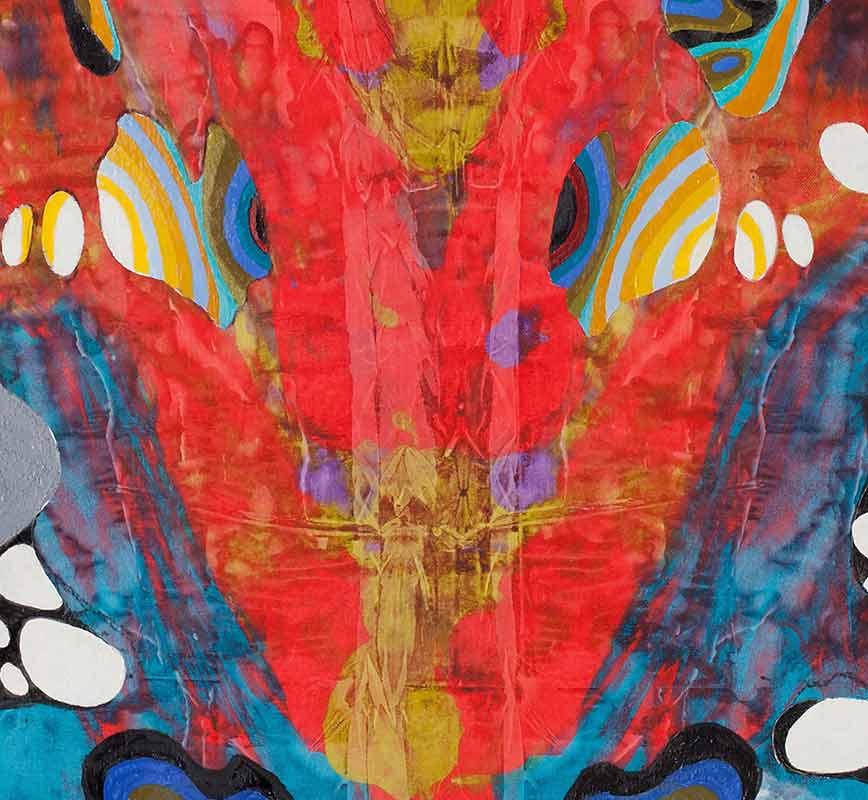
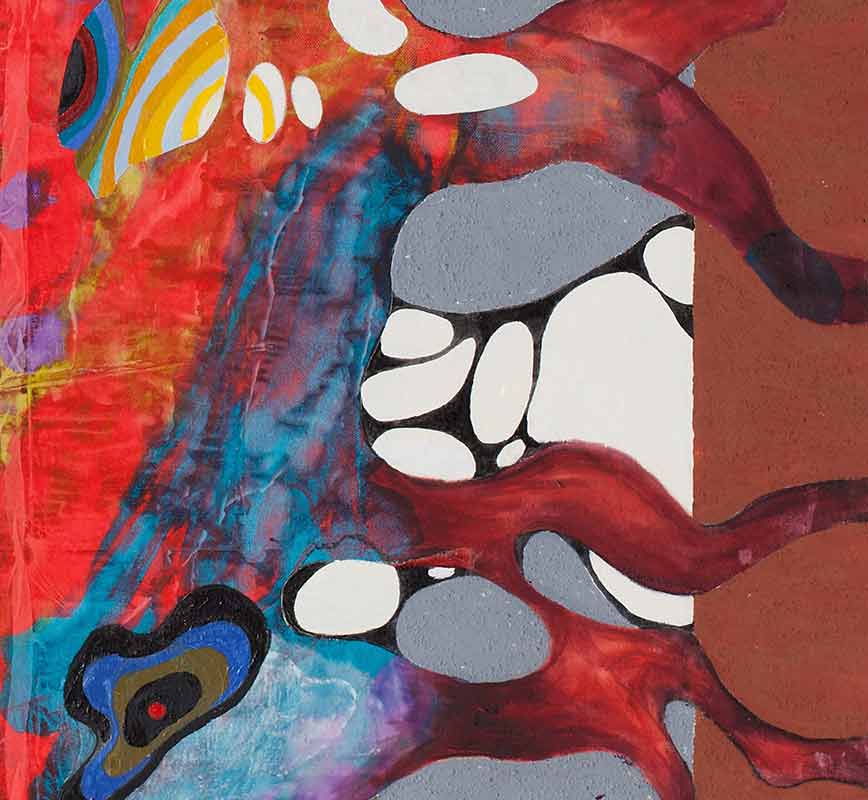
A copper-leaf ground runs the full length of this canvas, building the kind of surface you find at the edge of a bronze-age find: dense, reddish-brown, carrying its own internal history in the accumulated texture of its oxidation. Against and within this metallic field, a tangle of red, yellow, and blue organic forms moves in sinuous lines, neither botanical nor anatomical, yet unmistakably alive. Turquoise contour-drawing weaves through the composition like the trace of something passing just below a membrane.
A copper-leaf ground runs the full length of this canvas, building the kind of surface you find at the edge of a bronze-age find: dense, reddish-brown, carrying its own internal history in the accumulated texture of its oxidation. Against and within this metallic field, a tangle of red, yellow, and blue organic forms moves in sinuous lines, neither botanical nor anatomical, yet unmistakably alive. Turquoise contour-drawing weaves through the composition like the trace of something passing just below a membrane.
The copper leaf is not decorative but structural: a stratum of matter on the same ontological level as the biomorphic forms it supports, continuous with them in the logic of the polimateriale research that had been central to Vanni's practice since the mid-1970s. What grows from a metal world is already inside it: copper is geologically prior to biological life and, in the form of trace minerals, essential to it. The canvas holds that paradox in a single field where the ground is indistinguishable from what grows from it.
The biomorphic forms occupy a philosophical territory whose boundaries Arp established: organic shape as autonomous identity, independent of representational function. But the ground is not Arp's. His surfaces are smooth and refined; these are rough, ancient, chemically active matter, and the organisms they carry could only have grown from something as dense and particular as itself.